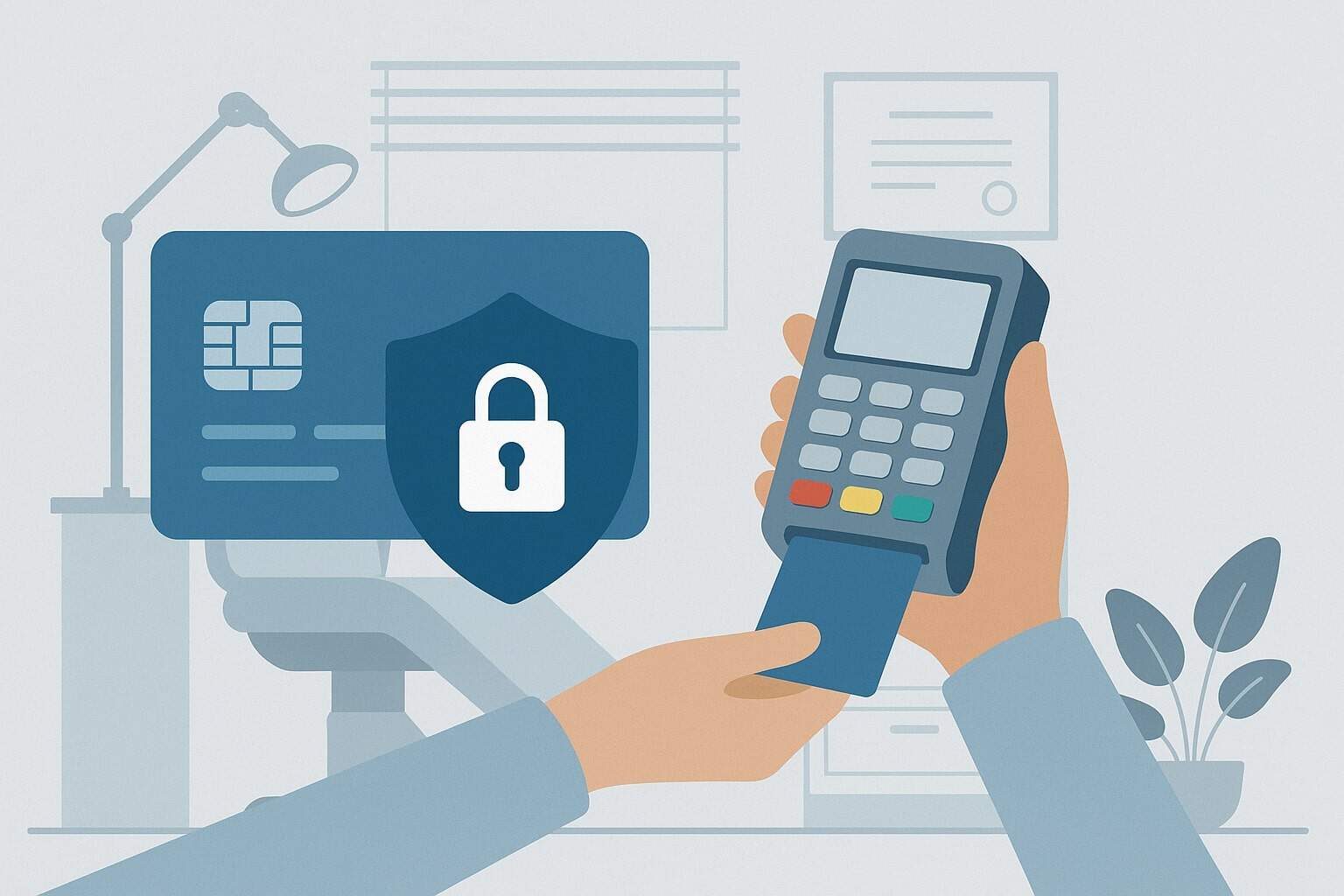
EMV technology has quietly become one of the most important tools protecting dental clinics in the United States from payment fraud. While most patients just see a chip card being dipped or tapped, under the surface EMV technology is generating dynamic, encrypted transaction data that’s extremely difficult for criminals to exploit.
This doesn’t just reduce fraud losses; it also protects your revenue, reputation, and regulatory standing.
For dental offices, where payments, clinical care, and patient trust intersect, understanding how EMV technology works—and how to implement it correctly—can make the difference between a secure, compliant practice and a costly breach or chargeback nightmare.
In this guide, we’ll walk through how EMV technology reduces fraud, how it fits with PCI DSS and HIPAA, and what practical steps U.S. dental clinics should take to stay safe and compliant.
Understanding EMV Technology in a Dental Practice Setting
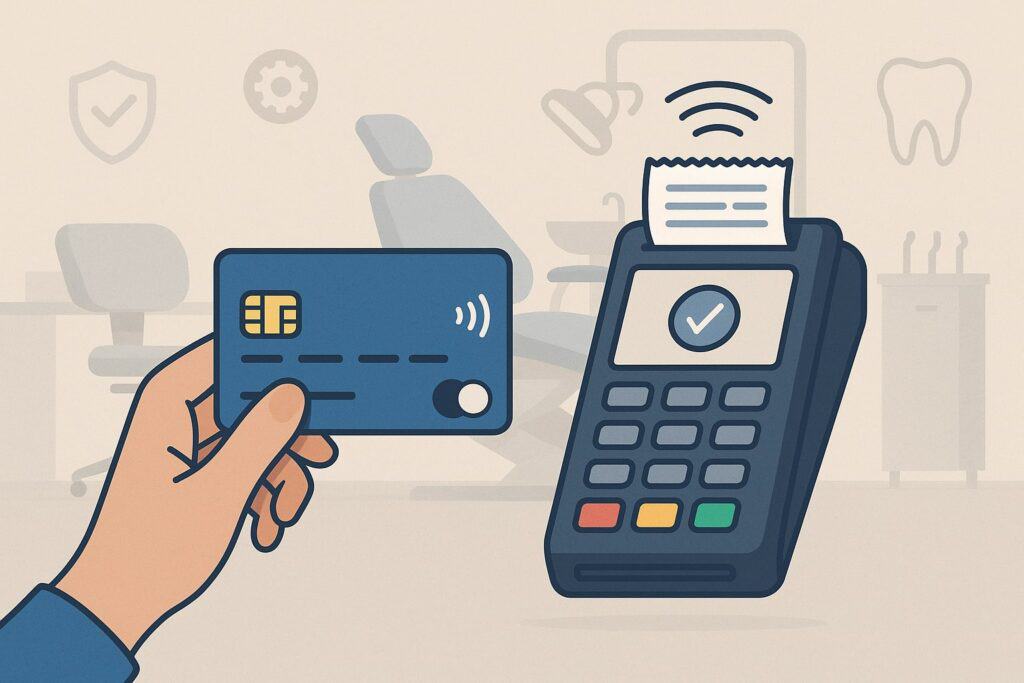
EMV technology (named after Europay, Mastercard, and Visa) is the global standard for chip-based payment cards and terminals. Instead of storing static card data on a magnetic stripe, EMV technology uses an embedded microchip that generates a unique, one-time cryptogram or transaction code every time a card is used.
That unique transaction data is what makes EMV technology much more secure than traditional magstripe systems.
In a dental practice, card payments are typically “card-present” transactions: the patient is physically in the office, checking in or checking out at the front desk. With EMV technology, the patient inserts or taps their card into an EMV-enabled point-of-sale (POS) device, which communicates securely with the processor and card network.
The chip verifies that the card is genuine and that the transaction hasn’t been altered. Because the transaction data is dynamic, stealing it via skimming or eavesdropping doesn’t allow a criminal to make a usable counterfeit card.
EMV technology has become the global best practice for secure in-person payments. Many countries adopted EMV years before the United States, and they saw major reductions in card-present counterfeit fraud as a result.
Research and industry data show EMV technology blocks the vast majority of cloned card attacks and has driven very large declines in in-person payment fraud in markets that fully adopted chip technology.
For dental clinics, EMV technology does more than stop cloned card fraud. It also changes who is financially responsible when fraud occurs.
Since the U.S. EMV “liability shift,” if a counterfeit chip card is used and your clinic is not using an EMV-capable terminal, your practice can be held liable for the fraud loss—even if the issuing bank would previously have absorbed it.
That liability shift means EMV technology is not just a security upgrade; it’s a critical financial risk management tool.
Ultimately, EMV technology fits naturally into the front-desk workflow: staff collect co-pays, treatment prepayments, or balances using a chip reader, the patient completes the transaction, and the EMV terminal sends secure, dynamic data to the processor.
When combined with PCI DSS controls and good office policies, EMV technology becomes a powerful defense layer for both the practice and its patients.
From Magnetic Stripe to EMV: Why the Upgrade Matters for Dentists
Legacy magnetic stripe cards store card numbers, expiration dates, and other sensitive data as static information on the stripe. That static data can be easily copied with cheap skimming devices placed on or near card readers.
Once copied, criminals create counterfeit cards or use the stolen data for fraudulent purchases. Skimming at gas pumps and older terminals is still common, and healthcare offices with outdated hardware can be prime targets.
EMV technology breaks this model. The chip in an EMV card is essentially a small computer. When the card is inserted or tapped, it interacts with the terminal to generate a unique transaction code that can only be used once.
If a criminal captures this data, they can’t reuse it for another chip transaction. EMV technology also supports stronger card authentication methods, including PIN and offline risk checks, making it far harder to successfully use a counterfeit card.
For dental clinics, moving from magstripe-only terminals to EMV technology brings several specific advantages:
- Reduced counterfeit and skimming risk: Skimming a chip transaction won’t give usable data for future chip purchases.
- Better alignment with card-brand rules: Major card brands are phasing out magnetic stripes by the early 2030s, so staying magstripe-only is a short-term and risky strategy.
- Improved patient trust: Patients increasingly expect to see secure chip and contactless readers in medical settings. Old, swipe-only terminals send the opposite message.
- Liability shift protection: Using EMV technology helps ensure the issuing bank retains responsibility for many types of counterfeit fraud, rather than pushing it to your practice.
Even if your clinic believes “we’ve never had a fraud incident,” the landscape has changed. As EMV technology closes off easy targets in retail, fraudsters look for softer spots like small healthcare offices using outdated hardware. Upgrading to EMV technology is about staying ahead of that shift, not waiting for the first loss.
The Fraud Risks Dental Clinics Face Today
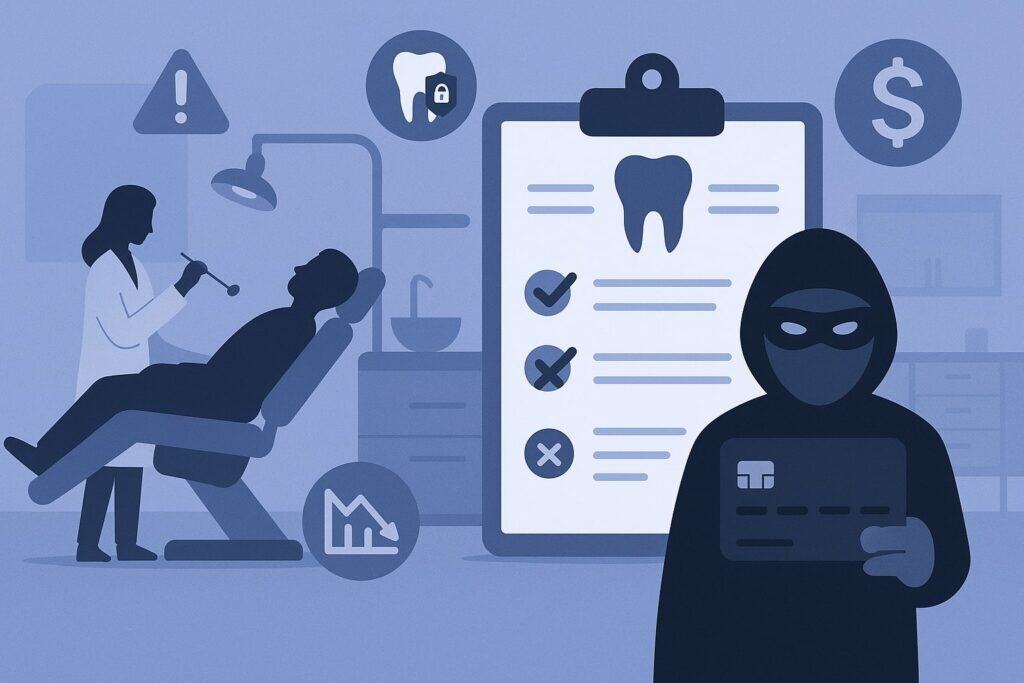
Dental practices tend to see themselves primarily as healthcare providers, not financial institutions.
Yet in day-to-day operations, your clinic behaves like a small financial business: you collect payments, store patient data, transmit card information, and rely on billing systems tied directly to money movement. That makes dental offices an attractive and sometimes overlooked target for criminals.
Fraud risks fall into several categories. There’s classic card-present fraud at the terminal—counterfeit cards, lost or stolen cards, and skimming. There’s card-not-present fraud related to online bill pay, virtual terminals, and phone payments.
There’s also insider risk, where staff with access to cardholder data misuse or mishandle information. EMV technology is especially powerful against card-present fraud, but it must be combined with other controls to address the full risk profile.
In the broader U.S. market, card-present fraud has shifted as EMV technology adoption has grown. Some analysis shows dramatic declines in counterfeit fraud where EMV is fully adopted, while other research explores how fraud losses are reallocated between issuers, merchants, and cardholders depending on the network and card type.
For a dental office, the key takeaway is simple: using EMV technology moves your clinic into the best-protected category, while refusing to adopt it leaves you exposed both technically and legally.
Card-Present Fraud Threats at the Dental Front Desk
Card-present fraud at a dental office might look mundane: a patient checks out using a card that isn’t theirs, or a cloned card created from skimmed magstripe data. In some cases, the fraud isn’t discovered until weeks later when the issuer disputes the payment and your practice gets hit with a chargeback.
Without EMV technology and strong documentation, your clinic may lose both the payment and any materials or chair time already invested.
EMV technology directly addresses several of these threats:
- Counterfeit cards: EMV chips are extremely difficult to clone. Transaction data generated by EMV technology is unique and validated by the issuer, so most cloned cards fail when used with a chip reader.
- Skimming at the terminal: Criminals often install skimmers on older, swipe-only terminals. EMV technology reduces the value of skimmed data because chip transactions cannot be replayed using copied data.
- Lost or stolen cards: While EMV technology doesn’t completely stop lost/stolen card use, it can support additional verification methods such as PIN or 3D Secure-style flows when cards are paired with mobile wallets.
However, EMV technology is only effective if the front desk actually uses it. If staff habitually swipe cards instead of dipping or tapping, your practice may forfeit the protections EMV technology provides.
That means training staff to always use the chip or contactless interface, refusing to “force swipe” unless absolutely necessary, and documenting exceptions.
Even with EMV technology in place, front-desk procedures matter. Verifying ID for high-dollar treatment plans, using signed treatment authorizations, and keeping clear documentation all help when disputes arise.
EMV technology significantly reduces fraud risk, but pairing it with strong office policies turns your front desk into a robust control point rather than a weak spot.
Card-Not-Present and Online Payment Risks for Dental Offices
While EMV technology is focused on card-present transactions, dental clinics increasingly rely on card-not-present channels: online patient portals, text-to-pay links, virtual terminals, and phone payments for balances.
These channels are essential for patient convenience, but they bring different fraud dynamics that EMV technology alone doesn’t solve.
Industry research shows that as EMV technology reduces card-present fraud, criminals often shift toward card-not-present channels. In the United States, the pattern has been more gradual than in some other countries, but card-not-present fraud has steadily increased over the past decade.
Dental offices that adopt EMV technology at the front desk while leaving their online payments loosely controlled risk seeing fraud migrate to those remote channels.
To complement EMV technology, your clinic should:
- Use payment processors that support 3D Secure, address verification (AVS), and CVV checks.
- Avoid storing card numbers in practice management software unless tokenized and handled by a PCI-compliant provider.
- Limit virtual terminal access to trained staff and require strong authentication.
- Monitor online and phone transaction patterns for unusual activity.
EMV technology is still vital because it protects the bulk of in-office payments. But card-not-present security layers must be added around portals and remote billing. Together, these measures give your dental clinic a comprehensive fraud defense instead of leaving an open back door.
How EMV Technology Reduces Fraud in Dental Clinics
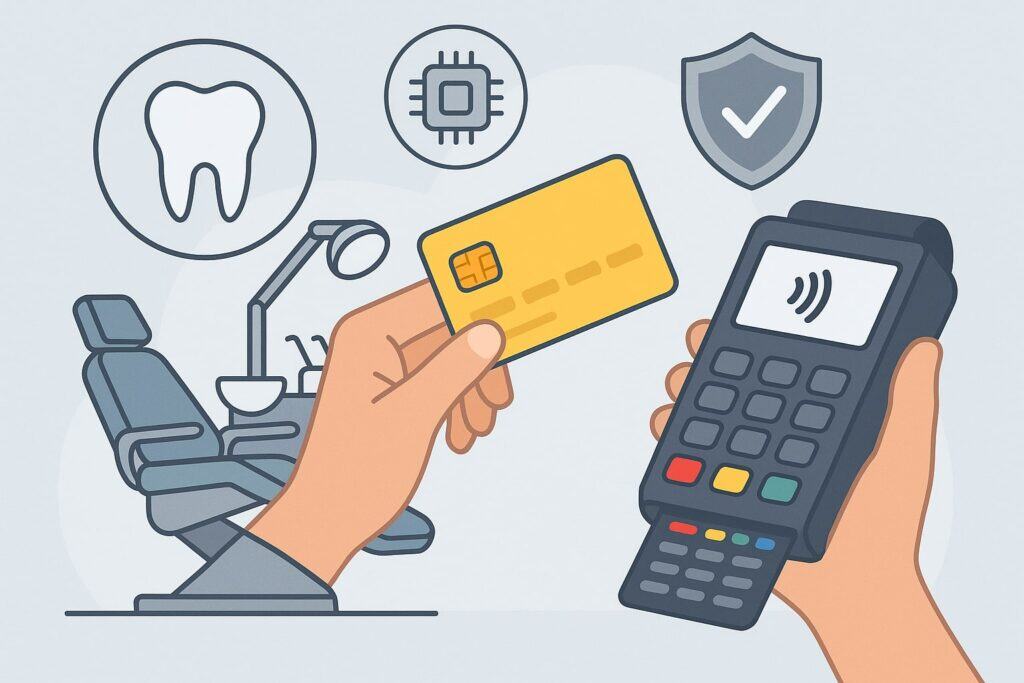
EMV technology dramatically changes how card authentication works. With magstripe, the terminal reads static data and passes it along; if the data is valid, the issuer approves the transaction. With EMV technology, the chip and terminal engage in a cryptographic “conversation.”
The chip generates a unique transaction cryptogram, which the issuer verifies. If anything looks off—wrong keys, altered data—the issuer can decline the transaction.
For a dental clinic, this means EMV technology is doing several things behind the scenes: validating that the card itself is genuine, validating that the transaction data hasn’t been altered, and enabling richer risk scoring by the issuer. These protections operate in milliseconds, without slowing down your check-out process.
Dynamic Authentication and Encryption at the Point of Sale
The core security advantage of EMV technology is dynamic data authentication. Every time a patient uses their chip card at your dental clinic, the card generates a one-time cryptogram that contains transaction-specific details, such as the amount and merchant information. This cryptogram is digitally signed and verified by the issuing bank.
Because EMV technology makes each transaction unique, stolen data from one transaction cannot be reused to approve another chip transaction. This is fundamentally different from magstripe systems, where the same static track data is replayed over and over.
Even if a criminal intercepts EMV transaction data, they can’t simply clone it onto another card and have it work in a chip reader.
Modern EMV terminals also support:
- End-to-end encryption (E2EE) between the terminal and the processor, which protects card data in transit.
- Point-to-point encryption (P2PE) and tokenization, replacing card numbers with non-sensitive tokens once they reach the processor.
When configured correctly, EMV technology helps ensure that actual card numbers are never stored or visible in your practice management systems. Instead, your dental clinic sees tokens or references that are useless to attackers.
Combined with PCI DSS controls, EMV technology reduces the likelihood and impact of a data breach—protecting both patient card data and your practice’s reputation.
Preventing Counterfeit Cards, Skimming, and Shimming
EMV technology is particularly effective at stopping counterfeit card fraud. To create a functional counterfeit EMV card, an attacker would need not only the cardholder’s data, but also cryptographic keys and the ability to generate valid cryptograms.
Modern EMV technology makes this extraordinarily difficult, which is why chip adoption has led to sharp reductions in counterfeit fraud in many markets.
However, criminals haven’t given up. Newer schemes focus on shimming, where ultra-thin devices inserted into chip slots try to intercept communication between card and terminal.
Even here, EMV technology remains resilient because the intercepted data is still dynamic and one-time-use. It may help criminals with some forms of analytics, but it doesn’t allow simple cloning of EMV cards.
EMV technology also reduces the value of skimming. On older magstripe-only terminals, skimmers can capture full track data, which can be written onto blank cards for use in other magstripe environments.
On EMV-enabled terminals, especially when staff are trained to avoid unnecessary swipes, there are far fewer opportunities to capture usable magstripe data. As major card brands move toward phasing out magnetic stripes entirely by 2033, EMV technology will only become more dominant.
For dental practices, simple physical controls support the protections of EMV technology:
- Inspect terminals regularly for loose panels or unusual attachments.
- Position devices where staff can see them and where patients don’t feel pressured or rushed.
- Disable fallback magstripe transactions where possible, or tightly control their use and logging.
Chargeback Protection and Liability Shift for Dentists
One of the most tangible benefits of EMV technology for a dental clinic is improved protection against certain types of chargebacks. When the U.S. card networks implemented the EMV liability shift, they changed the rules about who pays for counterfeit card fraud. If a counterfeit chip card is used in a transaction where:
- The card is chip-enabled, but
- The merchant (your dental clinic) uses a non-EMV or magstripe-only terminal,
then the merchant is generally liable for the fraud loss. If your clinic is using EMV technology properly and processes the transaction through the chip interface, the liability usually remains with the issuing bank for counterfeit-related fraud.
This doesn’t mean EMV technology magically eliminates all disputes. Patients can still contest charges they don’t recognize, or disagree with treatment plans. However, EMV technology strengthens your position in the chargeback process. General benefits include:
- Better authentication evidence: EMV transaction logs show that the correct chip process was followed.
- Lower counterfeit fraud chargebacks: Many card brands give additional protection to merchants who consistently use EMV technology.
- Clearer separation of clinical vs. payment disputes: When counterfeit fraud is minimized by EMV technology, remaining disputes more often relate to service issues, which can be handled with clear consent and documentation.
To fully realize these benefits, dental clinics should keep accurate records of EMV transaction receipts, treatment plans, and authorization forms. When paired with EMV technology, these records help your practice win legitimate chargeback disputes and keep revenue stable.
EMV Technology, PCI DSS, and HIPAA: Compliance for US Dental Clinics
U.S. dental offices sit at the intersection of two important regulatory frameworks: HIPAA, which focuses on patient health information (PHI), and PCI DSS, which governs payment card data security.
EMV technology doesn’t replace either of these, but it plays a critical role in satisfying PCI DSS and supporting a secure environment that protects both payment and patient data.
HIPAA applies to dental practices that are “covered entities” because they conduct standard electronic transactions, such as electronic claims or eligibility checks.
PCI DSS, on the other hand, applies to any business that accepts, processes, transmits, or stores cardholder data, including even small dental offices with just a few card transactions.
PCI DSS Basics for Dental Practices That Accept Cards
PCI DSS (Payment Card Industry Data Security Standard) is a set of technical and operational requirements designed to protect cardholder data.
If your dental clinic accepts credit or debit cards, you must comply with PCI DSS, regardless of size or volume. Non-compliance can lead to fines, higher processing costs, and costly remediation after a breach.
Key PCI DSS principles include:
- Building and maintaining a secure network and systems – firewalls, secure configurations, and hardened POS systems.
- Protecting cardholder data – encryption in transit, restricting storage, and strong access control.
- Maintaining a vulnerability management program – regular updates, patching, and anti-malware.
- Implementing strong access control measures – role-based access and strong authentication.
- Monitoring and testing networks – logging, monitoring, and regular security testing.
- Maintaining an information security policy – documented processes and staff training.
EMV technology alone does not make a dental practice PCI-compliant, but it reduces the scope and impact of card data exposure by ensuring that most card-present transactions use secure chip-based authentication and often integrated encryption/tokenization.
This, in turn, can simplify your PCI self-assessment questionnaire (SAQ) and reduce the burden on your IT environment.
How EMV Terminals Support PCI DSS Requirements
EMV technology and PCI DSS are complementary. The PCI Security Standards Council explicitly notes that the EMV chip is focused on authenticating the card and reducing counterfeit fraud, while PCI DSS addresses the broader security of card data throughout the environment.
Properly chosen and configured EMV terminals can:
- Encrypt card data at the point of interaction, satisfying PCI requirements for protecting data in transit.
- Reduce card data stored in the practice, especially when paired with tokenization, thereby shrinking PCI scope.
- Support secure PIN entry and contactless EMV transactions, aligning with evolving card-brand mandates.
For a dental clinic, a practical approach is to work with a payment processor and POS provider that:
- Offers EMV-certified terminals and software.
- Provides PCI-validated point-to-point encryption (P2PE) where possible.
- Supplies documentation to support your PCI SAQ completion.
Using EMV technology with a PCI-focused vendor allows your team to focus on dental care instead of becoming payment security experts, while still meeting industry standards.
Where HIPAA Ends and EMV/PCI Begin in a Dental Office
A common point of confusion for dental practices is how HIPAA and PCI DSS overlap. HIPAA is primarily concerned with protected health information (PHI)—names, diagnoses, treatment plans, and similar data. PCI DSS, supported by EMV technology, focuses on cardholder data—card numbers, expiration dates, and related authentication data.
In practice:
- HIPAA governs your practice management system, clinical notes, patient communications, and EHR or imaging systems.
- PCI DSS and EMV technology govern your payment terminals, payment gateway, and any systems that may store or transmit card data.
These worlds intersect at the front desk and in any system where patient identity and payment information are both present. EMV technology helps keep card data from leaking into your HIPAA environment by ensuring it is encrypted and tokenized immediately.
That way, if your practice suffers a HIPAA-related incident (like a compromised workstation), card data is much less likely to be involved.
For dental clinics, the best strategy is to treat HIPAA, PCI DSS, and EMV technology as parts of a unified security and compliance program.
You protect PHI with HIPAA safeguards, protect payment data with PCI and EMV technology, and protect your reputation by showing patients that their information—clinical and financial—is handled with serious care.
Implementing EMV Technology in a Dental Clinic Step by Step
Implementing EMV technology in a dental clinic isn’t just about buying a new terminal. It’s about designing a secure, efficient payment experience that fits your existing practice management, clinical workflows, and patient expectations.
A thoughtful rollout helps you avoid downtime, staff confusion, and configuration gaps that could undermine the security benefits of EMV technology.
Choosing an EMV-Certified Payment Processor and POS for Dentistry
Your first decision is who will handle your card processing and what hardware/software you will use. Not all EMV solutions are equal, and dental clinics have specific needs like recurring billing, treatment plan financing, and integration with dental practice management software.
When evaluating EMV technology providers for your dental office, look for:
- EMV Level 1 & Level 2 certified terminals that support chip insert and contactless tap.
- PCI-DSS compliant gateways and support for tokenization, so card data never lives in your local environment.
- Healthcare/dental integrations that connect to your practice management system (PMS) with minimal manual entry.
- Support for card-on-file via tokenization for payment plans and recurring billing, rather than storing card numbers locally.
- Strong chargeback support and reporting to help you see fraud trends.
Make sure the EMV technology vendor clearly explains how their solution supports both PCI DSS and HIPAA-friendly workflows. For example, they should show that their payment screens isolate card data from PHI and that tokens are used instead of raw card numbers inside your PMS.
Securing the Network, Terminals, and Staff Workflow
EMV technology is strongest when deployed alongside basic cyber hygiene. Even the best EMV terminal can be undermined if your network is open, your Wi-Fi password is “123456,” or anyone can physically tamper with the device.
PCI DSS guidance highlights the need for secure terminal inspections, restricted access, and network segmentation for cardholder data environments.
Best practices for dental clinics include:
- Physically secure EMV terminals: Bolt them to the counter or desk, inspect them regularly, and train staff to recognize tampering.
- Segment your network: Keep payment devices on a dedicated VLAN or separate network from guest Wi-Fi and general office traffic.
- Update firmware regularly: Ensure EMV technology devices stay up to date with card brand and security updates.
- Enforce least-privilege access: Limit access to payment dashboards and reports to a small, trusted group of staff.
Workflow design is just as important. Build EMV technology into a standard script: staff greet the patient, confirm treatment and amount, present the EMV terminal for dip or tap, and wait for approval before scheduling follow-up visits or printing receipts.
Consistency reduces the chance that someone will cut corners and swipe a card or key in numbers unnecessarily.
Staff Training, Policies, and Patient Communication
The success of EMV technology in your dental practice depends heavily on staff behavior. The most secure hardware won’t help if team members routinely bypass protections. A short, focused training program can ensure everyone understands how and why to use EMV technology correctly.
Training should cover:
- Why EMV technology is more secure than magstripe and manual entry.
- How to handle exceptions (e.g., a damaged chip) and when to refuse a transaction.
- How to identify suspicious behavior or possible terminal tampering.
- How to discuss payment security with patients in plain language.
It also helps to have written policies that specify:
- Always using chip or contactless EMV technology for card-present payments.
- Prohibiting storage of card numbers on paper, in email, or in unencrypted notes.
- Required steps to report a suspected security incident or device tampering.
Patients notice when you use EMV technology and modern payment methods. A simple script such as “For your security, we use encrypted chip and contactless payments that protect your card information” reinforces trust.
In an era of rising fraud headlines, this reassurance can strengthen patient loyalty and differentiate your practice from less secure competitors.
Advanced Fraud Prevention: EMV Plus Tokenization, Contactless, and Real-Time Monitoring
EMV technology is a powerful foundation, but the most secure dental clinics go further by combining EMV with tokenization, encryption, and intelligent monitoring.
Think of EMV technology as the front door lock; tokenization and monitoring are your alarm system and cameras. Together, they create a layered defense that makes your clinic a very hard target.
Using Contactless EMV and Mobile Wallets Safely in Dental Clinics
Contactless EMV payments—tap-to-pay cards, Apple Pay, Google Pay, and other mobile wallets—use the same EMV technology under the hood, but with added convenience. Instead of inserting the chip, patients tap their card or device near the reader. The transaction still relies on EMV cryptography and dynamic data.
From a security perspective, contactless EMV technology is as safe or safer than contact EMV because:
- Mobile wallets often require biometric authentication (Face ID, fingerprint) before payment.
- Device-specific tokens are used instead of raw card numbers, reducing exposure.
For dental clinics, enabling contactless EMV technology can:
- Speed up check-out and reduce front-desk congestion.
- Minimize card-handling, which patients appreciate in a clinical environment.
- Demonstrate a modern, security-conscious approach to payments.
Ensure your EMV terminals are configured to support contactless and that staff know how to prompt patients to tap when available. Also confirm with your processor that contactless EMV transactions are fully EMV-certified and covered under the same liability protections as contact chip transactions.
Tokenization, Encryption, and End-to-End Security
While EMV technology protects the transaction at the terminal, tokenization protects card data when you need to store it—for example, for payment plans, membership programs, or recurring monthly billing. Tokenization replaces card numbers with random tokens that are meaningless if stolen.
A strong architecture for dental practices is:
- EMV technology encrypts and sends card data from the terminal to the gateway.
- The gateway decrypts and immediately tokenizes the card.
- Your PMS or billing system stores only the token, not the raw card number.
Paired with EMV technology, this ensures card data is protected across the entire lifecycle—from the first chip insert or tap to the recurring payment months later. PCI guidance and merchant resources emphasize the value of combining EMV, encryption, and tokenization as part of a modern fraud prevention strategy.
Monitoring, Auditing, and Regular Security Assessments
Even with EMV technology, encryption, and tokenization in place, your clinic should adopt basic monitoring and auditing to detect suspicious behavior. PCI DSS requires logging and monitoring for systems handling card data, but even small practices can apply simple controls:
- Review settlement and refund reports weekly for unusual patterns.
- Limit who can issue refunds or manually key in card numbers.
- Log physical inspections of EMV devices and keep a checklist on file.
- Work with your processor to enable alerts for high-risk transactions or chargeback spikes.
Annual or semi-annual security reviews—in which you revisit your PCI SAQ, HIPAA safeguards, and EMV configuration—help keep your controls aligned with evolving threats. Fraud techniques like card cloning, shimming, and social engineering continue to change, but EMV technology plus regular assessment keeps your clinic prepared.
Measuring the Impact of EMV Technology on a Dental Practice
It’s not enough to deploy EMV technology and forget it; you should also measure its impact on your dental clinic’s risk and revenue. While many benefits—like a reduced chance of a catastrophic breach—are hard to quantify, several key metrics can show whether EMV technology is working as intended.
Tracking Fraud, Chargebacks, and Payment Disputes
Start by establishing a simple baseline of:
- Number and dollar amount of chargebacks per month.
- Reason codes for those chargebacks (fraud, service dispute, processing error).
- Instances of card-present vs. card-not-present fraud.
Over time, as EMV technology is fully adopted at the front desk, you should see:
- A reduction in counterfeit-related chargebacks on card-present transactions.
- Fewer disputes where the bank claims the cardholder didn’t participate in the transaction.
- Clearer separation between true fraud and legitimate patient dissatisfaction.
These metrics help you refine policies. If card-not-present fraud starts rising while EMV technology has reduced card-present incidents, you may need to strengthen controls on your online portal or virtual terminal rather than at the front desk.
Financial ROI, Insurance, and Reputation Benefits
EMV technology investments—new terminals, upgraded gateways, staff training—carry upfront costs. But the return on investment typically comes through:
- Avoided fraud losses and chargebacks.
- Reduced likelihood of expensive PCI non-compliance penalties or breach remediation.
- Stronger patient trust and retention, especially among security-conscious consumers.
Your cyber liability or business insurance carrier may also look favorably on EMV technology adoption as part of an overall security posture.
Demonstrating that your dental office uses EMV technology, follows PCI DSS best practices, and maintains HIPAA safeguards can help in underwriting and claims scenarios after a security incident.
Long term, EMV technology becomes part of your brand. Patients see modern terminals, contactless options, and consistent processes and infer that your practice cares about both their health and their financial security. That reputation benefit, while hard to quantify, is a real asset in a competitive dental market.
Common Mistakes Dental Clinics Make with EMV Technology
Even clinics that invest in EMV technology can accidentally blunt its effectiveness through configuration and behavior mistakes. Understanding these pitfalls helps you ensure that your EMV deployment actually delivers the fraud reduction and liability protection you expect.
Staying EMV-Enabled But Not EMV-Optimized
One common mistake is installing EMV technology hardware but continuing to operate as if nothing changed. Examples include:
- Staff routinely swiping cards “because it’s faster” or to avoid chip read errors.
- Terminals left with magstripe fallback enabled and rarely monitored.
- Not enabling contactless EMV or mobile wallets, even when patients ask.
In these scenarios, EMV technology exists in theory but not in practice. Fraudsters can still exploit the magstripe track, and the liability shift may still place responsibility on the practice if the chip wasn’t used. To avoid this, you should:
- Configure terminals to prioritize chip and contactless transactions.
- Limit and log magstripe fallback, investigating repeated fallback with specific cards or devices.
- Emphasize in training that EMV technology offers security benefits that depend on correct use.
Think of EMV technology as a safety harness. Buying the harness but never clipping it on doesn’t protect you. Optimization is about actually using EMV technology in every eligible transaction and aligning your behavior with its design.
Ignoring Card-Not-Present Risks While Focusing Only on EMV
Another mistake is assuming that once EMV technology is in place at the front desk, all payment fraud problems are solved. In reality, as EMV technology closes doors for card-present fraud, criminals often push harder on card-not-present channels—online, phone, and recurring billing.
Dental clinics that invest in EMV technology but ignore online payment security may see:
- Increased disputes from cards used via portals or phone without proper verification.
- Compromised staff credentials granting criminals access to virtual terminals.
- Poorly secured third-party payment links exposing patient and card data.
The solution is balance. EMV technology greatly reduces in-person fraud and protects your clinic during check-out. But you must also implement address verification, CVV checks, 3D Secure where supported, and strong authentication on any portal or virtual terminal.
When EMV technology is part of a broader fraud strategy—not the only defense—your dental clinic is protected across all payment channels.
Future Trends: How EMV Technology Will Evolve for Dental Clinics
EMV technology continues to evolve alongside broader trends in digital payments, healthcare, and cybersecurity. For dental clinics, this evolution will shape how patients expect to pay and how fraudsters attempt to attack.
Contactless-Only, Cardless, and Embedded Payments in Healthcare
Over the next several years, card brands and issuers are expected to continue phasing out magnetic stripes and doubling down on EMV technology, contactless, and tokenization. MasterCard, for example, has already announced timelines to remove magnetic stripes from newly issued cards, with a full phase-out targeted by 2033.
For dental offices, this likely means:
- More contactless-only transactions: Patients tapping phones or wearables instead of cards.
- Card-on-file and cardless experiences: Tokens stored securely for payment plans and in-app payments.
- Embedded payments within patient apps, portals, and virtual visit platforms.
EMV technology will remain the underlying standard for authenticating card-based payments, but it may become increasingly “invisible” as it moves into mobile wallets and background token services. Clinics that embrace modern EMV-based experiences will meet patient expectations for fast, low-friction, and secure payments.
Preparing Your Dental Clinic for Emerging Fraud Threats
As EMV technology and PCI DSS controls continue to reduce traditional counterfeit card fraud, attackers will keep pivoting—toward social engineering, account takeover, insider threats, and sophisticated schemes like synthetic identities.
Articles on modern card cloning scams already highlight the resurgence of advanced skimming, shimming, and “white card” fraud techniques.
To stay ahead, dental clinics should:
- Keep EMV technology firmware and POS software up to date.
- Maintain a culture of security awareness, where staff feel comfortable reporting unusual behavior.
- Periodically review PCI DSS requirements and HIPAA safeguards as both evolve.
- Work closely with payment partners to enable new security tools as they emerge.
EMV technology is not a one-time project; it is a living part of your security architecture. As fraud patterns shift, you’ll adapt your EMV settings, monitoring rules, and training to keep your practice protected.
FAQs
Q.1: Is EMV technology required for dental clinics in the United States?
Answer: There is no single federal law that explicitly says, “Every dental clinic must use EMV technology.”
However, major card networks implemented the EMV liability shift in the U.S., meaning that if your clinic does not use EMV technology and processes a chip card using magstripe, you may be liable for counterfeit card fraud that would otherwise fall on the issuer.
In practice, this creates a strong business requirement to adopt EMV technology if you accept in-person card payments.
Additionally, PCI DSS requires that any merchant accepting cards protect cardholder data and use secure, up-to-date technology. While PCI DSS doesn’t mandate EMV by name, EMV technology is widely recognized as a critical component of a secure card-present environment and is recommended in PCI and industry guidance.
For dental clinics, using EMV technology is best viewed as a standard of care in payment security: it’s what patients expect, what card brands reward, and what regulators and insurers increasingly assume as baseline.
Q.2: Does EMV technology make my dental office fully PCI compliant?
Answer: No. EMV technology significantly improves card-present transaction security, but it does not by itself make your practice PCI-compliant. PCI DSS covers areas like network security, data storage, device management, access control, logging, and vulnerability management across your environment.
EMV technology helps by:
- Reducing the risk and impact of counterfeit card fraud.
- Enabling encryption and tokenization that limit where card data exists.
- Potentially reducing your PCI scope and simplifying some parts of the self-assessment questionnaire.
However, you still need to complete the appropriate PCI SAQ, follow your processor’s guidance, and apply reasonable security controls across systems and staff. EMV technology is a powerful tool, but PCI DSS compliance remains a broader obligation.
Q.3: Does EMV technology protect online and phone payments for my dental clinic?
Answer: EMV technology primarily protects card-present transactions where the card or device is physically present and used with a chip or contactless reader.
It does not directly protect card-not-present payments such as online patient portal transactions, text-to-pay links, or phone payments. Those channels require additional measures like address verification, CVV checks, device fingerprinting, and 3D Secure.
That said, EMV technology can indirectly help by supporting tokenization and secure storage for card-on-file scenarios.
When a patient first pays in person using EMV technology, your processor can tokenize the card, and that token can later be used for secure, authorized card-not-present payments—reducing the need to re-enter card data over the phone or via email.
Q.4: Can chip cards still be hacked, and if so, is EMV technology worth it?
Answer: Yes, chip cards can still be compromised under certain circumstances, such as sophisticated shimming attacks, compromised terminals, or account takeover events. No technology is completely hack-proof.
However, EMV technology dramatically reduces the easiest and most common forms of card-present fraud by making it extremely difficult to clone cards or reuse stolen transaction data.
Industry data shows that EMV technology has led to major reductions in card-present counterfeit fraud and that retailers using EMV terminals see significantly fewer fraudulent transactions.
For dental clinics, that means fewer losses, fewer disputes, and fewer headaches. EMV technology is absolutely worth it as part of a layered security strategy that also includes PCI DSS controls, staff training, and monitoring.
Q.5: How does EMV technology relate to HIPAA in my dental practice?
Answer: EMV technology and HIPAA address different types of data. EMV technology and PCI DSS are focused on cardholder data, while HIPAA regulates protected health information (PHI). In your dental clinic, the front desk often handles both at the same time, so secure design is critical.
EMV technology helps by limiting where card data flows and ensuring it is encrypted and tokenized. That way, even if a system containing PHI is compromised, card data is less likely to be exposed.
You still need to comply with HIPAA for clinical records and PHI, but EMV technology supports a clean separation between clinical and payment systems, reducing the chance that a single incident affects both.
Conclusion
For U.S. dental clinics, EMV technology is no longer optional “nice-to-have” technology; it is a foundational part of modern payment security and compliance.
By replacing vulnerable magstripe transactions with dynamic, chip-based authentication, EMV technology dramatically reduces counterfeit card fraud, helps shield your practice from liability, and reassures patients that their financial information is handled responsibly.
However, EMV technology delivers its full value only when implemented thoughtfully: with EMV-certified terminals, PCI DSS-compliant processors, network and device security, robust staff training, and aligned office policies.
It also needs to be complemented by strong controls for card-not-present channels, including online portals and phone payments, where EMV technology doesn’t directly apply.
When you combine EMV technology with tokenization, encryption, ongoing monitoring, and a culture of security, your dental clinic becomes a hard target for fraudsters and a trustworthy partner for patients.
You protect not just card data, but also your reputation, your regulatory standing under PCI and HIPAA, and the long-term financial health of your practice.
If your dental office is still relying on magnetic stripe swipes or outdated terminals, upgrading to EMV technology is one of the most impactful steps you can take—today—to reduce fraud and build a safer, more resilient clinic for the future.