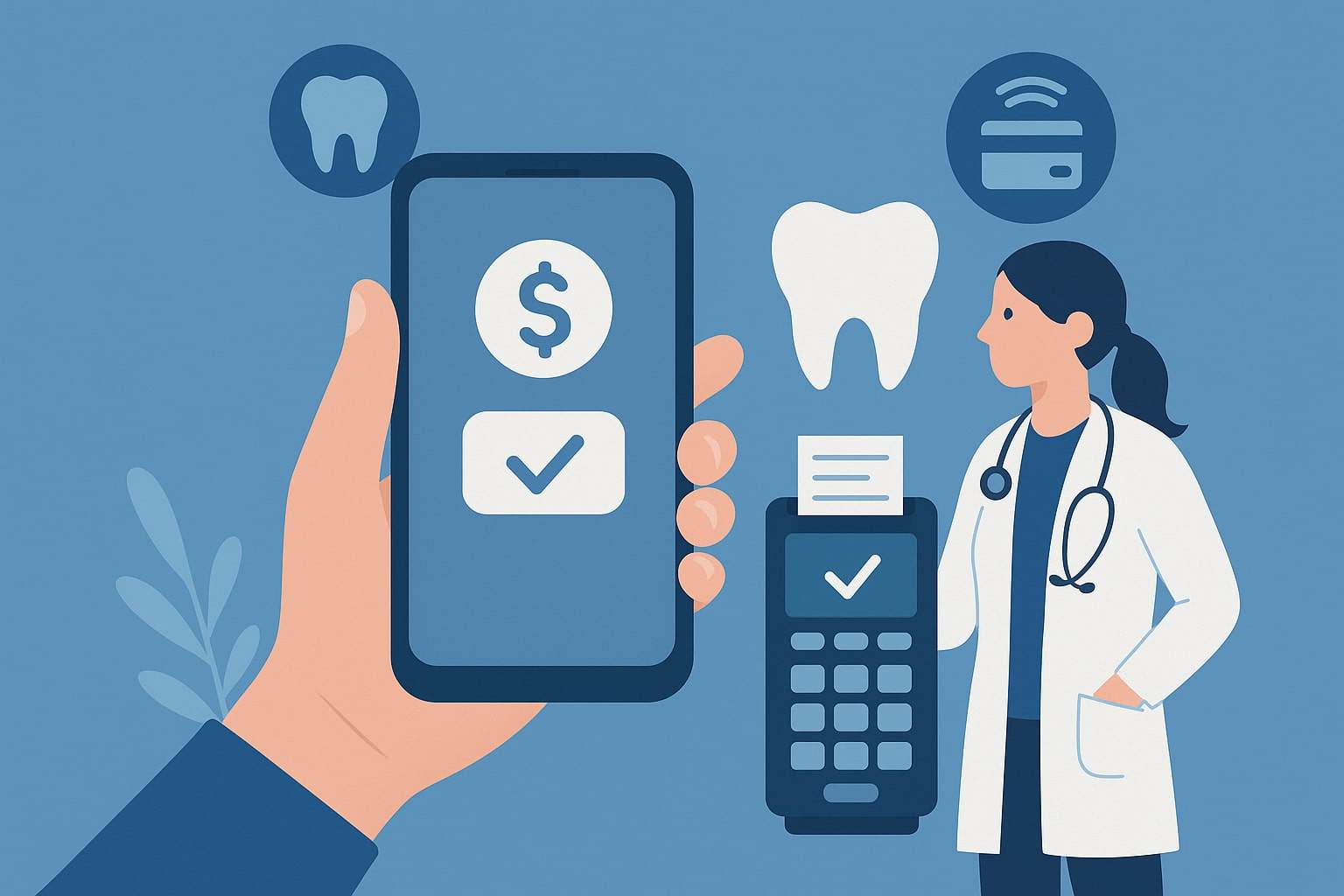
Mobile payment solutions for dental practices are no longer a “nice-to-have” add-on — they are quickly becoming a core part of how U.S. patients expect to pay for care.
As smartphone use and mobile wallets like Apple Pay and Google Pay continue to grow, more Americans are comfortable paying medical bills on their phones, via contactless cards, and through patient portals.
Studies on the U.S. mobile payment market show steady growth through at least 2028, driven by smartphone penetration and consumer preference for fast, contactless transactions.
At the same time, healthcare digital payment adoption is accelerating, especially in North America. The U.S. leads global healthcare digital payment usage thanks to strong technology infrastructure and a population that already uses mobile payments in everyday life.
Dental practices that still rely on paper statements, mailed checks, and in-person swipe terminals increasingly look outdated compared with modern practices that offer mobile payment links, QR codes, and tap-to-pay at the front desk.
For dental teams, adopting mobile payment solutions for dental practices isn’t just about convenience. It is also a powerful strategy to reduce accounts receivable, speed up collections, and improve cash flow.
When patients can quickly pay co-pays, remaining balances, and payment plans from their phones, you cut the delay between treatment and payment. That means fewer aging balances, fewer follow-up calls, and more time for staff to focus on care and case acceptance instead of chasing overdue bills.
From the patient’s perspective, mobile payment solutions for dental practices eliminate friction at an already stressful moment. Patients may be nervous about treatment and anxious about cost.
Offering multiple secure mobile options — in-office contactless, text-to-pay, and online payment portals — helps them feel in control. When payment feels as easy as buying groceries or paying for a ride-share, patients are more likely to accept recommended treatment and return regularly for preventive care.
Understanding the Mobile Payments Landscape in the U.S. Healthcare and Dentistry
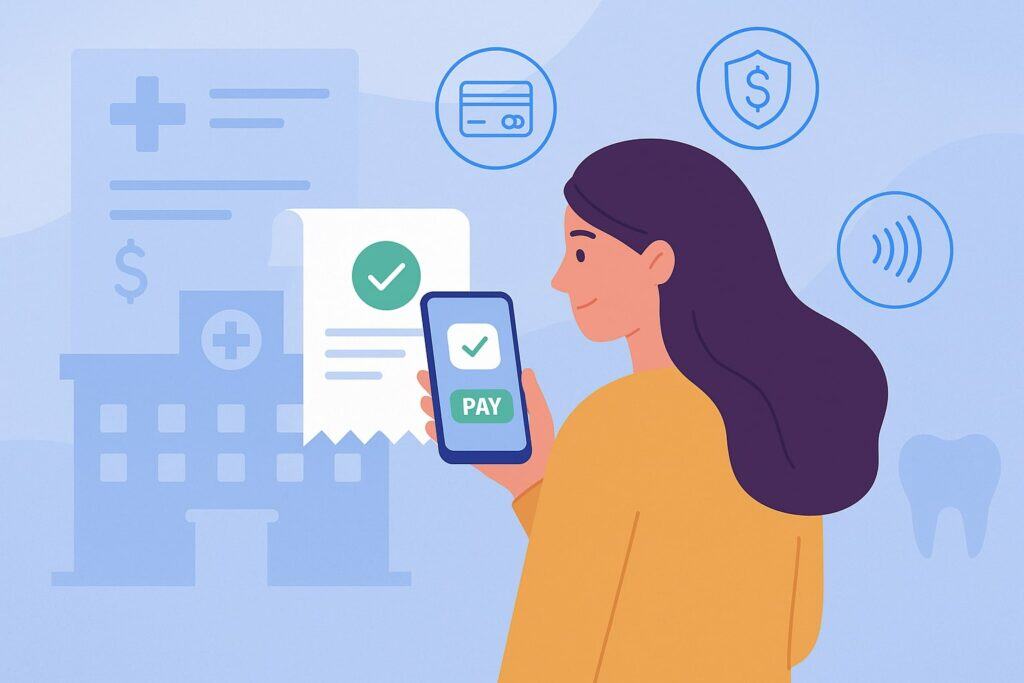
Modern mobile payment solutions for dental practices sit within a broader U.S. trend: the move from cash and checks to digital, card, and mobile transactions. Federal Reserve payments studies show long-term growth in non-cash payments as consumers shift to cards, ACH, and digital methods.
In parallel, contactless and mobile wallet usage continues to rise, with global contactless transactions projected to make up the majority of in-store payments in the next few years.
Healthcare has historically lagged behind retail in modernizing payments. Many practices still hand patients paper statements and ask them to call in with a card number.
But recent research shows digital payment adoption in healthcare is finally catching up, with North America leading the shift toward healthcare-specific digital payment platforms, patient portals, and mobile-friendly billing.
Dental practices that move early gain a competitive advantage, especially with younger patients who expect mobile options everywhere.
In this context, mobile payment solutions for dental practices are not just another merchant terminal. They are an integrated set of tools — mobile wallets, contactless readers, online payment pages, text-to-pay links, and in-app payments — connected to your practice management system (PMS) and your clinical workflows.
When chosen and implemented correctly, they help shrink billing cycles, reduce no-shows, and make paying for dental care feel as simple as paying for streaming services.
Key Types of Mobile Payment Solutions for Dental Practices
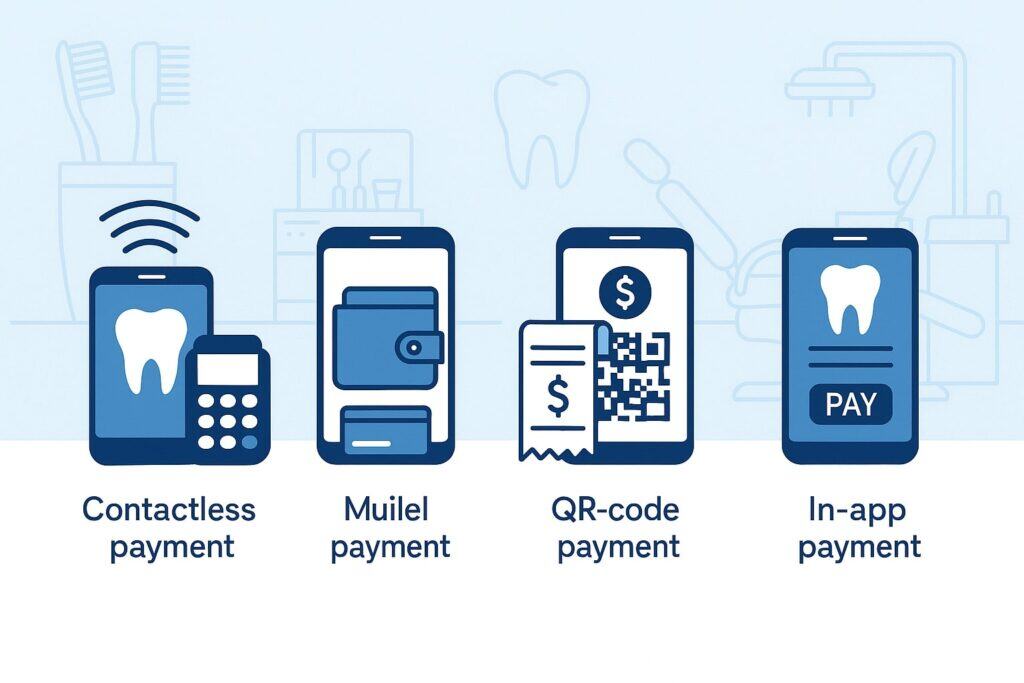
To choose the right mobile payment solutions for dental practices, it helps to understand the main categories of tools available. Most dental practices will benefit from combining several of these options.
1. Mobile wallets and contactless card payments
These include Apple Pay, Google Pay, Samsung Pay, and tap-to-pay credit/debit cards. Patients hold a phone, watch, or card near an NFC reader to complete payment in seconds.
These methods are ideal at the front desk or chairside for co-pays and same-day payments. They also support tokenization, which reduces the exposure of raw card numbers and helps with PCI DSS security.
2. Text-to-pay and email pay links
Many mobile payment solutions for dental practices now let your team send a secure payment link via SMS or email. The patient taps the link, reviews their bill on a mobile-optimized page, and pays using a card, ACH, or wallet.
This is particularly helpful for collecting balances after insurance adjudication or for following up on overdue accounts without printing and mailing statements.
3. Online payment portals and patient apps
Some solutions integrate with your PMS to provide a self-service portal or app where patients can view past visits, see balances, and pay from their phone at any time. When mobile payment solutions for dental practices include portals, you can also support stored payment methods, recurring plans, and family accounts.
4. In-office tablets and kiosk solutions
Tablets at check-in allow patients to review consent forms and pay at the same time. Kiosks can capture updated insurance details and collect co-pays up front. This is especially useful for high-volume practices or DSOs with multiple operatories and busy front desks.
By mixing these tools, your dental office can meet patients where they are — at the chair, at home, or on the go — while keeping all payments flowing into a unified, mobile-enabled system.
How Mobile Wallets and Contactless Payments Work in the Dental Office
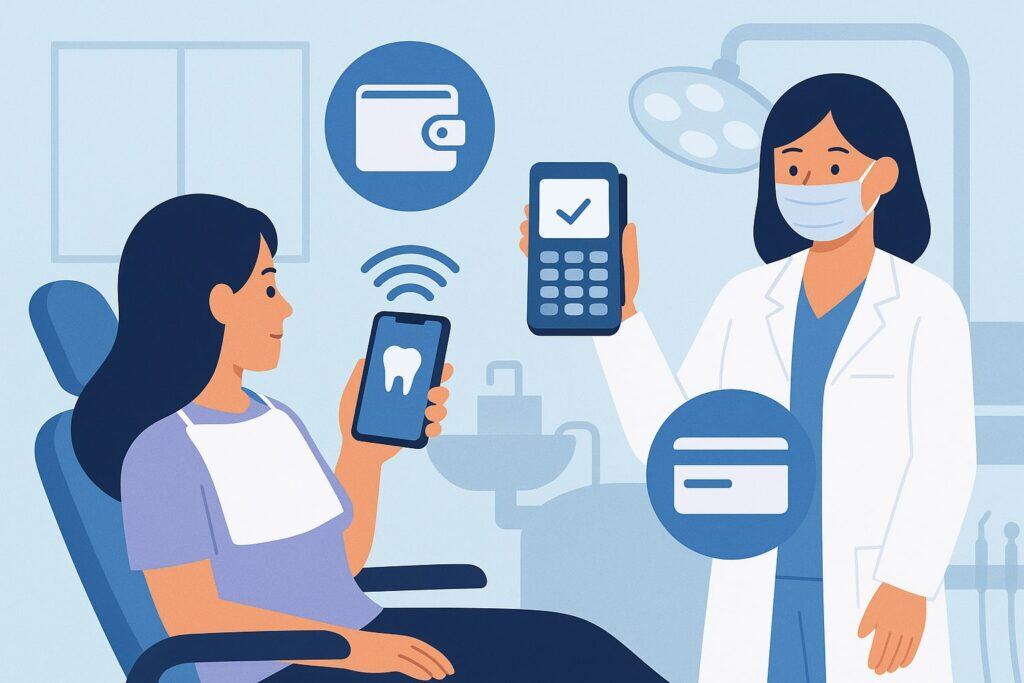
Mobile wallets and contactless cards are often the first step when implementing mobile payment solutions for dental practices. Understanding how they work helps you explain them to patients and evaluate vendors.
When a patient pays with a mobile wallet like Apple Pay, their actual card number is not transmitted to your terminal. Instead, the wallet uses tokenization to send a device-specific token and a cryptogram to your payment processor.
PCI DSS guidance emphasizes tokenization and encryption as best practices for reducing card data exposure and risk. This means your practice stores and touches less sensitive data, which simplifies compliance and helps protect patients.
From a workflow standpoint, your contactless terminal connects to your PMS or standalone payment gateway. When staff posts a charge, the amount appears on the reader.
The patient simply taps their phone, watch, or card. Transactions typically authorize in seconds, and patients can receive digital receipts by email or SMS instead of paper.
Mobile payment solutions for dental practices should also support contactless refunds and partial adjustments. If a claim is reprocessed or treatment changes, you want to be able to issue refunds back to the original payment method without extra hassle.
Many dental practices also find that offering contactless tap-to-pay speeds check-out, shortens lines at the front desk, and makes it easier to move patients quickly between hygiene, doctor exams, and leaving the office on time.
Patient Portals, Text-to-Pay, and In-App Payments
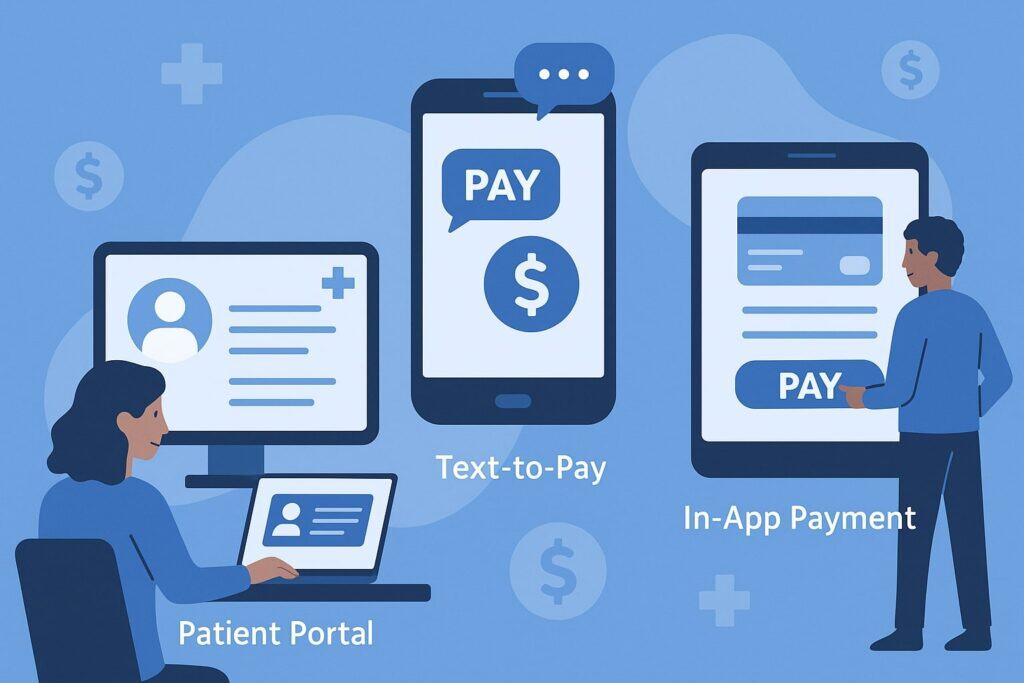
While contactless is powerful at the front desk, many balances are owed after insurance pays. That is where portals, text-to-pay, and in-app payments become critical components of mobile payment solutions for dental practices.
A patient portal or app integrated with your PMS can show real-time balances, estimates, and explanations of benefits. Patients can log in, review what insurance paid, and pay the remaining amount from their phone using card, ACH, or wallet.
Healthcare digital payment market research indicates that self-service portals and mobile billing significantly improve collection rates and reduce staff time spent on manual follow-ups.
Text-to-pay takes this further. When a claim is finalized, your system automatically or manually sends a personalized SMS with a secure link. The patient taps, verifies their details, and pays in under a minute.
Because patients read texts more frequently than mail or email, mobile payment solutions for dental practices that include text-to-pay often see faster payments and fewer bad debts.
Some platforms also allow in-app payments connected to appointment reminders and treatment plans. Patients may receive a push notification reminding them of an upcoming visit and offering the option to pay their estimated co-pay in advance.
This reduces the balance due on the day of treatment and lets busy patients handle billing at a time that fits their schedule.
Compliance, Security, and Regulatory Requirements for Dental Mobile Payments
Security and compliance are non-negotiable when selecting mobile payment solutions for dental practices. Unlike retail, dental offices must consider both payment card rules and healthcare privacy regulations.
Even when your payment processor hosts most of the sensitive data, your practice remains responsible for choosing compliant partners and using them correctly.
In the U.S., three pillars dominate this landscape: HIPAA for patient health information (PHI), PCI DSS for cardholder data, and various state privacy and data breach laws.
HIPAA rules allow providers to use PHI for treatment, payment, and operations without additional patient authorization, but they also require reasonable safeguards to protect the confidentiality, integrity, and availability of that information.
On the payments side, PCI DSS v4.0.1 establishes the global standard for securing card data and applies to any organization that stores, processes, or transmits cardholder information — including dental practices that accept credit and debit cards.
As of April 1, 2025, all merchants must comply with the new v4.0 “best practice” requirements that are now mandatory.
Modern mobile payment solutions for dental practices can greatly reduce your compliance burden by handling card data in secure, tokenized environments and offering HIPAA-aware integrations.
However, you must still understand where PHI and card data flow, sign appropriate Business Associate Agreements (BAAs) when needed, and configure systems to minimize risk.
HIPAA, PHI, and What Applies to Mobile Payment Solutions for Dental Practices
One common misconception is that any app used by a healthcare provider must be “HIPAA compliant.” The reality is more nuanced, especially when it comes to mobile payment solutions for dental practices.
Under HIPAA, payment activities that involve PHI — such as using a patient’s name, treatment codes, or insurance details to submit claims or manage billing — fall under the privacy and security rules.
HHS guidance explains that covered entities can use PHI for their own payment operations and disclose it to health plans as needed, but must apply safeguards.
However, pure payment card processing is generally exempt from HIPAA because it is treated as a standard financial transaction, not as handling medical information.
The complications arise when payment providers offer extra services like storing invoices that contain treatment descriptions, sending itemized bills, or integrating with your PMS in ways that expose PHI. In those cases, the payment vendor may act as a Business Associate, and a BAA could be required.
For mobile payment solutions for dental practices, this means you should:
- Map what PHI, if any, flows through each payment channel (portal, SMS, app, terminal).
- Avoid including detailed diagnostic or treatment descriptions in payment messages where possible; use generic labels such as “dental services” plus date of service.
- Ask vendors whether they sign BAAs and how they segregate payment data from PHI-containing records.
- Ensure that staff only discusses necessary billing information in public spaces, even when using mobile devices.
While you should always seek legal counsel for definitive compliance advice, designing mobile payment workflows with “minimum necessary” PHI in mind is a practical way to align your payment strategy with HIPAA expectations.
PCI DSS 4.0, Tokenization, and Data Security Best Practices
PCI DSS v4.0.1 sets out 12 broad requirements to protect cardholder data, including building secure networks, encrypting transmission of card data, restricting access, monitoring systems, and maintaining information security policies.
For dental offices, the goal is to minimize how much card data you store or transmit directly by leveraging cloud-based, tokenized mobile payment solutions for dental practices.
Tokenization replaces card numbers with randomly generated tokens that are useless if stolen. When a patient pays via mobile wallet or online portal, the card details are sent securely to your processor, which returns a token.
Your PMS or payment platform stores only the token, not the card number. This allows you to safely support card-on-file for payment plans, recurring charges, and family accounts without holding sensitive data.
In addition, look for mobile payment solutions for dental practices that:
- Use point-to-point encryption (P2PE) from the card/mobile device to the processor.
- Undergo regular third-party security assessments and provide PCI Attestation of Compliance (AOC).
- Allow role-based access control so only authorized staff can issue refunds, view reports, or manage tokens.
- Support multi-factor authentication (MFA) for admin users and remote access.
Because PCI DSS 4.0 requirements became fully effective in 2025, now is the ideal time for dental practices to review their payment stack. Choosing updated mobile payment solutions for dental practices that align with the latest standard will help avoid penalties and reputational damage from a data breach.
Managing Fraud, Chargebacks, and Emerging Mobile Payment Risks
Mobile payment solutions for dental practices reduce some traditional risks but introduce new ones. While tokenization and contactless technologies can be more secure than manual card entry, threats like account takeover, stolen phones, and new scams require vigilance.
Recent reports highlight scams targeting contactless and NFC users, such as “ghost tapping,” where fraudsters attempt unauthorized tap-to-pay charges by getting close to a victim’s device.
Although such scams are more common in crowded retail settings, dental practices should still maintain good hygiene around tap-to-pay — for example, never handing terminals to unknown individuals and keeping readers located in controlled spaces at the front desk or chairside.
To protect your practice, your mobile payment solutions for dental practices should include:
- Address Verification Service (AVS) checks for card-not-present transactions.
- Card Security Code (CVV) verification for online and text-to-pay.
- Optional 3D Secure or similar step-up authentication on higher-risk payments.
- Automated alerts for unusual patterns, such as multiple failed attempts from the same IP.
Operationally, train staff to verify patient identities before processing larger payments, especially over the phone or via manually keyed entries. Establish a written chargeback response procedure that includes maintaining signed treatment plans, consent forms, and clear financial policies.
When disputes arise, this documentation, combined with detailed processor logs from your mobile payment solutions for dental practices, will help you successfully respond to chargebacks.
Essential Features to Look for in Mobile Payment Solutions for Dental Practices
Not all payment platforms are built with healthcare or dental workflows in mind. When evaluating mobile payment solutions for dental practices, focus on feature sets that align with how your team actually works rather than just generic retail capabilities.
First, confirm the solution supports the core channels your patients expect today: contactless in-office payments, secure online portals, text-to-pay, and the ability to save payment methods for future visits.
Next, look at how well the platform integrates with your PMS. Manual double-entry of charges and payments wastes time and leads to errors that harm both patient satisfaction and revenue cycle performance.
Additionally, consider whether the mobile payment solution supports healthcare-specific needs like estimating patient responsibility, handling insurance adjustments, managing HSA/FSA cards, and setting up recurring payment plans for orthodontics or cosmetic dentistry.
U.S. consumers increasingly use HSA/FSA funds for dental services, and your system should clearly identify eligible transactions and provide compliant receipts.
Finally, reporting, reconciliation, and security controls matter just as much as patient-facing features. You need to be able to see which channels drive the most payments, reconcile deposits to your bank, and manage users as staff join or leave.
Choosing robust mobile payment solutions for dental practices up front saves significant operational headaches later.
Front-Desk and Clinical Workflow Integration
The best mobile payment solutions for dental practices feel invisible to staff because they are seamlessly built into existing workflows. That starts at the front desk, where staff schedule appointments, verify insurance, and collect co-pays.
Look for solutions that integrate directly with your PMS so that when an appointment is checked in, the system automatically calculates estimated patient responsibility and displays it on the payment terminal or portal.
Front-desk staff should be able to collect payment in a couple of clicks, without re-typing amounts or switching between multiple systems.
In operatories, consider whether your mobile payment solutions for dental practices support chairside payments. Hygienists or treatment coordinators could review a treatment plan on a tablet, obtain e-signatures, and accept deposits or full payments on the spot.
This is especially valuable for larger elective cases where patients are more likely to commit if they can pay immediately before leaving the room.
Workflow integration also includes real-time posting of payments back into the PMS ledger. When a patient pays via text-to-pay at home, that payment should automatically appear on the correct account, with the corresponding invoice marked as paid.
This reduces reconciliation work and prevents awkward conversations where staff cannot see payments patients have already made.
Insurance, HSA/FSA, and Recurring Payment Management
Dental finances often blend insurance, out-of-pocket payments, and tax-advantaged accounts like HSAs and FSAs. Mobile payment solutions for dental practices must handle these complexities gracefully.
First, verify that your payment platform can distinguish between insurance estimates and patient responsibility, and that it supports partial payments when exact amounts are not yet known. Some systems allow you to preauthorize a maximum amount and then capture only what is owed once the claim settles. This reduces the need to chase patients later.
Second, ensure the solution accepts HSA and FSA cards, which are usually processed as specialized debit cards. Clear receipt and proper categorization are important so patients can document eligible dental expenses for IRS purposes if requested.
Many Americans rely on HSA/FSA funds for orthodontics, implants, and major restorative work, so mobile payment solutions for dental practices that make it easy to use these accounts will be especially attractive.
Third, recurring payments are critical for memberships, in-house dental savings plans, and multi-visit treatments. Your platform should enable secure card-on-file or bank account-on-file with clear patient consent.
Automated recurring billing helps patients budget and reduces the chance that they fall behind. Tokenized recurring payments also limit your PCI scope while still giving you predictable revenue from payment plans.
Reporting, Reconciliation, and Practice Analytics
Even the most patient-friendly mobile payment solutions for dental practices must be financially sound. Robust reporting and analytics help you understand which channels are driving payments and where you may be losing revenue.
At a minimum, your system should provide:
- Daily deposit reports that match processor batches to bank deposits.
- Breakdown of payments by method (contactless, portal, text-to-pay, ACH, etc.).
- Aging reports that highlight overdue accounts and show whether mobile reminders are improving collections.
- Productivity metrics per provider, location, or department.
Better platforms go further, offering dashboards that show average days in accounts receivable, percentage of balances paid at time of service, and adoption rates of mobile payment options.
Combined with PMS data, mobile payment solutions for dental practices can give you insight into case acceptance patterns and the financial impact of membership plans or promotional financing.
From a compliance perspective, detailed audit logs are also essential. You should be able to see which user issued refunds, changed payment plans, or updated card-on-file tokens. This helps enforce internal controls, satisfy auditors, and respond quickly if an error or suspected fraud occurs.
Step-by-Step Implementation Plan for Mobile Payment Solutions in a Dental Practice
Implementing mobile payment solutions for dental practices does not have to be disruptive. A structured, step-by-step approach helps you modernize payments while keeping your schedule full and your team confident.
Start by clarifying your goals. Are you trying to reduce days in A/R, cut statement mailing costs, improve patient satisfaction, or support new services like orthodontic payment plans? Most practices want all of the above, but ranking priorities will guide vendor selection and rollout sequencing.
Next, form a small internal project team that includes a practice manager, a lead from the front desk, and at least one clinician or treatment coordinator.
These stakeholders understand the day-to-day realities of your workflows and will provide valuable input on how mobile payment solutions for dental practices should work in your environment.
Finally, communicate early with staff and patients. Let them know that new payment options are coming, explain the benefits, and reassure them that the system is secure and compliant. When patients understand that mobile payments are designed to make their lives easier, adoption rises quickly.
Assessing Your Current Systems and Patient Demographics
Before signing contracts, take a close look at your current technology stack and patient base. This assessment phase is critical to successfully implementing mobile payment solutions for dental practices.
Inventory your existing PMS, imaging systems, and any third-party billing or reminder tools. Identify whether your current PMS has built-in payment features or preferred integrations. If your PMS offers an app marketplace, review which mobile payment partners they already support. This can simplify implementation and reduce integration costs.
Next, analyze your patient demographics and payment behaviors. Younger urban patients are more likely to use Apple Pay, Google Pay, and text-to-pay, while some older patients may still prefer traditional card swipes or checks.
However, research consistently shows rising mobile payment adoption across age groups, especially as contactless and mobile wallets become mainstream in the U.S. Tailoring your communication and training to different patient segments will help maximize usage of your new tools.
Also, review your accounts receivable data: what percentage of balances remain unpaid after 30, 60, and 90 days? How much are you spending on mailing statements and making collection calls? Quantifying these issues gives you a baseline to measure the impact of mobile payment solutions for dental practices after rollout.
Selecting Vendors, Pricing Models, and Contracts
Choosing the right partner is one of the most important steps in implementing mobile payment solutions for dental practices. Beyond standard considerations like rates and fees, focus on healthcare alignment, integration strength, and security posture.
First, shortlist vendors that specialize in healthcare or dental payments and can demonstrate successful deployments in U.S. practices. Ask for references from similar offices in terms of size and specialty. Look for solutions that offer patient portals, text-to-pay, mobile wallets, and strong PMS integrations in a single platform so you are not juggling multiple vendors.
Second, compare pricing models carefully. Some providers charge flat-rate pricing for all card types; others use interchange-plus. Evaluate monthly platform fees, per-user fees, and add-on costs for features like text messaging or advanced reporting.
Mobile payment solutions for dental practices should be transparent about total cost of ownership, including any gateway fees or PCI compliance program charges.
Third, review security and compliance documentation. Request copies of PCI DSS Attestations of Compliance and ask how the vendor is addressing new PCI DSS 4.0 requirements effective in 2025.
If the solution handles PHI, confirm that they sign Business Associate Agreements and follow HIPAA-aligned practices.
Finally, read contract terms regarding auto-renewals, early termination fees, and equipment leases. Whenever possible, avoid long, inflexible terminal leases in favor of shorter commitments or equipment you can repurpose with other processors.
Staff Training, Go-Live, and Continuous Optimization
Even the best mobile payment solutions for dental practices will fail if staff are not trained and comfortable. Plan training and go-live as carefully as you would for a new clinical technology.
Start with role-specific training sessions. Front-desk staff need to know how to process contactless payments, send text-to-pay links, and handle partial payments.
Billing team members must understand reporting, reconciliation, and how to use mobile tools to follow up on overdue accounts. Clinicians and treatment coordinators should learn how mobile payment options fit into case presentation and consent workflows.
During go-live, consider a phased rollout. You might begin with contactless payments at the front desk, then add portals and text-to-pay a few weeks later. This gives staff time to adjust and helps you identify any issues early.
Encourage team members to share feedback about where mobile payment solutions for dental practices are working well and where they feel friction.
After launch, monitor metrics such as days in A/R, number of mailed statements, and usage of each mobile channel. Use this data to make improvements.
For example, if text-to-pay adoption is low, you might revise the language of SMS messages or send them at different times of day. Periodically retrain staff on best practices and bring new employees up to speed quickly so your payment experience remains consistent.
Real-World Use Cases and Best Practices for U.S. Dental Practices
Once mobile payment solutions for dental practices are in place, the real payoff comes from using them strategically. Practices that align payment options with patient communication, scheduling, and treatment planning see the strongest results.
One best practice is to integrate payment options into every touchpoint: appointment reminders, treatment plan discussions, check-out, and post-visit follow-ups. Patients should never have to ask, “How do I pay?” because the answer is always visible in texts, emails, portals, and in-office signage.
Another is to regularly review mobile payment analytics. Look for patterns such as which appointment types generate the highest mobile payments and whether certain times of day yield better response to text-to-pay. Over time, you can refine your communication cadence and segment outreach for maximum effectiveness.
Finally, use mobile payment solutions for dental practices to support broader business goals such as expanding cosmetic services, launching membership plans, or opening additional locations. Once your payment infrastructure is modern and mobile-friendly, scaling becomes much easier.
Reducing Accounts Receivable with Text-to-Pay and Payment Plans
A major driver for implementing mobile payment solutions for dental practices is reducing accounts receivable. Traditional mailed statements are slow and often ignored. Mobile tools can dramatically change this equation.
Text-to-pay allows you to send a payment request as soon as a claim is processed or a balance is posted. Because most people check their phones many times a day, SMS has a far higher open rate than paper or email.
Patients can pay in seconds, often before they forget about the bill. This shortens the collection cycle and lowers the percentage of balances that drift into 60- or 90-day territory.
Payment plans are another powerful tool. For larger treatments — such as orthodontics, implants, or full-mouth restorations — offering structured, automated payment plans makes high-value care more accessible.
Mobile payment solutions for dental practices can automatically charge a stored card or bank account on a monthly basis, send reminders before each charge, and pause or adjust plans when treatment schedules change.
Combined, text-to-pay and payment plans can significantly reduce the administrative burden on your billing team. Instead of spending hours making collection calls, staff can focus on helping patients understand their benefits, scheduling follow-up care, and supporting case acceptance.
Improving Patient Experience and Case Acceptance
In dentistry, financial friction is one of the top reasons patients delay or decline treatment. Mobile payment solutions for dental practices help remove that friction by making payment feel predictable, secure, and convenient. During case presentation, treatment coordinators can explain both clinical benefits and financial options in one conversation.
They might show the patient an estimate, then immediately offer a choice: pay in full today via contactless, set up a recurring plan, or split between an HSA card and a personal card. When patients see clear options and know they can manage payments on their phone, they are more likely to say yes.
Mobile payment solutions for dental practices also enhance the experience after the visit. Instead of confusing paper statements arriving weeks later, patients receive clear digital summaries and simple payment links.
They can review charges at their convenience, pay from home, and keep digital receipts for their records. This transparency builds trust, reduces billing disputes, and increases the likelihood that patients return regularly and follow through with recommended treatments.
Marketing, Reviews, and Patient Loyalty Tied to Convenient Payments
Payment experience can also become part of your marketing and patient retention strategy. Many patients mention billing frustrations in online reviews. When you offer smooth mobile payment solutions for dental practices, you create an opportunity for positive feedback instead.
For example, you can highlight “easy mobile payment options” on your website, Google Business Profile, and in new-patient materials.
After successful mobile payments, your system can trigger follow-up messages inviting satisfied patients to leave a review or join your in-house membership plan. Because the payment moment is often when patients feel relieved that a bill is handled, it’s a natural time to ask for feedback.
Additionally, mobile payment solutions for dental practices can support loyalty initiatives. You might offer small incentives for patients who enroll in autopay or complete payments before a due date, such as entries into a drawing or discounts on elective whitening.
Over time, these programs not only improve cash flow but also deepen patient engagement with your practice.
FAQs
Q.1: Are Mobile Payment Solutions for Dental Practices Safe and Compliant?
Answer: Yes, mobile payment solutions for dental practices can be very safe when they are properly chosen and configured.
Security and compliance rely on using technologies such as tokenization, encryption, and secure cloud processing rather than storing sensitive data locally in your office. PCI DSS v4.0.1 provides a detailed framework for protecting cardholder data, and reputable payment providers regularly undergo audits to demonstrate compliance.
From a healthcare perspective, HIPAA focuses on protecting PHI, not payment card numbers. Pure card processing is generally exempt from HIPAA, but when payment platforms handle invoices or data that include treatment details, they may become HIPAA Business Associates.
That’s why it is essential to choose mobile payment solutions for dental practices that understand healthcare and will sign BAAs when appropriate.
Your role is to select trustworthy vendors, limit local storage of card and PHI data, enforce strong passwords and multi-factor authentication, and train staff on safe payment practices.
When these steps are followed, mobile payment systems can be more secure than older workflows that relied on paper forms, manual card entry, or storing card numbers in practice computers.
Q.2: Which Payment Methods Should My Dental Practice Offer via Mobile?
Answer: To make the most of mobile payment solutions for dental practices, you should offer a mix of methods that reflect how U.S. consumers already pay for other services.
At a minimum, this includes credit and debit cards (Visa, Mastercard, Discover, American Express), Apple Pay, Google Pay, and online card payments through a portal. These cover a large portion of the population and fit naturally into mobile workflows.
You should also consider ACH/eCheck options for larger balances, particularly for payment plans and membership programs. ACH often carries lower processing fees than cards and can be more cost-effective for recurring charges.
Additionally, ensure your mobile payment solutions for dental practices support HSA and FSA cards, as many patients use tax-advantaged funds for dental services.
Some practices explore peer-to-peer apps like Zelle or PayPal. However, you must carefully evaluate whether those apps are configured in ways that protect PHI and meet your compliance obligations, since many consumer apps are not designed specifically for healthcare.
In most cases, a dedicated healthcare-oriented payment platform that supports wallets, cards, ACH, and portals will be a more robust long-term choice.
Q.3: How Can I Introduce Mobile Payment Solutions Without Confusing Patients?
Answer: Successful rollout of mobile payment solutions for dental practices depends heavily on clear communication. Start by training staff to explain new options in simple language during check-in and check-out.
For example: “We now offer secure text-to-pay and online payments so you can take care of your bill from home if that’s easier.” Provide short scripts and FAQs so everyone gives consistent answers.
Next, update your website, welcome packets, and appointment reminders to mention your mobile payment options. Include screenshots or short explanations of how text-to-pay and portals work.
Reassure patients that these tools are secure, compliant, and optional — they can still pay in office if they prefer. Over time, most patients will naturally gravitate toward the most convenient options.
Finally, roll out mobile payment solutions for dental practices in phases. You might begin with contactless in-office payments, then add text-to-pay for balances, followed by full patient portals. Monitor patient feedback and be ready to adjust messaging or timing.
With thoughtful communication and staff engagement, patients will see mobile payments as a helpful upgrade, not a confusing change.
Conclusion
Mobile payment solutions for dental practices are far more than trendy gadgets or apps. They represent a strategic shift in how your office interacts with patients, collects revenue, and manages financial risk.
As U.S. consumers increasingly expect fast, secure, and mobile-friendly payment options, dental practices that modernize will stand out as patient-centric and technologically up to date.
By selecting secure, healthcare-aware platforms that support contactless, portals, text-to-pay, ACH, and HSA/FSA payments — and by integrating them tightly with your PMS — you can reduce days in A/R, shrink mailing and collection costs, and boost case acceptance.
Ensuring alignment with HIPAA, PCI DSS 4.0, and state privacy rules protects both your reputation and your patients’ trust.
Most importantly, mobile payment solutions for dental practices make paying for care feel simple and predictable. When patients can quickly handle bills on their phones, they are more likely to return regularly, accept recommended treatments, and speak positively about your practice.
With a thoughtful implementation plan, ongoing staff training, and data-driven optimization, mobile payments can become a durable competitive advantage for your dental office in 2025 and beyond.