
Recurring credit card billing for dental membership plans allows a dental office to collect scheduled membership fees automatically after receiving authorization from the patient.
The arrangement may support preventive care memberships, hygiene plans, family programs, orthodontic monitoring plans, cosmetic benefit programs, or discount-based memberships offered directly by a practice.
For patients, recurring dental payments can make routine care expenses easier to anticipate. Instead of paying one larger amount at enrollment, a patient may choose monthly, quarterly, or annual billing based on the options provided by the practice.
For dental offices, automated dental billing can reduce the number of invoices staff must prepare, send, monitor, and follow up on manually. Predictable payment schedules may also help a practice organize membership revenue, forecast collections, and maintain more consistent communication with enrolled patients.
However, convenience does not remove the need for careful administration. Recurring billing involves ongoing payment authorization, card-on-file security, patient privacy, renewal notices, failed payment procedures, cancellations, refunds, chargebacks, reconciliation, and accurate membership records.
A dental practice should therefore treat its membership billing program as a defined operational workflow rather than simply scheduling repeated card charges. Written agreements, secure payment tools, trained staff, clear patient communication, and regular account reviews are essential.
The information below is general educational guidance. Practices should obtain appropriate professional review for legal, healthcare privacy, accounting, tax, contract, card-network, or regulatory questions that apply to their specific membership program.
What Is Recurring Credit Card Billing for Dental Membership Plans?
Recurring credit card billing for dental membership plans is an automated process in which a patient authorizes a dental practice to charge a payment card according to an agreed schedule.
The schedule may be monthly, quarterly, annually, or customized to match the structure of the membership. The patient typically signs or electronically accepts a membership agreement that explains the price, payment dates, included benefits, renewal terms, cancellation procedure, and refund policy.
After enrollment, the practice’s recurring billing software submits each scheduled transaction through a payment gateway. The processor requests authorization from the card issuer, and approved funds are later included in a settlement deposit to the practice.
Recurring billing for dentists is different from simply keeping a card number available for future use. A responsible program connects the saved payment method to documented consent, a defined payment schedule, membership terms, and an account-management process.
The practice should also distinguish dental membership billing from insurance coverage. A membership may provide preventive services, reduced fees, or other practice-defined benefits, but it should be described accurately so patients understand what they are purchasing.
Practices that want a broader understanding of scheduled charges, card-on-file workflows, payment reminders, receipts, and reconciliation can review this guide to automated billing systems for dental offices.
How Recurring Dental Payments Work
The process begins when a patient reviews a membership offer and chooses to enroll. The office explains the membership price, billing frequency, services included, limitations, renewal rules, and cancellation method.
The patient then provides payment authorization. This may occur through a secure online payment portal, an electronic enrollment form, a payment terminal, or another protected payment channel.
Where supported, the payment platform replaces the card number with a token. The token can be used for later transactions without requiring the practice’s general office systems to store the raw card number.
On each billing date, the recurring billing system submits the scheduled charge. The patient receives a digital receipt, and the office records the transaction in the membership system, patient ledger, or accounting workflow.
If the payment fails, the system may send an alert, apply approved retry logic, or request an updated payment method. Staff then follow the practice’s documented failed-payment procedure.
Dental Membership Billing vs. One-Time Payments
A one-time dental payment is generally connected to a specific visit, procedure, deposit, or outstanding balance. The patient approves that individual transaction, and no future charge is automatically scheduled unless separate authorization exists.
Dental subscription billing creates an ongoing relationship. The office must manage not only the initial transaction but also future billing dates, plan renewals, payment-method changes, expired cards, failed payments, membership status, cancellation requests, and recurring receipts.
The documentation requirements are also different. A receipt may be sufficient evidence of a straightforward one-time transaction, but recurring dental payments usually require a membership agreement and recurring payment authorization that can be retrieved later.
Ongoing communication is another distinction. Patients may need renewal reminders, card-expiration notices, payment-failure messages, benefit summaries, and confirmation when a membership is changed or canceled.
Because several months may pass between enrollment and a disputed transaction, accurate records become especially important. Staff should be able to identify when the patient enrolled, what terms were accepted, what benefits were used, and whether any cancellation request was received.
Why Dental Practices Offer Membership Plans

Dental membership plans may appeal to practices that want to provide an organized option for patients who do not use traditional dental benefit coverage or who prefer predictable preventive care costs.
A plan might include examinations, cleanings, routine imaging, emergency evaluations, or discounts on eligible treatment. The exact structure depends on the practice, patient population, professional guidance, and applicable requirements.
For patients, a recurring payment may be easier to budget than an annual lump sum. For the practice, dental membership payment processing can support more consistent collections and reduce dependence on manual renewal invoices.
Membership programs may also encourage patients to maintain regular preventive visits. When services are clearly described and enrollment records are accurate, the program can provide a visible framework for scheduling and benefit tracking.
Still, a membership should not be promoted as appropriate for every patient. Staff should explain the program accurately, avoid overstating savings, and give patients enough information to compare the membership with their other payment or benefit options.
Benefits for Dental Practices
A well-managed program can make collections more predictable. Instead of contacting every member individually at renewal, the office can schedule authorized payments and focus staff attention on exceptions such as expired cards or canceled memberships.
Dental membership billing may also support patient retention. Patients who have prepaid or are making recurring payments for preventive benefits may be more likely to schedule services included in the plan.
Administrative organization is another potential benefit. A centralized system can help staff review enrollment dates, billing schedules, active memberships, benefits used, failed payments, refunds, and renewal status.
Recurring payments may also improve visibility into membership revenue. Settlement reports and membership records can help the practice determine how much was collected, which transactions failed, and whether deposits match patient ledger entries.
These benefits depend on accurate procedures. Automation can reduce repetitive work, but poorly configured automation may create duplicate charges, missed cancellations, incorrect renewal dates, or inconsistent patient balances.
Benefits for Patients
Patients may appreciate knowing what their recurring cost will be and which preventive services or discounts are associated with the membership. A defined monthly or annual amount can make personal budgeting more manageable.
Automatic billing also reduces the need to remember individual payment dates. When digital receipts and reminders are provided, the patient can maintain a record of charges without repeatedly contacting the front desk.
Membership plans may make preventive care easier to schedule because the included services are described at enrollment. Patients can understand when they are eligible for visits and whether unused benefits expire or carry forward.
Convenience should not come at the expense of transparency. Patients need to know that the payment is recurring, when it will be charged, how renewal works, and what happens if they cancel.
How Dental Membership Payment Processing Works
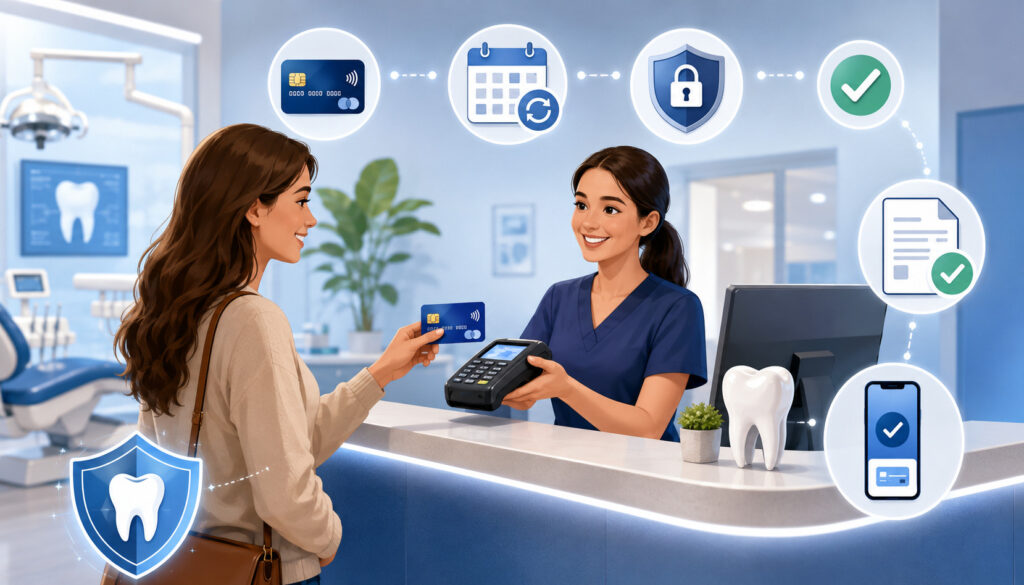
Dental membership payment processing typically involves a merchant account or payment service, a gateway, recurring billing software, a secure method for capturing payment details, and a system for recording payments.
The payment gateway carries transaction information between the practice’s payment interface and the processing network. The recurring billing tool determines when an authorized transaction should be submitted.
After approval, the transaction appears in the processor’s reporting system. Funds are later deposited according to the settlement schedule, less applicable processing fees or adjustments.
The practice must then connect the payment to the correct patient, membership, and ledger category. This can happen automatically through a practice management software integration or manually through a documented posting procedure.
A complete dental practice payment processing workflow should also address receipts, failed transactions, refunds, chargebacks, expired cards, settlement reports, staff permissions, and reconciliation.
Because most automatic membership charges are processed without the patient presenting a physical card each time, dental teams should understand the differences between card-present and card-not-present payments in dentistry.
Card-on-File and Tokenized Payment Methods
Card-on-file billing allows an approved payment method to be used for later transactions. In a secure setup, the dental office does not retain the complete card number in notes, spreadsheets, paper files, or general practice software.
Instead, the payment provider creates a token associated with the card. The recurring billing system uses that token when submitting scheduled charges.
Tokenization reduces the number of places where usable card data is exposed. The PCI Security Standards Council’s tokenization guidance explains how tokenization may affect the protection of cardholder data and the scope of PCI DSS responsibilities.
Tokenization does not remove every responsibility. The practice must still protect login credentials, control staff access, maintain secure devices, review provider responsibilities, and follow the applicable PCI validation process.
Patients should also understand that their payment method is being saved for recurring use. The authorization record should connect the stored credential with the agreed amount, schedule, and membership terms.
Payment Gateway and Billing Software Role
For practices offering digital enrollment, online card updates, or self-service membership payments, this guide to payment gateways for dental websites explains important gateway features and patient-facing payment considerations.
A payment gateway securely transmits transaction requests, while recurring billing software controls the payment schedule and account status.
Depending on the platform, the software may support monthly and annual plans, prorated changes, automatic receipts, card-expiration alerts, account updater services, failed-payment retries, membership suspension, and transaction reporting.
An account updater may refresh certain card details after a participating issuer replaces a card or changes its expiration date. The feature can reduce avoidable declines, although it should not replace patient communication or record review.
Retry logic determines whether and when a declined payment is submitted again. Excessive or poorly communicated retries may frustrate patients, so the timing should match the practice’s written policy and processor rules.
Integration also matters. A platform that connects with practice management software may reduce manual posting, but the office should test how payments, refunds, discounts, and failures appear in the patient ledger.
Recurring Billing Options for Dental Membership Plans Compared
No single billing schedule is appropriate for every dental practice or patient. The right setup depends on membership price, included services, staff capacity, software capabilities, patient preferences, refund rules, and the practice’s approach to renewal.
The following table provides a practical comparison.
| Billing Setup | Best For | Benefits | What to Review |
| Monthly recurring billing | Ongoing dental memberships | Lower payment amount per billing cycle | Consent, failed payments, retry timing, and reminders |
| Annual billing | Simple yearly membership plans | Fewer transactions and easier renewal tracking | Renewal notices, cancellation timing, and refund rules |
| Quarterly billing | Mid-range payment schedules | Balance between payment size and administrative frequency | Exact dates and patient communication |
| Card-on-file billing | Automated membership payments | Convenient and consistent processing | Tokenization, authorization records, and access controls |
| Online payment portal | Patient self-service enrollment and card updates | Convenient updates, receipts, and account access | Portal security, authentication, and privacy controls |
| Manual invoice billing | Small or highly customized programs | Greater staff review before each payment | Administrative workload and missed follow-up |
| Recurring payment plans | Membership fees or structured balances | Predictable scheduled collections | Whether the arrangement is a membership or treatment payment plan |
How to Use the Table Before Choosing a Billing Setup
Begin by comparing the membership price with the likely payment preferences of the practice’s patients. A lower monthly charge may be easier to budget, while annual billing creates fewer individual transactions.
Next, consider staff capacity. Monthly billing creates more transaction activity, failed-payment alerts, receipts, and reconciliation entries than annual billing.
Review cancellation and refund procedures before selecting the schedule. For example, a practice collecting an annual fee should decide how unused benefits and midterm cancellations will be handled.
The payment platform must also support the intended workflow. Confirm whether it can store authorization records, create tokens, send reminders, update cards securely, retry failed payments, issue refunds, and export settlement reports.
Finally, evaluate the patient experience. Enrollment, payment updates, receipts, and cancellation instructions should remain understandable regardless of the billing schedule.
Why Recurring Billing Needs Clear Rules
Recurring payments occur after the original enrollment conversation, sometimes many months later. Without clear rules, patients may forget the plan, misunderstand the renewal date, or believe a cancellation was already effective.
Written terms help the patient and practice refer to the same information. They also encourage consistent decisions when staff members handle failed payments, plan changes, refund requests, or disputes.
The rules should cover billing frequency, authorization, renewal, cancellation, benefit use, payment failures, card updates, receipts, and refunds. Staff should not invent different answers for different patients.
Clear rules also improve internal accountability. When a cancellation request is received, employees should know where to document it, who changes the billing status, and how the patient receives confirmation.
Key Elements of a Dental Membership Billing Agreement

A dental membership billing agreement should describe both the membership benefits and the payment arrangement. The document should be reviewed by qualified professionals familiar with the practice’s location and program structure.
Core elements commonly include:
- Membership price and enrollment date
- Monthly, quarterly, annual, or custom billing frequency
- First payment date and future billing dates
- Renewal term and renewal notification process
- Services and treatment discounts included
- Services, products, or charges excluded
- Rules for unused or expired benefits
- Recurring payment authorization
- Card update procedure
- Failed payment and retry procedure
- Cancellation requirements and effective date
- Refund and credit policy
- Patient acknowledgment and signature
- Practice contact information for billing questions
The agreement should avoid vague statements that leave important decisions undefined. It should also remain consistent with staff scripts, marketing descriptions, online enrollment pages, and billing-system settings.
Payment Authorization Language
Payment authorization should clearly identify what the patient is allowing the practice to do. It should state the amount or method for determining the amount, billing frequency, expected charge date, payment method, and duration of the authorization.
The authorization should also explain whether the membership renews automatically. Patients need to know how they can withdraw authorization, cancel the membership, or update a payment card.
If the practice may change the price, the agreement should explain how and when notice will be provided. A practice should not assume that authorization for one amount automatically covers an unexpected new amount.
The signed or electronically accepted authorization should be stored with the membership record. Staff should be able to retrieve the version accepted by the patient and the date of acceptance.
Membership Terms and Service Limits
Membership benefits should be described precisely enough to prevent misunderstandings. If a plan includes two cleanings, an examination, and a treatment discount, the agreement should explain eligibility, timing, and any limitations.
The document should clarify whether benefits expire at the end of the membership term, whether they can be transferred, and whether unused services have a cash value.
Discount rules also need attention. Patients should understand which services qualify, whether the discount applies to outside laboratories or products, and whether it can be combined with other programs.
The practice should distinguish membership payments from treatment charges. Paying a monthly membership fee does not necessarily mean that all future dental treatment is included.
Patient Consent and Recurring Payment Authorization
Patient consent is the foundation of dental recurring payments. The practice should be able to demonstrate that the patient knowingly agreed to the membership and the recurring billing arrangement.
Consent may be collected with a written signature or a properly configured electronic process. The method should preserve the agreement, acceptance date, patient identity, and relevant payment terms.
A general card-on-file form may not be enough if it does not explain the recurring amount and frequency. Similarly, verbal approval without supporting documentation can be difficult to verify later.
When billing terms change, the office should determine whether renewed authorization or additional acknowledgment is required. Practices should obtain professional guidance for requirements applicable to their specific arrangements.
Why Consent Must Be Clear and Specific
A patient should understand the financial commitment before enrollment. That includes the amount, billing frequency, membership term, automatic renewal process, and cancellation method.
The patient should also know whether the first charge occurs immediately and whether later charges happen on a fixed calendar date or the anniversary of enrollment.
Consent should not be hidden inside unrelated paperwork. Important recurring billing terms should be visible and presented before payment information is submitted.
If the membership is enrolled through a family account, the practice should identify who is authorizing payment, which individuals receive benefits, and who may request changes.
Clear consent protects the patient from surprise billing and gives the office a more reliable record if questions arise.
Keeping Authorization Records Organized
The membership file should contain the signed agreement, recurring payment authorization, enrollment date, payment schedule, membership status, and history of material changes.
The office should also retain renewal notices, card-update records, receipts, failed-payment communications, cancellation requests, refund decisions, and dispute documents according to its record-retention policy.
Files should be easy for authorized employees to locate but unavailable to staff who do not need access. Role-based permissions can help separate membership administration from broader system access.
Version control is useful when membership terms change. The practice should know which patient accepted which version rather than replacing an old agreement with a new template.
Payment Security for Recurring Dental Billing
Recurring billing can increase payment-data exposure when a practice uses weak storage methods or gives too many employees access to payment tools.
PCI DSS applies to environments that store, process, or transmit cardholder data. The PCI Security Standards Council emphasizes protecting stored card data and limiting storage where possible.
Dental offices should use validated payment technology, tokenized card-on-file features, secure gateways, protected devices, strong passwords, multifactor authentication where available, and controlled user permissions.
Security should extend beyond software. Staff should verify patients before changing saved cards, avoid discussing account details where others can hear, and report suspicious requests.
Dental offices can use a structured dental payment security checklist to review card handling, staff permissions, payment devices, stored credentials, access controls, and everyday front-desk procedures.
Tokenization and Encryption Basics
Tokenization and encryption protect information in different ways.
Encryption transforms readable data into encoded data that can be interpreted only with the appropriate key. It protects information during transmission and, depending on the implementation, during storage.
Tokenization replaces a card number with a substitute value. The practice’s recurring billing application uses the token, while the actual card data remains within a more restricted payment environment.
Neither method should be treated as a complete security program. Secure configuration, access controls, software updates, staff training, device protection, and vendor oversight remain necessary.
When comparing providers, practices should ask who stores the card data, how tokens are created, what appears in the dental software, and what responsibilities remain with the office.
Avoiding Unsafe Card Storage
Practices that accept recurring cards or maintain tokenized payment methods can also review this overview of PCI DSS requirements for dental practices to better understand card-data protection responsibilities and secure payment workflows.
Dental offices should not write complete card numbers on paper, store them in spreadsheets, save photographs of cards, place them in unprotected documents, or enter them into clinical notes.
Payment details should not be requested through ordinary email, unsecured text messages, or general-purpose messaging applications.
If a patient calls to update a card, staff should use an approved virtual terminal or send a secure payment link rather than documenting the number for later entry.
Printed receipts and reports should also be reviewed. They should not expose more card information than necessary, and discarded records should be handled under the practice’s secure-destruction procedure.
HIPAA, Patient Privacy, and Membership Billing
Payment processing and patient privacy are related but distinct responsibilities. A dental membership record may contain patient identity, account details, plan benefits, appointment information, and communications connected to care.
HHS guidance recognizes billing and collection as payment activities while requiring covered entities to handle protected health information consistently with applicable privacy requirements and their notices of privacy practices.
A payment receipt does not need to include a detailed treatment history. Similarly, a failed-payment reminder can identify the membership account without revealing unnecessary clinical information.
Practices should review how their payment gateway, recurring billing platform, patient portal, practice management software, and communication tools exchange information. Qualified privacy and legal professionals can help determine responsibilities for a particular configuration.
Keeping Payment Communication Privacy-Aware
Billing communication should contain only the information needed for the patient to understand and resolve the issue.
A reminder might state that a scheduled membership payment is approaching, provide the amount and date, and offer a secure method for updating the payment method. It does not need to list diagnoses, procedures, or sensitive treatment details.
The practice should also consider who might see an email subject line, text preview, mailed envelope, or shared family account. Neutral wording can reduce unnecessary disclosure.
Before discussing an account by phone, staff should follow the practice’s identity-verification procedure. The same care should be used when accepting cancellation or refund requests.
Limiting Staff Access to Payment and Membership Records
Employees should receive only the access needed for their roles. A staff member who schedules appointments may not need permission to issue refunds or export complete settlement reports.
Role-based permissions can restrict who may:
- View saved payment methods
- Create or change billing schedules
- Issue refunds
- Cancel memberships
- Export payment reports
- Change user permissions
- Review chargeback documents
Shared credentials weaken accountability. Each authorized user should have an individual account so the system can maintain an activity history.
Practices should remove access promptly when an employee changes roles or leaves the organization. Periodic permission reviews can identify unnecessary access before it becomes a problem.
Managing Failed Recurring Payments
Recurring payments can fail even when the patient originally provided a valid card. Cards expire, accounts close, available funds change, issuers block transactions, and replacement cards may receive new numbers.
A decline should trigger a controlled workflow rather than an improvised response. The practice’s software may retry the payment automatically, but staff should understand when retries occur and how the patient is notified.
Messages should be respectful and avoid implying wrongdoing. A declined transaction often reflects a routine account change rather than a deliberate refusal to pay.
The office should document the decline, communication attempts, updated payment information, retry result, and any change to membership status.
Common Reasons Recurring Dental Payments Fail
Common causes include:
- Expired payment card
- Card replacement after loss or fraud
- Insufficient available funds
- Closed account
- Incorrect billing address
- Issuer security block
- Recurring transaction restriction
- Outdated card number
- Temporary processing or network error
- Patient-requested card lock
The decline code may provide useful direction, but staff should not make assumptions about the patient’s finances.
Account updater tools may resolve some expired or replaced-card situations. Other declines require the patient to provide a new payment method through an approved secure channel.
Failed Payment Follow-Up Workflow
A reasonable workflow may include an initial automated notice, a limited number of policy-approved retries, a staff follow-up, and a defined point at which the membership is paused or reviewed.
The notice should identify the failed membership payment, explain the next step, and provide a secure card-update method. Staff should never ask the patient to send card details through an unsecured reply.
If the membership is paused, the practice should apply the rule consistently and explain how the patient can restore active status.
Document every action in the appropriate record. Notes should identify dates, communication methods, retry attempts, and patient responses.
Cancellations, Refunds, and Membership Changes
Cancellations and refunds are among the most sensitive parts of dental membership billing. Problems often arise when the patient believes a membership has ended but the billing system remains active.
A practice should provide a documented cancellation method that patients can reasonably use. Requests should be acknowledged, dated, and connected to a clear effective date.
The office should also define what happens to unused benefits, already-used services, discounts received, pending appointments, and previously collected payments.
Membership changes require similar care. Moving from an individual plan to a family plan, changing billing frequency, or modifying the amount should create an updated record and, where appropriate, new authorization.
Creating a Clear Cancellation Policy
The policy should explain:
- How the patient submits a cancellation
- Whether written notice is required
- The effective date
- Whether advance notice is required
- Whether the plan remains active through the paid period
- How used and unused benefits are handled
- Whether renewal payments already processed can be refunded
- How cancellation confirmation will be delivered
Cancellation should not depend on undocumented verbal messages passed between staff members. A designated system or record category can reduce missed requests.
Once processed, the recurring billing schedule should be disabled and the patient should receive confirmation. Staff should verify that the membership platform and payment system show the same status.
Handling Refund Requests Fairly
Refund decisions should follow the written policy and consider the payment history, membership term, benefits used, cancellation timing, and any prior communication.
The practice should avoid inconsistent decisions based solely on which employee receives the request. Escalation criteria can identify situations requiring manager or professional review.
Approved refunds should be returned through the appropriate payment channel whenever possible and recorded in the patient ledger, membership record, processor report, and accounting workflow.
Chargebacks and Disputes in Dental Membership Billing
A chargeback may occur when a patient asks the card issuer to dispute a recurring transaction. The processor then notifies the practice and provides a deadline for responding.
Disputes can arise from genuine fraud, but many membership cases involve confusion. A patient may not recognize the billing descriptor, remember the renewal, understand the schedule, or believe a cancellation request was ignored.
Clear communication and retrievable records cannot prevent every chargeback, but they can reduce misunderstandings and support an accurate response.
Practices should monitor dispute patterns. Repeated claims involving the same issue may indicate unclear enrollment language, a poor billing descriptor, or a cancellation workflow that needs correction.
Common Chargeback Reasons for Membership Plans
Typical reasons include:
- The patient does not recognize the billing descriptor
- The patient believes the membership was canceled
- Automatic renewal was not understood
- The amount differs from the expected charge
- A duplicate payment was processed
- The patient disputes the authorization
- The patient misunderstood included services
- A family member enrolled using the card
- The practice continued billing after a failed cancellation
- The patient expected a refund that was not processed
The office should respond according to processor instructions and within the required deadline. Complex cases may require professional guidance.
Records That Help With Dispute Responses
Useful records may include the signed membership agreement, recurring payment authorization, enrollment confirmation, receipts, renewal notices, billing history, cancellation records, card-update history, benefit-use records, and relevant patient communications.
The evidence should be organized and directly related to the disputed transaction. Excessive unrelated clinical details should not be submitted merely because they are available.
The billing descriptor should also be reviewed. A recognizable descriptor can help patients connect the charge to the dental office before starting a dispute.
Posting Recurring Payments to Patient Ledgers
Collecting a payment is only one part of the workflow. The transaction must also be recorded correctly in the practice management or accounting system.
Membership fees should be distinguished from treatment payments, insurance receipts, deposits, financing proceeds, refunds, credits, and adjustments.
The practice should determine how membership revenue and included services are represented in its accounting records. Professional accounting guidance may be needed for revenue recognition, tax treatment, or complex plan structures.
An integration can post payments automatically, but automated posting still requires testing and review. Incorrect mapping can create errors at scale.
Avoiding Manual Posting Errors
Manual workflows may lead to missed entries, duplicate postings, incorrect patient accounts, or confusion between membership fees and treatment balances.
A written posting procedure should explain:
- Which report is used
- How the patient is identified
- Which ledger category receives the payment
- How processing fees are handled
- How refunds and chargebacks are posted
- Who reviews exceptions
Reconciling Membership Payments
Reconciliation compares processor activity with settlement deposits, membership records, patient ledgers, refunds, fees, chargebacks, and failed payments.
At minimum, staff should confirm that:
- Approved transactions appear in the billing report
- Deposits match expected settlements
- Refunds appear in both systems
- Chargebacks are recorded
- Failed payments remain unpaid
- Canceled memberships are no longer billed
- Duplicate transactions are investigated
- Fees and adjustments are understood
Exceptions should be investigated promptly. Delayed reconciliation can make it harder to identify the correct patient or billing event.
Patient Communication for Dental Membership Billing
Communication is one of the strongest dispute-prevention tools available to a dental office.
Patients should receive consistent information at enrollment, before renewal, after each payment, when a transaction fails, and when a membership is canceled or changed.
Communication should match the written agreement. A front desk explanation that contradicts the signed terms can create confusion even when the document is technically accurate.
Templates can improve consistency, but they should leave room for staff to answer patient-specific questions.
Explaining Membership Billing at Enrollment
Staff should explain the membership cost, billing frequency, initial charge date, included benefits, exclusions, renewal process, cancellation method, and payment authorization.
The patient should have time to review the agreement before providing payment information. Questions should be answered accurately, and staff should avoid making promises that are not reflected in the plan.
A brief enrollment summary can reinforce the most important points:
- Amount charged today
- Next billing date
- Future billing frequency
- Renewal date
- Main benefits
- Cancellation contact method
The patient should then receive a copy of the completed agreement and receipt.
Sending Renewal and Payment Reminders
Reminders may reduce surprise billing and give patients time to update expired cards, review plan terms, or cancel before renewal where permitted.
The timing depends on the billing schedule and applicable requirements. Annual renewals generally benefit from advance notice, while monthly plans may use periodic account summaries or payment confirmations.
Every successful transaction should produce a receipt showing the amount, date, payment method reference, billing descriptor, and contact method for questions.
Failed-payment notices should provide a secure update link rather than request card details in a reply.
Best Practices for Recurring Credit Card Billing for Dental Membership Plans
A dependable membership billing program combines technology, documentation, patient communication, and internal controls.
Recommended practices include:
- Use written membership agreements.
- Obtain specific recurring payment authorization.
- Use tokenized card-on-file tools.
- Avoid storing raw card numbers.
- Explain billing frequency before enrollment.
- Confirm the first and next payment dates.
- Provide a receipt for every charge.
- Send renewal reminders where appropriate.
- Maintain a failed-payment workflow.
- Limit and document payment retries.
- Provide secure card-update methods.
- Document cancellation requests immediately.
- Give patients cancellation confirmation.
- Apply refund policies consistently.
- Reconcile payments and deposits regularly.
- Restrict staff permissions.
- Review user access periodically.
- Train staff on privacy-aware communication.
- Monitor chargebacks and recurring complaints.
- Review membership terms and software settings regularly.
These practices should be adapted to the size of the practice, membership design, software environment, and professional advice.
Creating a Written Membership Billing Procedure
The procedure should cover every stage of the membership lifecycle:
- Presenting the plan
- Verifying patient information
- Collecting consent
- Capturing payment securely
- Scheduling recurring charges
- Posting payments
- Sending receipts
- Handling failed transactions
- Updating cards
- Processing plan changes
- Managing cancellations
- Reviewing refunds
- Responding to disputes
- Reconciling reports
- Retaining records
Assign responsibility for each step. When everyone assumes someone else will disable a canceled billing schedule, errors become more likely.
The procedure should also explain escalation points. Staff need to know when a request should go to a manager, privacy contact, accountant, attorney, or payment provider.
Training Front Desk and Billing Teams
Training should go beyond showing employees which buttons to click. Staff should understand the purpose of authorization, tokenization, access controls, receipts, cancellation documentation, and reconciliation.
Role-playing can prepare employees for situations such as:
- A patient wants to cancel immediately
- A card fails repeatedly
- A parent wants to change a family membership
- A patient disputes an annual renewal
- Someone requests a refund after using benefits
- A caller wants to replace the saved card
- A staff member notices a duplicate charge
Training should be repeated when policies, software, or plan terms change.
Common Mistakes to Avoid With Dental Membership Billing
Recurring billing problems usually develop from a combination of unclear terms and inconsistent execution.
Common mistakes include:
- Enrolling patients without clear authorization
- Storing card numbers in unsafe locations
- Failing to explain automatic renewal
- Using vague descriptions of plan benefits
- Continuing billing after cancellation
- Changing amounts without appropriate notice
- Sending receipts inconsistently
- Allowing too many employees to issue refunds
- Ignoring failed-payment reports
- Failing to reconcile deposits
- Using an unrecognizable billing descriptor
- Mixing membership payments with treatment balances
- Retaining outdated user access
- Giving different cancellation answers to different patients
A recurring billing system can automate transactions, but it cannot correct a poorly designed policy.
Billing Without Clear Authorization Records
Missing authorization creates uncertainty about what the patient agreed to. It can also make refund decisions, chargeback responses, and staff communication more difficult.
The office should not rely solely on the existence of a saved card. A stored token shows that a payment method was captured, but it may not prove the amount, frequency, term, or renewal arrangement the patient accepted.
Authorization records should be linked to the correct patient and membership. They should remain retrievable after staff changes or software migrations.
Making Cancellation Too Confusing
A confusing cancellation process can damage patient trust and increase disputes.
Patients should not be required to repeat the same request to several employees or use a method that was never disclosed at enrollment. The practice should provide a practical cancellation channel and maintain a clear record of receipt.
Staff should acknowledge the request, explain the effective date, stop future charges as required by policy, and send written confirmation.
A practice should periodically test its own cancellation procedure from the patient’s perspective. If trained employees cannot explain it consistently, the process needs improvement.
Dental Membership Billing Checklist
The following checklist can help an office review its program before launch and during periodic audits.
| Checklist Area | What to Review | Why It Matters |
| Membership agreement | Plan price, benefits, exclusions, limits, and renewal | Sets expectations |
| Payment authorization | Amount, frequency, dates, and card consent | Supports recurring billing |
| Billing schedule | Monthly, annual, quarterly, or custom timing | Prevents confusion |
| Security | Tokenization, secure gateway, and PCI-aware tools | Reduces card-data exposure |
| Privacy | Minimal sensitive information in notices | Supports patient trust |
| Failed payments | Retry rules and follow-up procedure | Reduces unresolved accounts |
| Cancellations | Submission method, effective date, and confirmation | Prevents disputes |
| Refunds | Eligibility, review, approval, and posting | Creates consistency |
| Receipts | Automatic confirmation for each transaction | Supports patient and office records |
| Reconciliation | Reports, deposits, ledgers, refunds, and disputes | Finds errors promptly |
How to Use the Checklist Before Launching a Membership Plan
Review each checklist area with the employees who will enroll patients, accept payments, post transactions, answer billing questions, and reconcile deposits.
Test the software using sample accounts. Run a successful payment, failed payment, card update, refund, membership change, cancellation, and renewal.
Review every patient-facing document and message. The agreement, enrollment page, receipt, reminder, failed-payment notice, and cancellation confirmation should use consistent terms.
The practice should also identify which questions require professional review before launch. These may involve contracts, privacy, accounting, taxes, card rules, consumer requirements, or state-specific membership regulations.
Records to Keep After Enrollment
Depending on the practice’s professionally reviewed retention policy, relevant records may include:
- Membership agreement
- Payment authorization
- Enrollment confirmation
- Payment schedule
- Transaction receipts
- Renewal notices
- Failed-payment alerts
- Communication notes
- Card-update records
- Cancellation request
- Cancellation confirmation
- Refund approval and receipt
- Chargeback correspondence
- Settlement reports
- Reconciliation records
- Membership benefit history
Retention should be secure, organized, and limited to records the practice has a legitimate reason to keep.
How to Choose Dental Membership Payment Processing Tools
A dental office should compare recurring billing tools based on security, reliability, workflow compatibility, patient experience, reporting, support, and total cost.
The tool should support the required billing schedules and maintain tokenized card-on-file credentials. It should also produce clear receipts, failed-payment alerts, refund records, settlement reports, and user activity logs.
Integration with practice management software may be valuable, but the practice should confirm exactly what the integration does. Some systems synchronize successful payments but not refunds, chargebacks, or membership-status changes.
Fees should be reviewed in context. Transaction pricing is important, but so are gateway fees, recurring billing fees, account updater fees, portal fees, PCI-related charges, refund costs, chargeback fees, and contract terms.
Questions to Ask Before Choosing Recurring Billing Tools
Ask potential providers:
- Does the system support monthly, quarterly, and annual schedules?
- How are recurring payment authorizations recorded?
- Who stores the underlying card data?
- Is tokenization supported?
- Can patients update cards through a secure portal?
- Does the system support account updater services?
- How are failed payments and retries handled?
- Can retry timing be configured?
- Are renewal and payment reminders available?
- Are digital receipts automatic?
- Can staff document cancellations?
- How quickly can recurring billing be stopped?
- How are prorated changes and refunds handled?
- What chargeback reporting is available?
- Does the platform integrate with the practice’s software?
- Which events post automatically to the patient ledger?
- Can permissions be assigned by role?
- Is multifactor authentication available?
- What reports support reconciliation?
- What fees and contract terms apply?
- What support is available when billing fails?
Comparing Security, Reliability, and Patient Experience
The lowest advertised transaction rate does not necessarily create the lowest operational cost.
A system that lacks reliable reporting may require hours of manual reconciliation. A platform without secure card-update tools may encourage staff to collect information through unsafe channels.
Patient experience also matters. Enrollment should be understandable, card updates should be convenient, receipts should be prompt, and cancellation status should be visible to staff.
Reliability includes more than transaction approval. The system should maintain accurate schedules, preserve authorization records, track user actions, and provide timely support when a billing issue affects multiple accounts.
Frequently Asked Questions
What is recurring credit card billing for dental membership plans?
Recurring credit card billing for dental membership plans is an arrangement in which a patient authorizes a dental office to charge a card automatically according to a defined membership schedule.
The schedule may be monthly, quarterly, annually, or otherwise agreed upon. The membership agreement should explain the cost, benefits, renewal terms, cancellation procedure, and refund rules.
How do recurring dental payments work?
The patient enrolls, accepts the membership and billing terms, and provides a payment method through a secure channel.
The payment system stores a tokenized payment credential where available. On each scheduled date, the system submits the authorized transaction, records the result, and sends a receipt.
Failed payments, cancellations, refunds, and card updates are managed through the practice’s documented workflow.
What should be included in a dental membership billing agreement?
The agreement should generally identify the membership price, billing frequency, payment dates, renewal rules, included benefits, exclusions, service limits, payment authorization, cancellation process, refund policy, and failed-payment procedure.
It should also explain how the patient can update a payment method and contact the practice with billing questions.
Qualified professionals should review the agreement for the practice’s specific circumstances.
Are recurring payments secure for dental membership plans?
Recurring payments can be managed securely when a practice uses tokenization, encryption, protected payment gateways, controlled staff access, strong authentication, secure devices, and appropriate PCI-aware procedures.
Practices should avoid storing complete card numbers in paper files, spreadsheets, photographs, email, text messages, or clinical notes. Security depends on the entire workflow, not only the payment software.
How should dental offices handle failed recurring payments?
The office should follow a written process that identifies the decline, sends a respectful notice, uses limited policy-approved retries, and provides a secure method for updating the card.
Staff should document communication and explain whether the membership will be paused after unresolved payment failures. The process should be applied consistently rather than improvised for each patient.
What records should dental practices keep for recurring billing?
Useful records include the membership agreement, recurring payment authorization, enrollment date, billing schedule, receipts, renewal notices, failed-payment messages, card updates, cancellations, refunds, chargebacks, and reconciliation reports. Records should be stored securely and retained according to a professionally reviewed policy.
How can dental offices reduce disputes with membership billing?
Practices can reduce disputes by explaining recurring charges clearly, using recognizable billing descriptors, sending receipts, providing renewal reminders, documenting authorization, and making cancellation straightforward.
They should also respond promptly to billing questions and reconcile payments regularly so errors are corrected before they become disputes.
Conclusion
Recurring credit card billing for dental membership plans can support predictable collections, patient convenience, preventive care participation, and organized membership management.
The benefits are strongest when recurring billing is treated as a complete operational process. Dental practices need clear membership agreements, specific payment authorization, secure tokenized card-on-file tools, accurate benefit records, privacy-aware communication, and reliable ledger posting.
Every office should also establish procedures for failed payments, expired cards, card updates, cancellations, refunds, plan changes, chargebacks, receipts, and reconciliation. Staff training and role-based access controls help ensure that these procedures are followed consistently.
Automation should make administration more organized—not make charges less visible to patients or less accountable within the practice. Clear reminders, recognizable billing descriptions, accessible cancellation instructions, and prompt confirmations help preserve trust.
Finally, membership structures and recurring payment requirements can involve healthcare privacy, consumer agreements, accounting, taxation, payment security, and other location-specific considerations.
Dental practices should seek appropriate professional guidance when developing or revising their programs, while using secure technology and careful documentation to support responsible recurring billing.