For a dental practice, EMV compliance is not just a technical payment term; it’s a real-world layer of protection for your patients, your team, and your bottom line. EMV (Europay, Mastercard, and Visa) technology uses chip cards and dynamic data to reduce card-present fraud at your point of sale.
In a typical dental office, patients pay for treatments, copays, and balances with credit and debit cards every day. That makes your front desk a meaningful target for card fraud if you’re not EMV compliant.
When your dental practice is EMV compliant, you process chip cards by inserting or tapping them on a chip-capable terminal instead of swiping the magstripe. This matters because chip transactions use one-time cryptographic data that is extremely hard for criminals to copy.
If your office still relies on swiping, storing card numbers manually, or using outdated terminals, you may be exposing your practice to counterfeit card fraud and chargebacks that you’re fully responsible for.
In the United States, the major card brands shifted fraud liability to the party using the less secure technology. That means if a counterfeit chip card is used in your office and you swipe it instead of running it through an EMV-enabled device, you may be held financially liable for that fraudulent charge.
For a busy dental practice, a series of fraudulent transactions and disputes can become a serious, unexpected cost. EMV compliance dramatically reduces this risk.
EMV compliance also supports overall payment security and patient trust. Patients already entrust you with protected health information (PHI) and expect professionalism in everything from scheduling to collections.
When they see you using up-to-date chip readers, contactless payments, and secure workflows, it reassures them that you take financial security as seriously as clinical care. In contrast, an office that still asks to “swipe the card again” or type the number into an old virtual terminal can feel outdated and risky.
As more dental practices adopt EMV-compliant equipment and integrated practice management systems, staying behind is not just a technical issue—it’s a competitive one.
Patients increasingly expect modern, frictionless, and secure payment options, especially in urban and suburban markets across the U.S. EMV compliance becomes one visible part of your broader digital patient experience, alongside online forms, text reminders, and secure billing portals.
Understanding EMV Technology in a Dental Practice
To make smart decisions about EMV compliance, dentists and office managers need a clear, non-technical understanding of how EMV technology works. EMV is essentially a global security standard for cards with embedded chips.
Instead of relying on the magnetic stripe alone, EMV cards have a tiny computer chip that interacts with your terminal to authenticate each transaction using unique, one-time data.
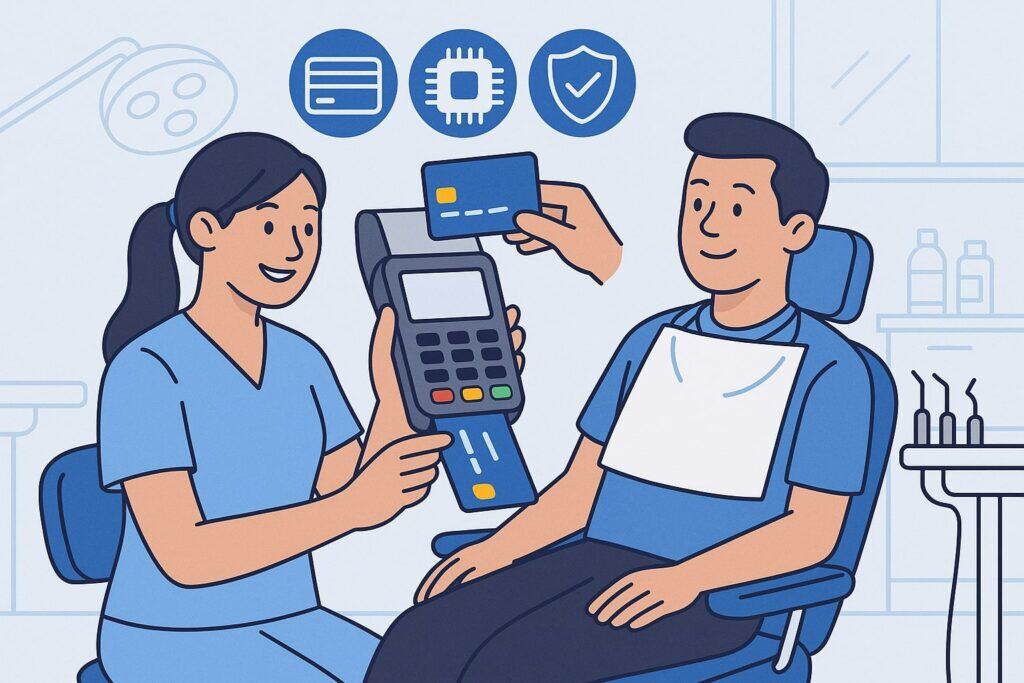
When a patient inserts their chip card at your dental front desk terminal, the device and card perform a secure “handshake.” The chip generates a unique cryptogram—a kind of digital signature—for that specific purchase.
Even if a criminal somehow captured that data, it cannot be reused to create another valid transaction. This is a core reason EMV compliance has significantly reduced counterfeit card fraud in the U.S. card-present environment.
In contrast, a magstripe stores static card data, such as the card number and expiration date, that can be copied and cloned relatively easily. Older dental office terminals that only support swiping provide an easier path for fraudsters to use counterfeit cards.
If your practice still uses a swipe-only reader, you are not fully EMV compliant and you’re taking on unnecessary risk with every in-office payment.
From a workflow perspective, EMV cards can be used by insertion, tap-to-pay (contactless EMV), or in some cases by mobile wallets like Apple Pay and Google Pay that rely on EMV-like tokenization.
For a dental practice, offering these methods is convenient for patients and keeps your office aligned with modern retail experiences they have everywhere else. Proper EMV compliance also means your staff know when to insert, tap, or manually key-enter a card, and they understand that keying card numbers should be a last resort.
It’s also important to recognize that EMV compliance is separate from PCI DSS compliance. EMV focuses on the security of the card-present transaction using chip technology, while PCI DSS (Payment Card Industry Data Security Standard) governs how card data is stored, processed, and transmitted across your systems.
A modern dental office should care about both: EMV for secure card acceptance at the front desk and PCI controls for any systems that handle card numbers, whether it’s your practice management software, payment gateway, or online patient portal.
When your dental practice invests in EMV-capable hardware and an EMV-certified processing solution, you are baking security directly into your everyday transactions.
Combined with PCI-aware workflows and staff training, EMV compliance helps you build a payment environment that is significantly more resistant to in-office fraud, card skimming, and costly disputes.
The Risk of Non-Compliance for Dental Practices

Remaining non-compliant with EMV standards exposes dental practices to financial, legal, and reputational risks. Even if you have never experienced a chargeback or a dispute, the risk profile of a non-EMV-compliant environment grows as card fraud becomes more sophisticated.
When criminals look for places to use stolen or counterfeit cards, they often target businesses with outdated terminals, because they know the liability will fall on that business.
The most immediate risk of ignoring EMV compliance is increased exposure to card-present fraud. If a fraudster presents a counterfeit chip card, and your office runs it by swiping the magnetic stripe (or by manually keying the number), your practice may be held financially responsible for the loss.
These losses can include the transaction amount, chargeback fees from your processor, and internal time spent dealing with the dispute.
Over time, repeated chargebacks can damage your merchant account standing. Payment processors evaluate your chargeback ratio as part of their risk management.
If your dental office experiences too many disputes, your processor may impose higher fees, place rolling reserves on your account, or, in extreme cases, terminate your processing relationship. Trying to find a new provider when you have a high-risk history can be difficult and more expensive.
Non-compliance with EMV can also intersect with PCI DSS risk. While EMV itself does not guarantee PCI compliance, offices that ignore EMV often overlook other security best practices as well.
For example, staff might write down card numbers on paper, store card info in unsecured notes within your practice management system, or allow patients to read card numbers aloud in public waiting areas. Over time, these habits increase the odds of data exposure or card theft originating from your office.
There is also a significant reputation risk. In a healthcare-oriented business like dentistry, patient trust is everything.
If a patient’s card is compromised and they suspect it happened at your office—especially if they remember you swiping their chip card or manually typing in their number—their confidence in your practice can erode quickly. They may hesitate to schedule future treatment plans or recommend you to friends and family.
Finally, the risk of non-compliance is cumulative. Each month you continue without EMV compliance, you process more transactions in a weaker security environment.
Because fraud and chargebacks can be retroactive, a single pattern of fraudulent activity or a data breach can suddenly impact months of prior transactions. Migrating to EMV does not erase past exposures, but it significantly limits future risk going forward. For a dental practice with thin margins and tight schedules, that reduction in risk is critical.
How EMV Compliance Reduces Fraud and Chargebacks in Dentistry

For dental practices, one of the most compelling reasons to prioritize EMV compliance is the proven reduction in fraud and chargebacks across card-present transactions. EMV technology is explicitly designed to combat counterfeit card use at your front desk, and by using it correctly, you shrink the opportunities for fraudsters to succeed.
When a patient inserts a chip card into an EMV-enabled terminal, the chip creates a unique transaction code that cannot be reused. This dynamic data makes it extremely difficult for criminals to clone the card and use it again at another location.
Since EMV rollout across U.S. merchants, card brands have reported significant declines in card-present counterfeit fraud. For healthcare and dental providers, that trend translates into fewer fraudulent charges passing through your merchant account.
EMV compliance also helps you during the chargeback process. Many disputes arise when cardholders claim they did not authorize a transaction. If the card was stolen or cloned and your office processed it by swiping instead of dipping the chip, the liability typically shifts to you.
However, if you processed the card with a fully EMV-compliant chip transaction, the liability is more likely to stay with the card issuer, provided you followed the proper procedures and obtained authorization.
Dental offices also face “friendly fraud,” where a patient or guarantor disputes a valid charge because they do not recognize the transaction or are unhappy with the treatment outcome or insurance coverage. While EMV technology cannot fully prevent friendly fraud, chip transactions provide stronger evidence that the card was physically present in your office.
Combined with signed treatment plans, consent forms, and appointment records, an EMV-based transaction can strengthen your case when you respond to a chargeback.
In addition, EMV terminals often support additional security features like PIN entry, AVS (Address Verification Service) for certain transactions, and CVV capture (for card-not-present scenarios such as phone payments).
While PIN is more common with debit transactions, having EMV-capable devices that support these features gives you more tools to authenticate cardholders and reduce fraud risk across different payment flows.
Over time, this reduction in fraud and chargebacks can lead to tangible savings. You spend less time responding to disputes, assembling documentation, and working with your processor’s chargeback team.
You avoid the hidden costs of staff stress and administrative overhead tied to payment problems. By embracing EMV compliance, your dental practice can keep more of its hard-earned revenue, maintain stable processing fees, and focus on delivering care rather than fighting fraud.
EMV Compliance and Patient Trust in Dental Offices
Patients may not use the term EMV compliance, but they absolutely notice how you handle their payments. In a modern U.S. consumer environment, most people are used to dipping or tapping cards at supermarkets, pharmacies, and big-box retailers.
When they walk into a dental office and see similar, secure payment experiences, it reinforces the perception that your practice is professional and up to date.
Trust in dentistry is built through many touchpoints: clean operatories, clear communication, compassionate staff, and evidence-based treatment plans. Your payment process is one more touchpoint. When a patient hands over their card, they want to feel that the transaction is handled smoothly and securely.
Using an EMV-capable terminal, minimizing manual data entry, and offering receipts via email or text are all small signals that your office respects their financial information.
EMV compliance helps you avoid awkward or unsettling moments at the front desk. If your terminal repeatedly declines chip transactions and your staff asks to swipe instead, patients may worry about whether their card is at risk.
They may also associate technical glitches with overall disorganization. By keeping your EMV terminals updated, tested, and integrated with your practice management system, you create a frictionless checkout experience that inspires confidence.
Patients who have experienced card fraud elsewhere are often more sensitive to payment security. If they know a friend whose card number was stolen at a healthcare provider, or if they’ve dealt with unauthorized charges, they may actively look for signs of secure payment practices.
Explaining that your office uses EMV-compliant technology and tokenized recurring billing can be a positive talking point when discussing payment plans or automatic card-on-file arrangements.
In group practices and multi-location dental organizations, consistent EMV compliance also supports brand trust. A patient who visits one location and sees secure chip readers and modern payment workflows expects the same at all locations.
Standardizing EMV-compliant hardware and policies across your organization helps you deliver a reliable, predictable experience that encourages loyalty and referrals.
Ultimately, patient trust extends beyond clinical outcomes. When you show that you are serious about EMV compliance, PCI-aware workflows, and general payment security, you reinforce your commitment to protecting patients in every dimension—health, privacy, and financial safety.
That holistic sense of professionalism can differentiate your practice in a competitive local market.
Legal and Regulatory Considerations for EMV in Healthcare Payments
While EMV compliance itself is not a law in the United States, it intersects with several regulatory and industry frameworks that matter for dental practices. Understanding this landscape can help you align your payment security strategy with your broader compliance obligations.
First, there is HIPAA (Health Insurance Portability and Accountability Act), which governs the protection of protected health information (PHI). Credit card numbers are not considered PHI by themselves, but they may be connected to patient identifiers within your practice management or billing systems.
If your office stores card data alongside clinical notes or patient records, you must ensure that the environment is protected as part of your HIPAA security program. EMV terminals that keep card data segmented from your internal network help reduce this risk.
Second, there is PCI DSS (Payment Card Industry Data Security Standard), which applies to any merchant that stores, processes, or transmits cardholder data. As a dental office accepting card payments, you are considered a merchant and must follow PCI requirements appropriate for your environment and transaction volume.
Using EMV-compliant terminals and keeping card data out of your systems as much as possible can simplify your PCI scope and reduce the number of controls you need to manage.
Card brands and processors may also have their own EMV, encryption, and tokenization requirements. For example, your merchant agreement may specify that you must use EMV-capable hardware and follow certain procedures for card-present transactions.
If you ignore these requirements, you could be in breach of your merchant contract, which can affect your rights during chargeback disputes or in the event of a security incident.
From a liability standpoint, EMV compliance plays a central role in who is responsible when counterfeit card fraud occurs. Although the EMV liability shift is driven by card brands rather than statute, it has real financial implications.
If your practice has the more secure technology (EMV) and uses it correctly, you are less likely to be held responsible for counterfeit fraud. If you have not upgraded, or if your staff bypasses EMV features, the liability may shift to you.
Dentists should also pay attention to state-level data breach notification laws. If card data is compromised due to weak security or mishandling inside your office, you may have obligations to notify affected patients, regulators, and possibly the media, depending on the size and scope of the incident.
While EMV does not eliminate all types of data breaches, it is a key part of a layered security approach that reduces the chance of card data compromise at the point of sale.
By approaching EMV compliance as part of a broader compliance strategy—including HIPAA, PCI DSS, and state privacy laws—you can build a more resilient payment environment.
Collaborating with a payment processor that understands healthcare can help you interpret these requirements and implement practical safeguards that fit your dental workflow and risk profile.
Choosing EMV-Capable Terminals and POS Systems for Dentists
Selecting the right payment hardware and software is essential for effective EMV compliance in a dental office. Your choice of EMV-capable terminals and point-of-sale (POS) or practice management integrations will affect everything from front desk efficiency to reporting and reconciliation.
Start by evaluating your practice management system (PMS). Many dental PMS platforms offer integrated payment solutions or certified partners that support EMV.
Integration allows you to post payments directly to patient ledgers, automate receipts, and manage recurring billing more efficiently. When possible, choose an EMV-capable payment solution that integrates with your existing PMS rather than piecing together separate systems that require double data entry.
Next, consider the type of EMV hardware that fits your operational style. Common choices for dental practices include countertop terminals, stand-alone EMV pin pads connected to your PMS workstation, and mobile EMV readers for satellite clinics or in-office payment flexibility.
Look for devices that support chip, contactless (NFC), and magstripe as a backup, but ensure your workflow prioritizes chip and contactless to stay fully EMV compliant.
Ease of use is critical for your team. Your EMV terminal should have a clear display, simple prompts, and a fast processing time. Confusing interfaces increase the chances that staff will accidentally bypass EMV features or select the wrong transaction type.
During demos, ask vendors to show exactly how a typical patient payment flows—from treatment posting to chip card insertion, to receipt delivery and reconciliation.
Security features are another key factor. Modern EMV devices often include end-to-end encryption (E2EE) and tokenization to protect card data from the moment of capture.
Ask your payment provider whether your EMV solution encrypts card data immediately at the terminal and whether it tokenizes stored cards for recurring payments. These features complement EMV compliance by reducing the chances of card data exposure inside your network.
Lastly, consider support, updates, and certifications. EMV standards evolve, and card brands sometimes introduce new requirements for contactless payments, PIN preferences, or offline authorizations.
Your payment provider should handle necessary software updates and provide documentation that your terminals and processing platform are EMV certified. Reliable U.S.-based support is important when your front desk needs quick help with terminal issues that can disrupt patient flow.
By choosing EMV-capable hardware and POS or PMS integrations thoughtfully, your dental practice can ensure that EMV compliance supports staff efficiency, patient experience, and security instead of being a burden. The right solution should feel like a natural extension of your existing workflow, not an extra step that slows everyone down.
Practical Steps to Achieve EMV Compliance in a Dental Office
Moving your dental practice toward full EMV compliance is a step-by-step process, but it is manageable with a clear plan. Whether you are upgrading from swipe-only terminals or replacing a dated EMV device, you can treat the transition like any other technology improvement in your office.
First, perform a payment technology audit. Identify all the ways you accept card payments: front desk terminals, mobile readers, online payment links, recurring billing, and any third-party portals.
Note which devices are EMV-capable and which are not. Check with your processor or vendor to confirm whether your current terminals are properly certified for EMV and whether they are configured correctly.
Second, work with your payment processor or merchant services provider to design an upgrade path. This may involve purchasing or leasing new EMV-capable terminals, enabling EMV features on existing hardware, or integrating a new payment platform with your practice management system.
Ask for clear documentation that your solution is EMV certified and supports chip and contactless transactions.
Third, update your office payment policies and procedures. Clearly state that the default method for card-present payments is chip or contactless, and swiping should only be allowed when EMV is not possible (for example, with non-chip cards).
Define when it is acceptable to key-enter card numbers, such as for phone payments, and ensure staff understand the higher risk and cost associated with non-EMV transactions.
Fourth, invest in staff training. EMV compliance is not just a hardware switch; it is a behavioral change. Train front desk staff on how to run EMV transactions, how to handle declined chip reads, and when to ask the patient to try another card.
Emphasize that staff should never bypass chip transactions just to speed up a line. Provide simple job aids, like quick-reference cards near each terminal, to reinforce the correct steps.
Fifth, test your EMV implementation thoroughly before going live. Run trial transactions, confirm that payments are correctly posted to patient ledgers, and verify that receipts are accurate. Monitor your first few weeks of EMV-based processing closely and ask staff to report any recurring issues so you can adjust workflows.
Finally, build EMV compliance into your ongoing technology maintenance. Keep track of terminal firmware updates, PCI compliance questionnaires, and any notices from your processor about EMV or security changes.
Periodically review your chargeback activity to see whether EMV is helping reduce in-office fraud and disputes, and adjust your policies as needed.
By following these practical steps, you transform EMV compliance from an abstract concept into concrete actions that improve payment security and efficiency in your dental office.
Integrating EMV Compliance with Recurring Billing and Payment Plans
Many dental practices rely on recurring billing, payment plans, and card-on-file arrangements to help patients manage larger treatment costs. When you adopt EMV compliance, it’s important to align your recurring payment strategy with secure, modern practices so you can protect both your patients and your revenue.
The first step is to capture card data securely at the point of sale using an EMV-compliant terminal that supports tokenization.
Instead of storing the actual card number in your practice management system or on paper, your payment gateway can convert it into a token—an encrypted identifier that can be used for future charges but cannot be reverse-engineered into the original card number. This approach dramatically reduces your PCI scope and improves overall security.
When setting up a payment plan, your staff can have the patient insert or tap their card on the EMV device during the initial visit. The gateway generates a token, which your PMS or payment portal uses to schedule automatic charges over the duration of the plan.
Each subsequent payment is processed using the token, not by retyping or swiping the card. This combines the security of EMV at the first capture with the convenience of automated billing.
Clear communication is essential. Explain to patients that your office uses EMV-compliant technology and tokenized card-on-file to protect their payment information.
Provide a written or digital agreement outlining the payment schedule, amounts, and the card that will be charged. This transparency reduces misunderstandings and lowers the risk of friendly fraud chargebacks later on.
EMV compliance also matters when patients update their cards, for example after a card expiration or reissue. Whenever possible, have patients present the new card in person so you can capture it again through an EMV-capable terminal and generate a fresh token.
Avoid asking patients to email card numbers or share them in unsecured channels. For remote updates, use secure online forms or patient portals provided by your payment or PMS vendor.
By aligning EMV compliance with your recurring billing workflows, you create a consistent security posture across all payment types.
You reduce the chances of card data exposure, lower your PCI burden, and make it easier for patients to say yes to treatment plans because they know their financial information is handled professionally and securely.
Staff Training and Best Practices for EMV in Dental Settings
Even the best technology cannot deliver full EMV compliance without well-trained staff. Front desk team members, treatment coordinators, and office managers all play a role in making sure your EMV processes are followed consistently in everyday situations.
Start with basic EMV education. Teach staff what EMV is, why chip cards are more secure, and how EMV compliance protects the practice from fraud and chargebacks. When team members understand the “why,” they are more likely to follow the “how” even when the office is busy or a patient is in a hurry.
Next, provide hands-on training with your EMV terminals. Walk through step-by-step scenarios, including standard chip transactions, contactless payments, and what to do if the chip cannot be read.
Emphasize that staff should not automatically switch to swiping or key-entering the card when there is a problem; instead, they should try another card, restart the terminal if needed, or contact support if issues persist.
Develop standard operating procedures (SOPs) for common situations:
- Handling partial approvals and split payments
- Accepting card payments over the phone (card-not-present)
- Setting up card-on-file for recurring billing
- Managing refunds and adjustments
Each SOP should reference EMV-compliant methods wherever applicable and highlight the higher risk of non-EMV transactions, particularly for card-not-present payments.
Encourage staff to be proactive in patient communication. When a patient asks why they must insert or tap instead of swipe, staff should be able to explain, in simple language, that EMV compliance is designed to protect the patient’s card from fraud. This reinforces trust and helps patients understand that any extra step is for their benefit.
Regular refresher training is also important. As your payment system evolves, new features or requirements may appear, such as updated contactless limits, new card brand rules, or revised PCI forms.
Schedule periodic check-ins to review EMV workflows, share updates from your processor, and address any recurring issues or questions.
By investing in staff training and reinforcing best practices, you make EMV compliance a natural part of your office culture. This not only strengthens security but also improves efficiency, reduces mistakes, and ensures that every patient encounter—including payment—is handled with professionalism.
Common EMV Mistakes Dental Offices Should Avoid
As dental practices adopt EMV compliance, certain mistakes tend to appear repeatedly. Being aware of these pitfalls can help you avoid unnecessary risk and frustration as you modernize your payment environment.
One common issue is continuing to swipe chip cards out of habit. Even after upgrading to EMV-capable terminals, some staff members may default to swiping because it feels faster or more familiar.
This undermines EMV compliance and can shift fraud liability back onto your practice. The best practice is simple: if the card has a chip, it should be inserted or tapped—not swiped—unless the chip is truly unreadable and other troubleshooting has failed.
Another mistake is ignoring terminal error messages or outdated firmware. EMV devices occasionally require software updates to stay aligned with card brand rules and security standards.
If your office repeatedly dismisses prompts to update or never schedules time for maintenance, your EMV compliance may weaken over time. Work with your payment provider to ensure that updates are installed promptly and that terminals are routinely checked.
Some practices mix EMV and non-EMV workflows inconsistently. For example, they may use EMV for some patients but still key-enter or swipe for others when they are busy.
This creates a patchwork of risk levels and makes it harder to track which transactions are protected. Committing to a consistent EMV-first policy across all card-present transactions is key.
A less obvious mistake is storing card data in insecure ways outside of your EMV and tokenization tools. Even if you use EMV for in-person transactions, your staff might jot down card numbers on treatment estimates, text them to each other, or store them in free-text notes within your PMS.
These habits can lead to data exposure and may violate PCI and privacy expectations. EMV compliance should be paired with a strict rule against writing down or storing raw card numbers.
Finally, some dental offices fail to monitor chargebacks and fraud trends after adopting EMV. They assume that once EMV terminals are installed, the work is done.
In reality, it is important to periodically review your chargeback reports, understand the reasons behind disputes, and adjust your policies accordingly. If you still see a pattern of card-present fraud, it may indicate that staff are bypassing EMV or that other vulnerabilities are present.
By recognizing and avoiding these common mistakes, your dental practice can get the full benefit of EMV compliance—stronger security, fewer disputes, and a more professional patient payment experience.
FAQs
Q.1: What is EMV compliance in a dental office?
Answer: EMV compliance in a dental office means using chip-enabled card readers and certified payment processing systems that support EMV standards for card-present transactions.
Instead of swiping magnetic stripes, your staff insert or tap chip cards, which generate unique transaction data that is difficult to counterfeit. EMV compliance also involves configuring your terminals correctly, following card brand rules, and training staff to use EMV features consistently.
Q.2: Is EMV compliance required by law for dentists in the US?
Answer: EMV compliance itself is not a specific law in the United States, but it is strongly encouraged and effectively enforced through the EMV liability shift and your merchant agreements.
If your dental practice does not adopt EMV and a counterfeit chip card is used at your office, you are more likely to be held financially responsible for the fraud. In practice, this makes EMV compliance a critical standard for protecting your business from losses and disputes, even if it is not formally written into statute.
Q.3: How does EMV compliance relate to PCI and HIPAA?
Answer: EMV compliance focuses on securing card-present transactions using chip technology, while PCI DSS governs how cardholder data is stored, processed, and transmitted, and HIPAA regulates protected health information.
All three can overlap in a dental environment. EMV reduces the risk of card fraud at the front desk, PCI helps you manage card data safely in your systems, and HIPAA protects clinical and personal patient information. A comprehensive security strategy for a dental practice should address all three areas.
Q.4: Do I still need EMV if I mainly bill insurance?
Answer: Yes. Even if insurance carriers pay the bulk of your fees, patients still pay copays, deductibles, and out-of-pocket balances by card. Those in-office transactions can be targets for fraud if you are not EMV compliant.
Additionally, many practices rely on payment plans and card-on-file for elective procedures, orthodontics, or cosmetic treatments. EMV compliance at the initial card capture and secure tokenization for recurring charges are essential for protecting these revenue streams.
Q.5: Is it expensive to become EMV compliant as a dentist?
Answer: The cost of achieving EMV compliance varies depending on your current setup, but it is typically manageable and often offset by reduced fraud and chargeback risk. Many processors provide EMV-capable terminals at low or no upfront cost as part of a merchant services agreement.
The bigger investment is often in choosing integrated solutions, training staff, and updating workflows. Over time, the cost of ignoring EMV—including potential chargebacks, higher risk fees, and reputational damage—can far exceed the cost of upgrading.
Conclusion
For U.S. dental practices, EMV compliance is no longer an optional upgrade or a retail-only concern. It is a practical, everyday way to protect patient payments, reduce fraud, avoid costly chargebacks, and reinforce the trust you work hard to earn in the operatory.
As patients increasingly expect chip and contactless payments everywhere they go, your approach to EMV compliance becomes part of your overall patient experience.
By understanding EMV technology, assessing the risks of non-compliance, and selecting the right EMV-capable terminals and integrated solutions, you can bring your payment environment up to modern standards.
Layering EMV with PCI-aware policies, HIPAA-aligned data protection, and clear staff training ensures that security is built into your workflows rather than bolted on as an afterthought.
Ultimately, embracing EMV compliance is about more than avoiding fraud. It signals that your dental office takes every aspect of patient care seriously—from clinical quality to financial safety.
When patients see that their card data is handled with the same care as their health information, they are more likely to trust your recommendations, commit to treatment plans, and refer your practice to others.
Making EMV compliance part of your standard of care is a smart, forward-looking move for any dentist who wants a secure, efficient, and patient-friendly practice in today’s U.S. payment landscape.