By Adamaa Grover January 25, 2026
Dental payment processing fees can feel confusing because they’re not “one fee.” They’re a stack of costs—some set by card networks and issuing banks, some set by your processor, and some created by the way your front desk collects payments.
When you understand what drives dental payment processing fees, you can usually reduce them without disrupting patient experience.
This guide breaks down dental payment processing fees in plain language, shows the most common pricing models, explains why dental transactions price differently than retail, and shares practical ways to lower your effective rate while staying compliant and patient-friendly.
It also includes future predictions on where dental payment processing fees are heading as instant payments and new security standards reshape the industry.
What “Dental Payment Processing Fees” Really Mean in a Dental Office
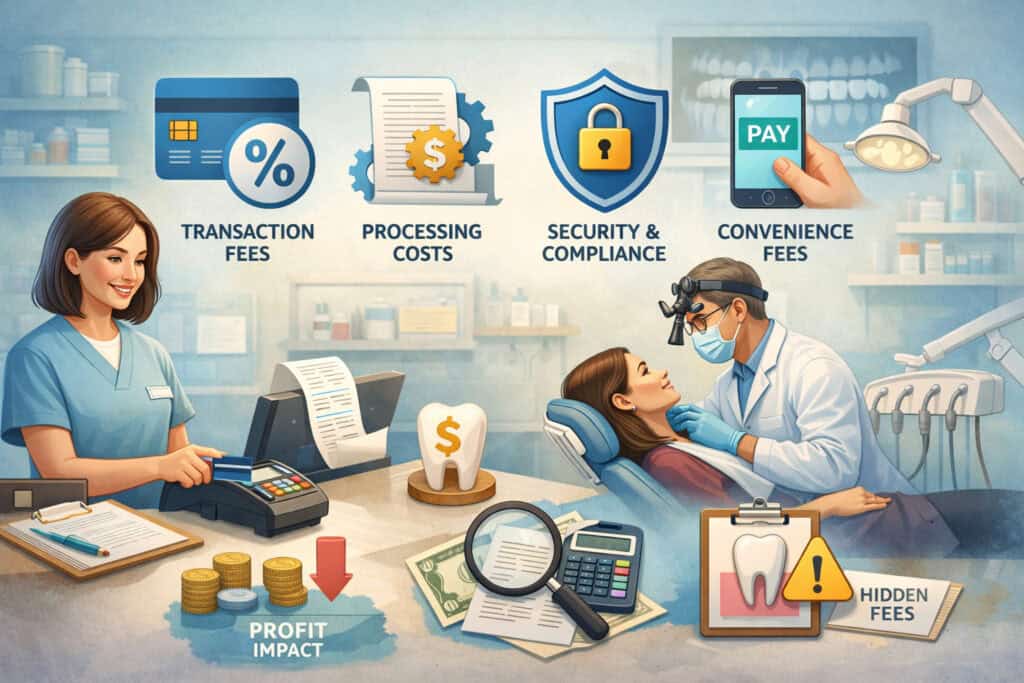
Dental payment processing fees are the total costs a practice pays to accept card and digital payments. In a dental office, those fees are influenced by the payment channel (in-person terminal, online portal, text-to-pay, stored card on file, recurring plan), the card type (debit, credit, rewards, business/commercial), and the data you send with the transaction (security and verification details).
Most practices see fees as a single percentage, but behind the scenes the cost is made of multiple layers. The largest layer is typically interchange, which varies by card category and how the transaction is processed.
Then come network assessments (small fees charged by the card networks). Finally, your processor adds markup for providing the merchant account, risk monitoring, customer support, and the technology that routes transactions.
Dental payment processing fees can also rise because dental practices frequently accept “card-not-present” payments—over the phone, through patient portals, or via recurring payment plans.
Those are generally priced higher than chip transactions because fraud risk is statistically higher when a card is not physically present. Even if your practice is low-risk clinically, payment risk is judged by transaction signals.
The Three Core Layers of Dental Payment Processing Fees

Dental payment processing fees usually break into three layers: interchange, assessments, and processor markup. If you don’t separate these layers, you can’t accurately compare quotes or understand why your fees changed month to month.
Interchange is the portion largely set by the issuing bank and card program. It changes based on factors like card type, how the transaction is captured (chip vs keyed), and transaction qualifiers (like AVS for keyed payments).
Interchange categories are published by the networks and updated periodically, which is why your dental payment processing fees can change even when your processor doesn’t change anything. Mastercard publishes detailed U.S. interchange program bulletins that show how varied these rates can be across card types and programs.
Assessments (also called network fees) are charged by card networks for using their rails. These are usually smaller than interchange, but they add up, and some are triggered by how you batch transactions or whether your transactions are card-present or card-not-present.
Processor markup is what your processor adds. This is the only layer you can negotiate directly. Markup may include a percentage, a per-transaction fee, monthly account fees, gateway fees, PCI/security fees, statement fees, and optional features like text-to-pay or patient financing integrations.
When you’re trying to reduce dental payment processing fees, most of your leverage is in (1) lowering avoidable “non-ideal” transaction types (like keyed when you could do tap) and (2) improving your processor markup structure so you’re not paying extra hidden fees that inflate the effective rate.
Why Dental Practices Often Pay Higher Processing Fees Than You Expect

Dental payment processing fees can land higher than a practice owner expects because dentistry blends retail, recurring billing, and healthcare-style payment patterns—especially after insurance adjustments.
Here are the biggest reasons dental payment processing fees can spike in dentistry:
1) More card-not-present transactions: Many dental offices take deposits by phone, collect balances via portal links, or run cards on file after insurance posts. These are often keyed or e-commerce transactions, which typically cost more than EMV chip or tap transactions.
2) Larger ticket sizes: Higher average tickets raise risk exposure for the payment ecosystem. Even if your chargeback rate is low, higher tickets can trigger more cautious risk settings from processors.
3) Split-tender and partial payments: Dental patients often pay part today and part later, or use multiple payment methods. This can increase transaction count, which increases per-item costs.
4) Rewards and premium cards: Patients frequently use high-rewards consumer cards, and those tend to carry higher interchange. If your patient base skews toward rewards cards, your blended dental payment processing fees will naturally rise.
5) Manual entry and inconsistent data: If front desk staff key transactions without AVS, fail to capture CVV when allowed, or use a terminal configuration that downgrades transactions, the practice may fall into more expensive categories.
A practice doesn’t need to become “payments obsessed” to fix this. You mainly need a consistent patient payment workflow: encourage tap/chip in person, use secure online links for remote payments, and use tokenized card-on-file tools rather than raw manual entry whenever possible.
Dental Merchant Account Pricing Models and How They Affect Your Effective Rate
Dental payment processing fees depend heavily on the pricing model your provider uses. Two practices with identical patient volume can pay very different fees if one is on a transparent model and the other is on a bundled model full of padded margins.
Interchange-plus pricing separates costs: you pay interchange + assessments (pass-through) plus a clear processor markup. This is often the easiest model to audit because you can see the markup and compare it against the market. For practices that want long-term cost control and transparency, interchange-plus often aligns well.
Tiered pricing groups transactions into “qualified / mid-qualified / non-qualified” buckets. Tiered pricing can look simple, but it’s usually harder to predict, and many common dental transactions (keyed, card-not-present, rewards) fall into more expensive tiers. That can inflate dental payment processing fees without making it obvious why.
Flat-rate pricing (common with some payment facilitators) charges one rate for most cards. It’s convenient, but if your average ticket is higher or your mix includes a lot of debit, flat-rate can be more expensive than interchange-plus.
Cash-discount or dual-pricing programs attempt to offset dental payment processing fees by adjusting pricing based on payment method. These programs require careful compliance, clear signage, and patient-friendly messaging. If implemented poorly, they can create patient friction or compliance issues.
If your goal is to reduce dental payment processing fees without upsetting patients, start by demanding clarity: a statement that shows effective rate, transaction counts, average ticket, card-present vs card-not-present mix, and a pricing structure you can actually verify.
The Dental Transaction Types That Change Fees the Most
Not all dental payments are priced the same. The single biggest driver of dental payment processing fees is transaction type—how the card is accepted and what security signals are included.
- In-person tap/chip (card-present EMV): Usually the most cost-effective card acceptance method. Tap and chip transactions provide strong authentication signals, reducing fraud risk and typically improving pricing categories.
- Keyed-in transactions (manual entry): Common for phone payments, but generally higher cost and higher risk. If you must key a card, using Address Verification Service (AVS) where applicable helps reduce fraud risk signals, and it can also reduce certain downgrade scenarios. (Exact pricing effects depend on the network and card type.)
- Online portal and pay-by-link (e-commerce): These can be priced similarly to keyed or e-commerce transactions, but they’re usually safer than staff-keyed transactions because the patient enters the card, and the flow can include modern security checks.
If your practice does many remote collections, a secure pay-by-link system can reduce both dental payment processing fees and chargeback risk compared with taking card numbers over the phone. - Stored card on file (tokenized): Tokenization is crucial. When you store cards for payment plans or to run the patient portion after insurance posts, tokenized vaulting reduces your exposure and usually improves operational success rates.
It can also reduce compliance burden because you’re not storing sensitive card data inside your practice systems. - Recurring payments (membership plans): Dental membership plans and subscription-style preventive care can create stable revenue, but recurring payments may have different cost characteristics.
The important part is to process recurring payments in a way that uses the right “recurring” indicators and tokenization, so you don’t accidentally run them like generic keyed transactions.
To reduce dental payment processing fees, map your payment flows. Count how many transactions are chip/tap versus keyed/portal/recurring. Shifting even 15–25% of transactions from manual entry to secure link or terminal-present can noticeably improve the blended effective rate.
Hidden and “Non-Processing” Fees That Inflate Dental Payment Processing Fees
When practices complain about dental payment processing fees, the culprit is often not interchange. It’s the add-ons: monthly fees, vague compliance charges, and stacked technology costs that don’t show up in the headline rate.
Common fee categories to watch:
- PCI and security program fees: Compliance is real, but the way it’s billed varies widely. There may be monthly “PCI program” fees, annual compliance fees, or non-compliance penalties.
PCI DSS 4.0 became the active standard and the industry transition timelines have been widely discussed, including movement from earlier versions and additional requirements becoming mandatory after transition periods. - Gateway and virtual terminal fees: If your practice uses a payment gateway for patient portals, text-to-pay, or online receipts, you may see monthly gateway fees and per-transaction gateway fees. These can quietly add up, especially for higher transaction counts.
- Batch fees and statement fees: Small individually, significant over time. Some providers charge fees for daily settlement batches or paper statements.
- Chargeback fees: Dentistry tends to have low chargeback rates when policies are clear, but when they occur, chargeback handling fees can be high. Make sure you have written authorization for stored credentials and post-insurance billing.
- Equipment lease costs: Leasing terminals is often far more expensive than purchasing. Leases can lock you into multi-year obligations that dwarf any savings from switching processing rates.
The best way to control dental payment processing fees is to measure your total cost of acceptance: not just the percentage rate, but also monthly fixed fees, per-transaction fees, gateway costs, and equipment costs.
Compliance and Patient-Friendly Fee Strategies: Surcharging, Cash Discount, and Dual Pricing
Some dental practices try to reduce dental payment processing fees by passing costs to patients through surcharging or offering cash discounts. This can work—but only if it’s compliant and communicated carefully.
Card network rules distinguish surcharging (adding a fee for using a card) from a cash discount (offering a discount for paying with cash or another method). Visa’s merchant surcharging guidance explains compliance expectations and also notes potential fines for improper surcharging.
Important practical realities for dental offices:
- Patient trust matters: Dentistry is high-trust and relationship-driven. A surprise fee at checkout can create complaints or negative reviews. If you use differential pricing, you need clear signage, consistent scripts, and an approach that feels fair.
- State and local rules vary: Differential pricing laws and disclosure requirements can vary. That means what works in one state might require adjustments in another. If you operate multiple locations, compliance must be consistent.
Dual pricing and cash discount programs can reduce dental payment processing fees substantially, but they must be set up correctly in your point-of-sale flow so the displayed price and final price match what your signage and receipts say. Many “done-for-you” programs exist, but quality varies.
If you want to reduce dental payment processing fees without creating friction, many practices instead focus on shifting payment mix: enabling ACH for large balances, encouraging debit for smaller balances, and using secure links instead of phone-keyed transactions.
How to Lower Dental Payment Processing Fees Without Hurting Collections
Reducing dental payment processing fees should not reduce your collection rate. The best strategies usually improve both cost and collections by making payments easier and more consistent.
1) Make card-present the default for in-office payments: Train staff to use tap/chip as the standard. Keep the terminal positioned so the patient can easily tap. This reduces keyed transactions that inflate dental payment processing fees.
2) Replace phone payments with secure links: Instead of taking card numbers by phone, send a secure pay-by-link text or email. This reduces staff handling of card data, improves security signals, and reduces compliance exposure.
3) Use a tokenized card on file with clear consent: When you plan to charge after insurance posts, obtain written authorization and store the payment method via tokenization. This reduces “payment chasing” and lowers the chance of disputes.
4) Offer ACH for large balances: Many patients are willing to use bank transfer for large treatment plans if it’s simple. Even modest adoption can lower blended dental payment processing fees because ACH often costs less than card acceptance for high tickets.
5) Audit downgrades and data quality: Ask your provider for a downgrade report or transaction qualification analysis. If your terminal configuration or gateway settings are missing recommended data fields, you may be paying avoidable costs.
6) Negotiate markup, not just headline rate: For transparent pricing, focus on processor markup (basis points + per-item) and fixed monthly fees. The goal is to reduce total cost without adding hidden charges that come back later.
The best approach is incremental: pick two changes, implement, measure your effective rate for 60–90 days, then optimize again.
Payment Technology Trends That Will Influence Dental Payment Processing Fees
Dental payment processing fees won’t stay static. Security standards, instant payments, and evolving network economics are actively reshaping what practices pay and how they get paid.
- PCI security changes will continue to tighten: PCI DSS has moved forward with updates and supporting documents, including PCI DSS v4.0.1 publications and related materials from the PCI Security Standards Council library.
This matters because compliance obligations often push practices toward tokenization, hosted payment pages, and modern terminals—tools that can reduce risk but may introduce new platform fees. Expect more processors to bundle “security suites” into monthly packages. - Instant payments will expand: Instant payment rails are growing, and the Federal Reserve has highlighted adoption and ongoing growth of its instant payments service over time.
As instant bank payments become more common, dental practices may shift some high-ticket patient balances away from cards, lowering dental payment processing fees—especially for larger treatment plans—while improving cash flow timing. - Card fee pressure may shift, but not disappear: Reporting in major financial outlets has discussed proposed settlements and ongoing legal and market pressure around interchange and acceptance rules, potentially affecting fees and merchant flexibility if approved.
Even if interchange pressure reduces some categories over time, card economics also tends to evolve toward new fee types rather than simply shrinking. Dental practices should plan for a mixed world: cards remain dominant, but bank-based and account-to-account options grow.
The practical “future-proof” move: build a checkout stack that supports cards, ACH, and instant-pay options, and prioritize tokenization and hosted payment collection to control security cost and risk.
Dental Billing Workflows That Reduce Fees: Insurance Posting, Patient Portion, and Membership Plans
Dental payment processing fees are deeply tied to billing workflow. Dentistry is unique because the final patient portion often becomes clear after insurance adjudication, which creates delayed billing and card-on-file needs.
- Insurance posting and delayed patient billing: If you wait to collect until insurance finalizes, you’ll often charge a card later. If you do it by manual entry, fees rise and disputes become more likely (“I didn’t authorize that”).
If you do it through a tokenized stored credential with signed consent, you improve authorization strength and reduce operational risk. - Pre-authorizations vs deposits: Some practices collect deposits for high-dollar procedures. Collecting deposits in person with tap/chip reduces dental payment processing fees compared to taking deposits by phone. If you need remote deposits, use a secure link.
- Dental membership plans: Membership plans can stabilize revenue and reduce reliance on insurance. But recurring payments must be set up correctly. Use a system that flags transactions properly as recurring and uses tokenization. Also, keep retry logic patient-friendly to reduce declines and staff workload.
- Split tender and financing: Many patients prefer monthly payment plans. If you offer ACH autopay as an option alongside card autopay, you can reduce dental payment processing fees on the portion of patients who choose bank payments. Even if only a minority adopt ACH, the savings can be meaningful on high-ticket care.
If you want lower dental payment processing fees, don’t start by renegotiating rates. Start by fixing the payment workflow so your transactions qualify for the lowest practical cost categories while still meeting your collection goals.
FAQs
Q.1: What is a normal range for dental payment processing fees?
Answer: A “normal” range depends on your mix of debit vs credit, card-present vs card-not-present, average ticket size, and pricing model.
Many dental practices see blended effective rates in the low-to-mid single digits when card payments dominate, but the exact outcome varies widely because rewards cards and card-not-present payments tend to cost more than debit and chip/tap.
The best benchmark is your effective rate: total processing cost divided by total card volume for the month. Track it for three months, then optimize based on what’s driving the number up—often keyed transactions, premium card mix, and stacked monthly fees.
Q.2: Why did my dental payment processing fees go up even though my provider didn’t change my rate?
Answer: Dental payment processing fees can rise because interchange and network costs change periodically, and because your transaction mix changes. If more patients used premium rewards cards, or if your office took more phone payments or sent more payment links, your blended fees can rise.
Card network interchange programs are updated over time, and published interchange documentation shows how many categories exist and how rates differ by program. Ask your provider for a month-over-month comparison of card-present vs card-not-present volume, keyed percentage, and average ticket.
Q.3: Are patient portal payments more expensive than in-office payments?
Answer: Often, yes—portal payments are typically treated as e-commerce/card-not-present, which can carry higher costs than in-person chip/tap. However, portal payments can still be a better choice than phone-keyed transactions because they reduce manual handling of card data and can improve security.
If you want to reduce dental payment processing fees while keeping portal convenience, use tokenization, hosted payment pages, and modern authentication features offered by your gateway.
Q.4: Can a dental office add a surcharge to cover card fees?
Answer: Sometimes, but it must be done correctly. Card network rules and state/local rules can apply, and disclosure requirements matter. Visa’s guidance discusses surcharging rules and potential consequences for improper surcharging.
Many practices choose alternatives like offering ACH for large balances, using cash discounts, or improving workflow to reduce the underlying dental payment processing fees instead of adding fees at checkout.
Q.5: How can I reduce dental payment processing fees for big treatment plans?
Answer: For high-ticket plans, the most effective lever is offering an easy bank-payment option (ACH or instant payments where available) and using clear payment plan policies.
Even partial adoption can reduce blended dental payment processing fees because cards are usually the most expensive method for large tickets. Pair bank payments with patient-friendly automation (text/email reminders, simple authorization flows) to keep collection rates strong.
Q.6: Will instant payments reduce dental payment processing fees in the future?
Answer: They can, especially for larger patient balances. Instant payment services have been expanding, and adoption growth has been highlighted by the Federal Reserve over time.
The likely future is hybrid: cards remain common for convenience, while bank-based options grow for high-dollar bills and recurring plans. Practices that offer both will have more leverage to control dental payment processing fees.
Conclusion
Dental payment processing fees are manageable when you treat them as a system: transaction type + card mix + pricing model + compliance costs.
The biggest savings usually come from reducing avoidable high-cost transactions (like manual entry), building a consistent patient payment flow (tap/chip in office, secure links for remote, tokenized card on file with consent), and switching to transparent pricing so you can see exactly what you’re paying.
In the near future, expect dental payment processing fees to be shaped by stricter security expectations (PCI updates and enforcement), expanding instant bank payment options, and continued pressure on card fee economics.
The dental practices that will win are the ones that make payments frictionless for patients while keeping the practice’s cost of acceptance predictable and auditable.