
Understanding average credit card processing fees for dental offices isn’t just about finding a “rate.” It’s about understanding why your effective cost lands where it does, what fee levers actually move the needle, and how dental workflows can raise or lower your real-world expense.
Most dental practices don’t pay a single flat percentage. Instead, your total cost is usually the combined result of (1) interchange (set by card issuers), (2) network assessments and fees (set by card brands), and (3) processor markup and platform fees (set by your provider). Visa and Mastercard publish rules and fee structures that influence how transactions qualify.
So when someone asks, “What are the average credit card processing fees for dental offices?” The best answer is an “effective rate” range plus the factors that push your practice toward the low or high end.
In 2025–2026, many small businesses land around 2.5% – 3.5% all-in depending on mix and setup, and dental offices often cluster in that band but can drift higher if they do a lot of keyed/online payments, accept rewards cards heavily, or have extra platform and gateway charges.
This guide breaks down typical ranges, how dental transactions price out, and the most practical ways to reduce your average credit card processing fees for dental offices—without wrecking patient experience.
What “Average” Really Means for Dental Card Fees

When owners compare average credit card processing fees for dental offices, they often compare the wrong number. A quoted rate (like “2.6% + 10¢”) is not the same as your effective rate, which is:
Total fees paid ÷ total card volume processed
That effective rate includes all the “small stuff” that adds up: batch fees, monthly minimums, PCI program fees, statement fees, terminal rentals, gateway charges, tokenization vault fees, chargeback fees, and sometimes AVS fees for keyed transactions.
Many dental practices discover their effective rate is materially higher than the headline percentage because the extras are spread across volume.
It’s also important to know that card brand averages vary by channel. One 2025 dataset compiled from processor-weighted averages shows typical network averages that differ for in-person vs online/keyed transactions (online/keyed tends to cost more).
That matters for dental offices because many payments are not a simple chip dip at the front desk—think phone payments, text-to-pay, online portals, prepay for procedures, or recurring payment plans.
Finally, “average” for a dental office depends on the practice’s payer mix and ticket size. A practice doing lots of $25 co-pays behaves differently from a practice collecting $2,500 Invisalign deposits.
Bigger tickets can sometimes improve costs if your provider’s pricing is clean, but they can also magnify losses if you’re stuck in a bad pricing model with junk fees and inflated “non-qualified” tiers.
If you want a realistic benchmark for average credit card processing fees for dental offices, you need to evaluate:
- In-person vs keyed/online mix
- Rewards card penetration
- Debit vs credit share
- Recurring payments and stored credentials
- Refund/void patterns and partial reversals
- Provider pricing model and extra monthly fees
That’s how you get from a vague “rate quote” to a true, decision-ready number.
Typical Fee Ranges: What Many Dental Offices Pay in 2025–2026

For a practical benchmark, many small businesses see total processing costs around 2.5% to 3.5% as an all-in effective range, with some merchants drifting above that depending on transaction type and add-on fees.
In dental, that same range is common—but the “shape” of dental payments often pushes certain practices toward the higher end unless systems are optimized.
Here’s how that typically shows up in a dental setting:
- Card-present (chip/tap) at reception: often cheaper than keyed, assuming good qualification and modern terminals.
- Keyed or card-not-present (phone, portal, invoice link): usually higher due to higher interchange categories and additional risk controls.
- Patient plans and recurring billing: can be efficient if stored credential rules are followed and the system uses the correct indicators; otherwise, costs creep up via downgrades and higher interchange.
- High rewards card usage: premium rewards cards frequently carry higher interchange, which affects your effective cost even if your processor markup is low. Interchange programs vary and are published by networks.
Another reality: dental offices often run “hybrid” collections—some payments in person, some after insurance adjudication, and some via remote links.
If your workflow relies heavily on remote collection, your average credit card processing fees for dental offices can be meaningfully higher than a retail store that runs mostly chip transactions.
Also, dental offices sometimes pay for integrated tools (practice-management integrations, patient texting, online forms, payment portals). Those subscriptions can be worth it, but they must be counted when you calculate your effective rate.
A practice might think it’s paying “2.7%,” but once you include gateway, portal, and platform fees, the effective rate might be 3.3%–3.9%.
If you want an honest “average,” you should benchmark two numbers:
- In-person effective rate (front desk only)
- Blended effective rate (all channels + all monthly fees)
That blended number is the true benchmark for average credit card processing fees for dental offices.
The Fee Stack Explained: Interchange, Assessments, and Processor Markup

To control average credit card processing fees for dental offices, you need to know what you can and can’t negotiate.
Interchange: The Base Cost You Don’t Control (But You Can Influence)
Interchange is the fee paid to the cardholder’s issuing bank. It varies by card type (debit, credit, rewards, corporate), acceptance method (chip, keyed, ecommerce), and data provided (AVS, indicators, sometimes additional data elements).
Interchange tables and programs are published by networks like Mastercard and governed by network rules. You cannot negotiate interchange with your processor. But you can influence it by improving your transaction quality:
- Prefer chip/tap over keyed whenever possible
- Use proper stored credential and recurring flags for payment plans
- Use AVS appropriately for card-not-present collections
- Avoid unnecessary downgrades caused by late batching or incorrect entry modes
In other words, interchange is fixed, but your operational choices change which interchange categories you hit—directly affecting average credit card processing fees for dental offices.
Network Assessments and Brand Fees
Card networks also charge assessments and various network fees. These are typically not negotiable and are part of the ecosystem cost. General explanations of these fee types appear in mainstream guidance on processing fees.
Processor Markup and Platform Fees: The Negotiable Portion
Your processor’s markup is where shopping and negotiation matter. Depending on your model, markup can be:
- A transparent per-transaction markup (e.g., “interchange + X bps + Y cents”)
- A blended/tiered rate with hidden spreads
- A flat-rate model (simple but sometimes expensive at higher volumes)
Because dental offices often have higher average tickets and stable volume, many can benefit from transparent pricing and a clean fee schedule. The “best” option depends on size, channels, and integration needs—but understanding the stack is step one to lowering average credit card processing fees for dental offices.
Pricing Models Dental Offices Encounter (And How Each Impacts Your Average)
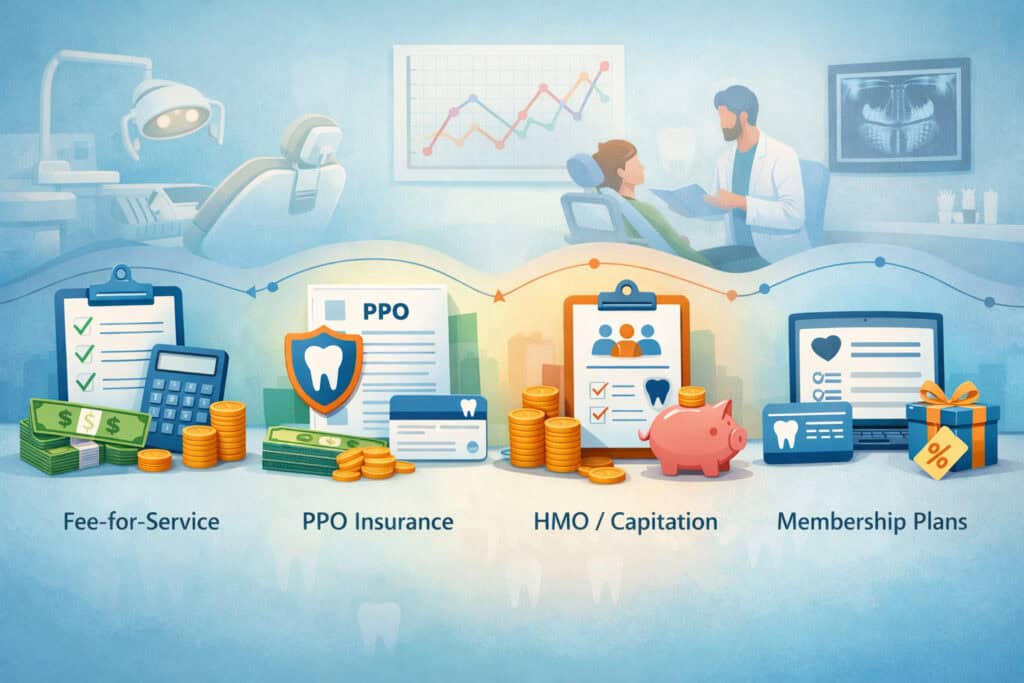
Dental owners often get quoted a “rate” without being told the pricing model underneath. That’s a problem, because the pricing model drives your real average credit card processing fees for dental offices.
Interchange-Plus Pricing
Interchange-plus separates the true base costs (interchange + assessments) from the processor’s markup. Many industry explainers describe interchange-plus as more transparent because you can see the markup clearly.
For dental practices with:
- consistent monthly volume,
- larger average tickets,
- and a mix of card-present plus remote payments,
interchange-plus often makes it easier to diagnose what’s happening and reduce waste. You can measure whether your effective rate problem is driven by card mix (interchange) or provider markup (negotiable).
Tiered Pricing
Tiered pricing groups transactions into buckets (often “qualified,” “mid-qualified,” “non-qualified”). Many merchant guides warn tiered pricing can obscure costs because the provider decides which transactions fall into which bucket and how big the spread is.
Dental offices can get hit hard here because keyed/online transactions and rewards cards often land in more expensive tiers, and the office may not realize the “non-qualified” tier is swallowing a large share of volume.
Flat-Rate Pricing
Flat-rate is simple and predictable, often appealing for new or low-volume practices. But if your dental office processes meaningful volume, flat-rate can keep your effective costs higher than necessary—especially when patients use debit or regulated debit, which is typically cheaper at the interchange layer.
The right goal isn’t “pick the fanciest model.” It’s: choose the model that minimizes your average credit card processing fees for dental offices while staying operationally smooth for your team and patients.
Dental-Specific Cost Drivers That Push Fees Up (or Down)
Dental payments have quirks. These quirks are exactly why average credit card processing fees for dental offices can vary so much from one practice to the next.
High Average Ticket Size and Split-Tender Payments
Large procedure deposits, crowns, implants, aligners, and cosmetic work can create big single-ticket payments. Big tickets aren’t automatically “bad” for fees, but they magnify whatever pricing inefficiency exists. If you’re overpaying by even 0.40%, that becomes painful fast on $200,000+ monthly volume.
Dental also commonly uses split tender:
- part insurance,
- part HSA/FSA,
- part patient credit card,
- sometimes in multiple visits.
If the workflow is clunky, staff may key cards more often “just to get it done,” pushing volume into higher-cost acceptance types.
Card-Not-Present Collections (Phone, Portal, Text-to-Pay)
Dental offices frequently collect after EOB posting, which often happens away from the chair and after the appointment. That means more remote payment links, phone payments, and portal payments.
Online/keyed acceptance tends to carry higher average costs than in-person acceptance. One 2025 dataset shows this pattern across major networks, with online/keyed averages higher than card-present averages.
This is one of the biggest reasons two dental offices can have very different average credit card processing fees for dental offices even with similar revenue.
Patient Experience Policies: Refunds, No-Shows, and Disputes
Refunds and disputes can raise your operational costs:
- Chargeback fees (flat fees per dispute)
- Time cost and admin overhead
- Risk flags that can lead to stricter processing controls
Dental offices can reduce dispute exposure by using clear invoices, signed treatment plans, and consistent descriptors on statements—so patients recognize the charge.
Integration and Practice-Management Workflows
Integrations can reduce keyed entry by making it easy to send secure links, store credentials properly, and track receipts inside the patient record. That can reduce downgrades and errors, helping your average credit card processing fees for dental offices even if the software has a monthly cost—because it reduces expensive mistakes.
How to Calculate Your True Effective Rate (Step-by-Step)
If you want to manage average credit card processing fees for dental offices, calculate your effective rate like a CFO would—not like a sales rep would.
Step 1: Pull Total Card Volume for the Month
Use your merchant statement or dashboard and capture the total processed volume by card type if available:
- Visa / Mastercard / Amex / Discover
- Debit vs credit
- Card-present vs card-not-present
Even if you can’t break it down perfectly, total volume is required.
Step 2: Add Every Fee You Paid
Include:
- Discount fees (percentage-based fees)
- Per-transaction fees
- Batch/settlement fees
- Monthly fees (PCI, statement, platform, gateway, tokenization vault)
- Terminal rental / support plans
- Any “non-standard” network fees passed through
This is where most dental offices underestimate. They look at the percentage line and miss the monthly stack.
Step 3: Divide Total Fees by Total Volume
That gives your effective rate.
Then calculate a second metric:
- Cost per transaction = total fees ÷ number of transactions
Dental offices often have fewer, larger tickets than retail. Two processors can have the same effective rate but different fixed-per-transaction fees that affect behavior. Understanding both metrics helps you choose the best pricing structure for your payment pattern.
Step 4: Compare In-Person vs Remote
If you can, segment fees by channel:
- front desk (chip/tap)
- portal/text link
- phone/keyed
Because online/keyed costs trend higher than in-person costs, channel mix is frequently the hidden driver of average credit card processing fees for dental offices.
Once you can measure accurately, cost reduction becomes much easier—and negotiations become grounded in numbers instead of vague promises.
Practical Ways to Lower Average Credit Card Processing Fees for Dental Offices
This is the section most practices care about: what actually works.
Improve Acceptance Mix: Shift Keyed Payments Toward Secure Links and Tap
If staff routinely keys card numbers, that’s often a cost and risk problem. Encourage:
- Tap-to-pay at checkout for in-person collections
- Secure payment links for post-visit balances
- Properly configured patient portals
Because online/keyed averages tend to be higher than card-present averages, reducing unnecessary keyed volume can lower your average credit card processing fees for dental offices.
Use Stored Credential Rules Correctly for Payment Plans
If you run recurring payments, make sure your system supports stored credentials properly. When recurring indicators are missing or misapplied, transactions can downgrade into more expensive categories and create higher fees over time. Dental industry commentary often highlights how processing complexity drives cost in dental settings.
Negotiate the Fee Schedule, Not Just “The Rate”
Ask for:
- interchange-plus with a clear markup (if appropriate for your volume)
- removal/reduction of junk fees (PCI program fees, statement fees, monthly minimums)
- fair per-transaction pricing aligned to your ticket size
- transparent pass-through of network fees
Educational resources comparing interchange-plus and tiered pricing emphasize transparency and how pricing structure affects total cost.
Consider Debit Optimization Where Appropriate
Many patients use debit, and debit can be cheaper at the interchange layer. Your job isn’t to force behavior—but you can make debit easier:
- ensure debit is enabled properly
- keep terminals updated and EMV compliant
- train staff to present payment options clearly
Reduce Disputes With Better Billing Communication
- Make descriptors recognizable (“Smile Dental of [City]”)
- Use clear receipts and treatment plan documentation
- Send reminders before running stored payments
Disputes are expensive even when you win. Less friction means lower total cost and more predictable average credit card processing fees for dental offices.
Passing Fees to Patients: Surcharging, Convenience Fees, and Cash Discounting (Dental Reality)
Dental offices sometimes explore passing costs to patients to offset average credit card processing fees for dental offices. This area is highly rule-driven and varies by state and network rules, so practices should review their compliance obligations carefully.
That said, the conceptual differences matter:
Surcharging (Adding a Percentage for Credit Cards)
Surcharging can reduce the practice’s net cost but may affect patient satisfaction and requires compliance steps and disclosures. Dental-specific guidance often discusses the operational and patient-experience tradeoffs practices face when passing fees.
Convenience Fees (Charging for a Specific Alternative Channel)
Convenience fees typically apply when you offer an alternative payment channel (for example, paying online or by phone) and meet specific rules. Not every dental setup qualifies, and rules matter.
Cash Discount Programs
Cash discounting presents one price and discounts it for cash (or certain payment types) depending on the program’s structure. This approach can be simpler for patients in some markets, but it still needs careful setup and clear signage.
A strong patient experience is part of a dental brand. If you choose any fee-passing strategy, your messaging must be clear, consistent, and empathetic:
- explain why (rising card costs)
- present alternatives (ACH, check, debit where possible)
- train staff to communicate calmly
The goal should be financial sustainability without surprising patients—because surprise leads to complaints, disputes, and reputational damage that can cost more than the fees you tried to recover.
What’s Changing in 2026 and Beyond: Trends and Future Predictions
Future-facing planning is a smart way to manage average credit card processing fees for dental offices, because fee structures and payment behavior keep evolving.
Continued Pressure on Transparency and Fee Awareness
More dental teams are paying attention to effective rates, not just quoted rates. Trade and industry commentary has noted shifting fee structures and subtle processor changes that many businesses miss. This trend pushes the market toward clearer statements and more scrutiny of “junk fees.”
Interchange and Program Updates Will Continue
Networks publish interchange programs and update them periodically. Mastercard’s published 2025–2026 interchange program documentation illustrates how formal and structured these schedules are—and why they don’t stand still. Dental offices should expect ongoing adjustments that can slightly move effective costs year to year.
More Contactless and “Card on File” Dental Payments
Tap-to-pay adoption keeps rising, and so do stored credential use cases for payment plans. Practices that modernize workflows to reduce keyed entry and handle stored credentials correctly should see better consistency and fewer downgrades—supporting lower average credit card processing fees for dental offices over time.
Growth of Alternative Rails for Patient Payments
Bank-to-bank options (like ACH) and real-time bank transfer experiences are improving in many markets. Dental offices may increasingly offer:
- ACH for large balances
- bank transfer links
- hybrid options (card for small balances, bank transfer for big cases)
This won’t eliminate cards—patients like cards—but it can shift the mix enough to reduce blended cost.
Patient Expectations: Digital First, Low Friction
Patients increasingly expect to pay via link, portal, or text, not only at the front desk. That’s a challenge because remote payments are often pricier than in-person acceptance. The winning strategy is not “avoid digital,” but “make digital cheaper” by using secure, optimized card-not-present workflows and negotiating the right pricing model.
FAQs
Q.1: What is the average credit card processing fees for dental offices today?
Answer: Most practices evaluate average credit card processing fees for dental offices using an effective rate. A commonly cited all-in range for many small businesses is about 2.5% to 3.5%, with variation based on transaction mix, card types, and monthly account fees.
Dental offices often fall in that band, but remote payment-heavy practices may trend higher because online/keyed transactions tend to cost more than in-person transactions across networks.
The most accurate way to know your number is to total all processing fees (percentage fees + per-item fees + monthly fees) and divide by total processed volume. If you only look at the headline percentage, you may underestimate your true cost.
For dental, it’s also helpful to calculate two effective rates: front-desk card-present only, and blended across all channels, because many offices collect balances via portal, text link, or phone after insurance posting.
Q.2: Why do dental offices sometimes pay more than other local businesses?
Answer: Dental has a unique payment workflow that can push average credit card processing fees for dental offices upward. Many practices accept significant card-not-present payments: patients pay after the visit, by phone, or online.
Those transactions are typically priced higher than chip/tap transactions. Dental also sees larger tickets for procedures and deposits, which magnify the impact of even small pricing inefficiencies.
If the practice is on tiered pricing, rewards cards and keyed payments may be pushed into expensive tiers, raising the blended cost. Educational resources on pricing models emphasize how the structure of pricing affects total merchant cost, not just the “rate.”
Lastly, many dental offices pay for integrated tools (portals, texting, token storage) that add monthly platform fees. Those fees can be worth it, but they increase your effective rate if you don’t include them in calculations.
Q.3: Is interchange-plus pricing better for the average credit card processing fees for dental offices?
Answer: Interchange-plus can be better for many dental offices, especially those with steady volume and mid-to-high average tickets, because it makes the processor markup transparent. Comparisons of interchange-plus vs tiered pricing commonly note interchange-plus is clearer and can reduce hidden spreads that tiered pricing introduces.
However, “better” depends on your practice. If you’re very low volume or want extreme simplicity, flat-rate might be acceptable—though it can cost more as volume grows. The key is to compare offers using your own real transaction history (or a recent merchant statement) and compute projected effective rates including monthly fees.
If a provider won’t disclose markup clearly or provides a confusing tier chart, that’s usually a warning sign for long-term cost control. The goal is predictable, auditable billing that you can manage as your patient payment mix evolves.
Q.4: Can a dental practice add a fee to cover card costs?
Answer: Some dental practices explore surcharging, convenience fees, or cash discounting to offset average credit card processing fees for dental offices. Dental-focused guidance notes that passing fees can reduce the burden but must be weighed against patient satisfaction and implemented carefully.
Rules differ by state and by card network requirements, and disclosure requirements matter. Many offices choose a softer approach first: offer ACH/check for large cases, encourage debit where appropriate, and reduce keyed entry by using secure links and tap-to-pay. If you do decide to pass fees, patient communication is everything.
The practice should explain the policy clearly before payment, provide alternatives, and train staff to avoid awkward surprises at checkout—because surprise is what drives complaints and disputes.
Q.5: What’s the fastest way to lower average credit card processing fees for dental offices without upsetting patients?
Answer: The fastest, least controversial wins usually come from operational and pricing clean-up rather than adding patient fees. Start by reducing unnecessary keyed transactions (use tap-to-pay in person, and secure payment links for remote balances).
Because online/keyed averages tend to be higher, shifting mix toward optimized methods can lower cost. Next, audit your statement for junk fees and negotiate the schedule—especially if you’re on tiered pricing or paying multiple monthly platform charges.
Finally, ensure your payment plan and stored credential workflows are configured correctly so recurring payments don’t downgrade into more expensive categories. Dental industry commentary points out that processing complexity is a major reason costs feel high, so simplifying workflows and tightening configuration often produces quick savings.
Conclusion
The best benchmark for average credit card processing fees for dental offices is not a single advertised rate—it’s your practice’s effective rate, calculated from total fees divided by total card volume.
In many cases, dental practices land around the broader small-business band of roughly 2.5% to 3.5% all-in, but dental-specific factors—especially remote collections and keyed transactions—can push the blended rate higher if workflows and pricing aren’t optimized.
The good news is you have leverage. You can’t negotiate interchange, but you can influence it through better acceptance methods, correct recurring/stored credential handling, and fewer downgrades. You can negotiate processor markup and remove junk fees by choosing transparent pricing and demanding a clean fee schedule.
And you can improve patient experience while lowering costs by modernizing how you collect balances—secure links, portals, and tap-to-pay—rather than relying on phone/keyed entry.
Looking ahead, expect ongoing adjustments in interchange programs and continued shifts toward contactless and digital-first patient payments.
Dental offices that measure effective rate monthly, segment costs by channel, and actively manage pricing model and workflow will be in the best position to keep average credit card processing fees for dental offices stable—even as the payments landscape evolves.