Contactless payments for dental patients are no longer a “nice-to-have” feature. In the United States, nearly nine out of ten consumers now use some form of digital or contactless payment, from tap-to-pay cards to mobile wallets.
For dental practices, this shift is huge. Patients expect the same frictionless, hygienic, and fast payment experience at their dentist’s office that they get at a grocery store or coffee shop. At the same time, new security standards like PCI DSS 4.0 and evolving HIPAA guidance are reshaping how healthcare providers handle payments and protect sensitive data.
In this guide, we’ll explore why contactless payments for dental patients matter, how they work, the benefits for both patients and practices, key security and compliance considerations, and practical steps to implement them in a U.S. dental office.
What Are Contactless Payments for Dental Patients?
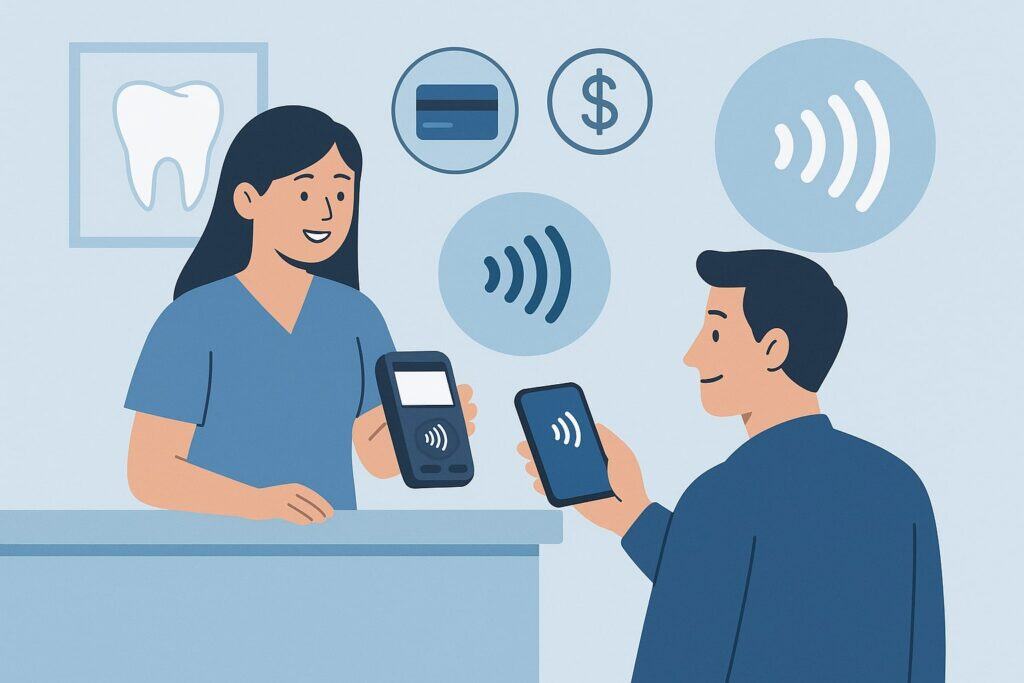
When we talk about contactless payments for dental patients, we mean any way a patient can pay without physically swiping or inserting a card or handing over cash. Instead, they tap or hold a card, phone, or wearable near a reader, or they pay remotely via secure links, text messages, or online portals.
At the heart of most contactless payments is NFC (Near Field Communication). A contactless card or device contains a tiny chip and antenna. When it gets close to an NFC-enabled terminal, the two devices exchange encrypted payment data.
Mobile wallets like Apple Pay, Google Pay, and Samsung Pay work the same way, but add extra security like device-specific tokens and biometric authentication.
In dental practices, contactless payments extend beyond the front desk terminal. Patients might:
- Tap a contactless credit or debit card at check-out.
- Use a mobile wallet on their smartphone or smartwatch.
- Receive a pay-by-text link and pay on their own phone before or after the visit.
- Log into a patient portal from home to pay balances or enroll in payment plans.
These options are especially helpful in dentistry, where patients may have multiple visits, follow-ups, and ongoing treatment plans. They support same-day collections, recurring billing for membership plans, and easier management of co-pays and out-of-pocket costs after insurance.
Because contactless payments for dental patients are digital, they also generate cleaner records, integrate more easily with practice management systems, and help teams track outstanding balances in real time.
For patients, the experience feels familiar—tap, click, or scan—rather than fumbling for cards and paper receipts.
Why Contactless Payments Matter in Modern Dental Practices
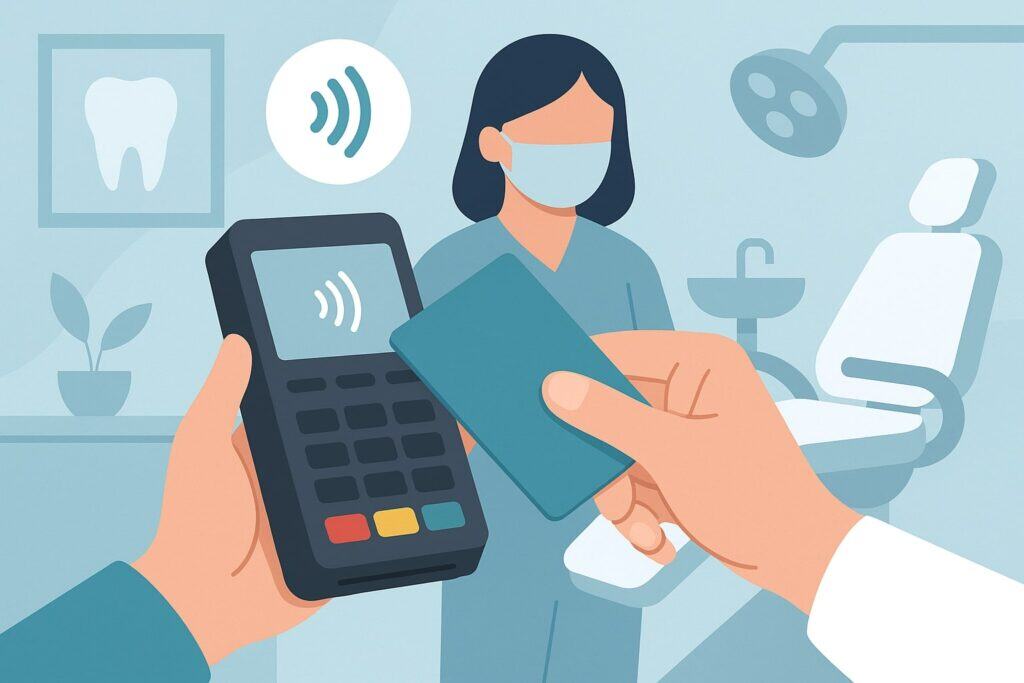
Modern U.S. dental practices operate in a world where digital convenience is the norm. Patients are used to online scheduling, text reminders, and instant confirmations. If payments feel outdated or inconvenient, it creates friction at the worst possible time—right after treatment, when patients just want to leave.
Recent research shows that over 90% of American consumers made a digital payment in the past year, and contactless card and wallet usage continues to grow rapidly.
That means most dental patients already have the tools in their pockets to pay contactlessly. Failing to support contactless payments for dental patients can make a practice feel behind the times.
Hygiene and infection control are another big driver. COVID-19 permanently elevated expectations around low-contact experiences, especially in healthcare settings.
Contactless payments reduce the need to pass cards back and forth or touch shared pin pads. For infection-conscious patients, that small detail translates into a sense of safety and professionalism.
There’s also a strong business case:
- Patients are more likely to pay promptly when the process is fast and familiar.
- Contactless options support same-day collections and fewer mailed statements.
- Practices can offer flexible options for larger treatment plans, like text-to-pay or recurring billing.
Finally, U.S. payment standards are evolving. PCI DSS 4.0 and updated guidance on healthcare payment processing are pushing clinics toward more secure, tokenized, and cloud-based solutions.
Implementing contactless, compliant systems helps dental practices stay ready for audits, avoid unnecessary liability, and reduce their exposure to card data.
In short, contactless payments for dental patients are about more than tapping a card—they’re about aligning your practice with how people live, pay, and interact today.
How Contactless Payments for Dental Patients Work (Step-by-Step)
Understanding the workflow helps practices choose the right tools and explain them to patients. While the details can vary between processors, most contactless payments for dental patients follow a similar path.
1. Initiation at the Point of Service
After treatment, the team posts the charges in the practice management or PMS system. The payment terminal (or virtual terminal) receives the total. The patient chooses a contactless option: tap card, mobile wallet, or scan/pay via link.
For an in-person tap:
- The NFC-enabled terminal broadcasts a short-range radio signal.
- The contactless card or smartphone responds by sharing a tokenized version of the card data—never the raw card number.
- The terminal securely sends this to the processor for authorization.
For a remote or pay-by-text payment:
- The practice sends a URL via SMS or email through a HIPAA-aware, PCI-compliant system.
- The patient opens a secure checkout page on their own device.
- Card or wallet data is entered and encrypted client-side, then transmitted directly to the payment gateway.
2. Authorization and Settlement
Once the data is captured, the processor routes the transaction through the card networks (Visa, Mastercard, etc.) to the issuing bank. The bank checks:
- Card validity
- Available funds or credit
- Fraud risk
If approved, an authorization code is returned in seconds, and the practice can complete the visit. Later, typically in a nightly batch, the transactions are settled, moving funds from the patient’s bank to the practice’s merchant account.
3. Integration With Dental and Insurance Workflows
The key difference in contactless payments for dental patients is integration with treatment plans, insurance estimates, and membership programs:
- Front desk teams can collect estimated co-pays contactlessly on the day of service.
- After insurance adjudication, remaining balances can be billed via text, email links, or portals, often with one-click pay options.
- For ongoing treatments (orthodontics, implants), recurring charges can be scheduled against a securely stored payment token.
Throughout the process, modern systems keep card data separate from clinical notes, supporting both PCI DSS and HIPAA-aligned payment flows.
Key Benefits of Contactless Payments for Dental Patients
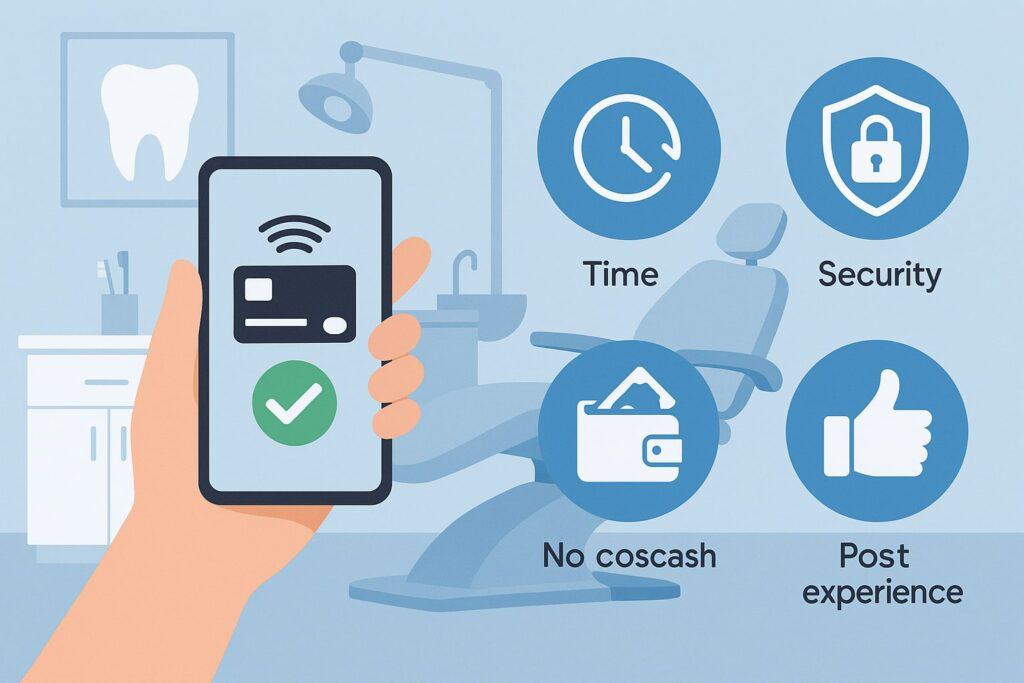
Convenience and Speed for a Better Patient Experience
One of the most obvious benefits of contactless payments for dental patients is convenience. Patients often arrive juggling work, family, and other appointments. The last thing they want is a long check-out experience.
With contactless:
- They can tap and go in seconds.
- They don’t need to sign receipts in most lower-risk transactions in the U.S.
- They can pay on their own device in the waiting room or from home.
Shorter payment times mean shorter total visit times. This helps reduce anxiety for patients who are already nervous about dental work. For parents with kids or caregivers managing appointments for others, being able to pay quickly and move on is a major relief.
Contactless payments for dental patients also fit modern habits. Many younger adults rarely carry physical wallets, relying on mobile payment apps and wearable devices. Giving them options like Apple Pay, Google Pay, or tap-to-pay cards feels natural and respectful of their preferences.
Even for less tech-savvy patients, contactless can be simpler: they tap the same card they would have swiped, but with fewer steps. Clear signage and friendly staff coaching (“Just tap your card right here”) go a long way toward building confidence.
Over time, these small touches create a stronger patient experience. Patients are more likely to remember your office as modern, efficient, and considerate—not just clinically competent. That can translate into better reviews, more referrals, and increased loyalty.
Enhanced Hygiene and Reduced Contact in Clinical Environments
Dental environments are highly sensitive to hygiene and infection control. Patients notice everything: gloves, masks, sterilization, and how often surfaces are cleaned. Payment is part of that experience.
Before contactless, many offices relied on shared pin pads, clipboards, and pens. Patients would insert cards, touch keypads, and sign receipts repeatedly throughout the day. Even with good cleaning protocols, that process feels outdated in a post-pandemic world.
Contactless payments for dental patients minimize physical contact in several ways:
- Tap-to-pay eliminates card insertion and pin pad touching for many transactions.
- Pay-by-text and patient portals let patients pay from their own phones, even before they enter the office.
- Digital receipts reduce the need for printed paper that gets handed back and forth.
For immunocompromised patients, older adults, and families with young children, this added layer of hygiene matters. It sends a message that your practice is serious about safety in every aspect of the visit.
From the staff perspective, fewer shared touchpoints can reduce cleaning workload and cross-contamination risks. Front desk employees handle fewer physical cards and forms, which can support both safety and morale.
While infection risk from payment hardware is lower than from aerosols generated during treatment, contactless payments for dental patients reinforce a holistic infection control strategy, aligning operational details with your clinical standards.
Flexible Financial Options and Easier Budgeting for Patients
Dental care in the U.S. can be expensive, with many services only partially covered by insurance. Patients may delay or decline recommended treatment if paying feels difficult or confusing.
Contactless payments for dental patients help by supporting flexible financial options:
- Patients can store a card or wallet token securely on file through a patient portal for future visits.
- Practices can offer recurring payments for orthodontic treatment plans, implants, or membership plans, billed automatically each month.
- Text or email reminders with embedded payment links make it easy to pay small balances as soon as they’re due.
Because contactless systems integrate with modern practice management and billing tools, they can automatically apply payments to the correct account and invoice. This reduces errors, double payments, and confusing statements.
Contactless payments also pair well with HSA and FSA cards, which many patients use for dental expenses. As long as the merchant category and transaction are eligible, patients can tap HSA/FSA cards or load them into mobile wallets and pay contactlessly, just like any other card.
From a psychological perspective, being able to pay quickly, securely, and in smaller amounts over time can increase patient willingness to accept recommended treatment. When payment feels manageable, patients focus more on the health benefits and less on the immediate cost.
Overall, contactless payments for dental patients support better financial transparency, predictability, and control, all of which improve patient satisfaction and treatment completion rates.
Benefits of Contactless Payments for Dental Practices
Faster Collections and Improved Cash Flow
For U.S. dental practices, cash flow is often a balancing act between insurance reimbursements, patient co-pays, and outstanding balances. Traditional workflows that rely on mailing statements and waiting for checks are slow, costly, and prone to bad debt.
Contactless payments for dental patients can dramatically accelerate collections:
- Same-day payment: Patients can tap or click to pay immediately after treatment or as soon as insurance updates a balance.
- Automated reminders: Text and email payment requests can be triggered automatically, with links to secure payment pages.
- Recurring billing: For large cases, the practice can automatically collect monthly installments, reducing the need for manual follow-up.
These capabilities reduce day sales outstanding (DSO) and create more predictable revenue. The practice spends less on postage, paper, and staff time chasing balances.
Since modern contactless systems post payments directly into the PMS or billing software, reconciliation is easier. Staff can match payments to procedures and claims with fewer errors and less manual data entry. That frees up time for higher-value tasks like treatment coordination and patient engagement.
In a competitive market where dental overhead continues to rise, the combination of higher collection rates, faster cash flow, and lower administrative costs makes contactless payments for dental patients a practical, bottom-line win.
Reduced No-Shows, Bad Debt, and Administrative Burden
Contactless payments are also a powerful tool for managing no-shows and bad debt. Patients who skip appointments or delay payment can erode revenue and disrupt scheduling.
With contactless payments for dental patients, practices can:
- Secure card-on-file authorization for cancellation fees or late cancellation policies, clearly disclosed and agreed to in advance.
- Collect deposits or prepayments for high-value procedures to reduce last-minute cancellations.
- Send automated pay-by-text links for small balances, making it simple for patients to clear accounts without calling the office.
These strategies reduce the burden on front desk teams, who otherwise spend time making collection calls and tracking down mailing addresses. Automation based on contactless systems means staff can focus more on patient relationships and less on repeated billing follow-ups.
From a patient relationship standpoint, contactless options feel less confrontational than repeated phone calls about money. Patients receive clear, timely digital reminders with a one-click way to resolve the issue. That can preserve goodwill even when finances are tight.
By pairing contactless payments for dental patients with smart policies and clear communication, practices can lower their rate of write-offs and keep the schedule more stable. Over time, this directly supports profitability and reduces stress for owners and office managers.
Operational Efficiency and Happier Front Desk Teams
Front desk staff sit at the intersection of clinical care, customer service, and payment collection. If payment workflows are clunky, they feel it first.
Contactless payments for dental patients simplify their day:
- Fewer manual card entries and fewer chances to mis-key card numbers or amounts.
- Less time printing, scanning, and filing paper receipts.
- Integrated reporting tools that show payments by provider, date, or procedure for easier end-of-day reconciliation.
When payments are fast and reliable, check-out lines shrink. That reduces congestion at the front desk and gives staff more time to answer questions, coordinate referrals, and schedule follow-ups.
Staff also benefit from improved security and reduced exposure to card data. Modern contactless systems are designed to keep cardholder data out of the practice’s environment as much as possible, relying on tokenization and PCI-validated payment platforms. This lowers anxiety about mistakes that might cause a data breach.
Happier, less overwhelmed front desk employees are more likely to deliver friendly, consistent service—and they’re easier to retain in a tight labor market. Investing in contactless payments for dental patients is therefore also an investment in team experience and practice culture.
Security, Compliance, and Privacy Considerations
PCI DSS 4.0 and Cardholder Data Security
Any practice that accepts card payments—contactless or otherwise—must comply with Payment Card Industry Data Security Standard (PCI DSS) rules. PCI DSS 4.0, which took effect in April 2024, introduced dozens of new requirements, many of which become fully mandatory in 2025.
For dental practices, the key goals are:
- Reduce how much cardholder data ever touches your systems.
- Use validated, PCI-compliant payment processors and hardware.
- Complete the required annual self-assessment or report on compliance.
Contactless payments for dental patients can actually make PCI compliance easier:
- NFC readers and mobile wallets transmit tokenized data instead of raw card numbers.
- Hosted payment pages and pay-by-text links keep card data off your local network, routing it directly to the processor.
- Card-on-file storage is handled by the processor using vault tokens, not by the practice.
By choosing solutions that follow PCI DSS 4.0, dental offices reduce their exposure in the event of a breach and avoid the heavy penalties associated with non-compliance. If your processor offers PCI scope reduction services, take advantage of them and verify in writing how responsibilities are shared.
HIPAA, PHI, and Payment Processing in Dentistry
Dentists in the U.S. must also comply with HIPAA, which protects patients’ health information. Payment data and health data intersect in dentistry, so practices need to think carefully about how contactless payments for dental patients fit into their overall compliance program.
In general:
- HIPAA focuses on protected health information (PHI).
- PCI DSS focuses on cardholder data.
Many modern healthcare payment platforms are designed to be both PCI DSS-compliant and HIPAA-aligned, providing encryption, tokenization, and clear separation between clinical data and payment records.
Important points for dental practices:
- If a third-party payment provider handles or can access PHI (e.g., through integrated patient records or portals), you may need a Business Associate Agreement (BAA) with that provider.
- In many cases, pure credit card processing services are exempt from HIPAA’s business associate requirements, but integrated portals and practice management integrations can change the analysis.
- Your privacy notices and financial policies should explain how payment information is used, stored, and protected.
By selecting vendors that specialize in healthcare or dental payments, you can align contactless payments for dental patients with HIPAA rules while still delivering a modern experience. When in doubt, consult legal counsel or a compliance expert to map out responsibilities.
Types of Contactless Payment Options Dental Offices Can Offer
Tap-to-Pay Cards and NFC Mobile Wallets
The most visible form of contactless payments for dental patients is tap-to-pay at the front desk. This relies on NFC-enabled hardware and software.
Common options include:
- Contactless credit and debit cards issued by U.S. banks.
- Apple Pay, Google Pay, and Samsung Pay on smartphones and smartwatches.
Advantages:
- Extremely fast transactions and short lines.
- Built-in security features like tokenization and device-level biometrics.
- Patients are already familiar with the interaction from retail stores.
To enable this, a dental practice needs:
- A merchant account or payment processing relationship that supports contactless.
- NFC-capable terminals integrated with practice management or a cloud-based POS.
- Updated signage (“Tap here to pay”) and staff training.
Tap-to-pay is ideal for in-person visits, co-pays, and smaller balances where patients are present. It rarely requires major workflow changes but immediately signals that your practice is current and patient-friendly.
Pay-by-Text, QR Codes, and Mobile Payment Links
Another powerful category of contactless payments for dental patients involves remote, mobile-first options: pay-by-text, QR codes, and secure links.
These tools let practices:
- Send a payment request via SMS or email with a unique link.
- Include a QR code on printed statements or at the front desk that opens a secure payment page.
- Offer post-visit payment for balances after insurance processes.
Benefits include:
- Patients can pay at their convenience, from anywhere.
- Fewer phone calls and mailed statements.
- Easy promotions for membership plans or discounts with built-in payment links.
Many dental-specific payment platforms support these features, integrating them with the PMS so that payments are automatically posted to the correct patient account. The best systems provide real-time status updates and automated reminders, further reducing manual workload.
From the patient’s perspective, these are very intuitive. They are already used to click links to pay utilities, subscriptions, and online orders. Bringing the same experience to dentistry helps normalize the cost of care and fit it into everyday financial routines.
Online Patient Portals and Virtual Terminals
Patient portals are another core channel for contactless payments for dental patients. These are secure web or mobile interfaces where patients can:
- View upcoming appointments and treatment plans.
- See insurance estimates and EOBs.
- Pay balances with cards, HSA/FSA accounts, or ACH.
When portals include built-in payment capabilities, they reduce friction and centralize communication. Patients log in for reminders or to review X-rays and can pay with a couple of clicks.
On the practice side, virtual terminals allow staff to accept payments over the phone or in-office without a physical card present. While not fully “contactless” in the NFC sense, they still support digital card-not-present flows that are faster and more trackable than checks.
Combined, portals and virtual terminals:
- Support remote care scenarios, such as tele-dentistry follow-ups.
- Enable family members or caregivers to pay on behalf of patients.
- Expand the ways patients can interact financially with your practice without coming to the office.
As patients increasingly expect digital self-service in healthcare, portals with integrated contactless payments for dental patients are becoming a competitive differentiator.
Contactless Membership Plans and Recurring Billing
Many U.S. practices now offer in-house membership plans or savings programs for uninsured or underinsured patients. Contactless technology makes these easier to manage.
Key features:
- Patients enroll through a digital form and add a payment method (card or ACH).
- Monthly or yearly fees are billed automatically via secure tokenized charges.
- Discounts and benefits apply automatically in the PMS when members schedule visits.
This model turns payment into a subscription-like experience. Patients spread costs over time, and the practice gains predictable recurring revenue.
Contactless payments for dental patients also support recurring billing for large treatment plans. For example, an implant case might be split into several installments, billed automatically after each clinical milestone.
When set up correctly, patients receive digital notifications, receipts, and the ability to update their payment method without exposing card data to staff, keeping everything secure and convenient.
Implementation Checklist for U.S. Dental Practices
Choosing the Right Payment Processor and Technology Stack
Implementing contactless payments for dental patients starts with the right partners. Look for processors and platforms that:
- Support NFC, mobile wallets, pay-by-text, and portals in a single ecosystem.
- Are PCI DSS 4.0 compliant and can clearly explain their security architecture.
- Offer healthcare or dental-specific features, such as integration with your PMS, ADA codes, and insurance workflows.
Evaluate:
- Transaction fees for contactless, online, and card-not-present payments.
- Monthly or hardware costs and contract terms.
- Availability of BAAs if the platform interacts with PHI.
Talk with vendors about future-proofing. Ask how they support new methods like FedNow, RTP, or open banking, so that your investment stays relevant as contactless payments for dental patients continue to evolve.
Integrating With Practice Management, Billing, and Insurance
The true value of contactless payments comes when they are fully integrated:
- PMS and EHR: Payments should automatically post to the correct patient, provider, and date of service.
- Online scheduling and reminders: Add payment links to appointment confirmations and recall messages.
- Insurance workflows: Once claims are processed, remaining patient balances should trigger digital statements or pay-by-text requests.
Work with your PMS vendor and payment processor to map out:
- How payment data flows between systems.
- How refunds and adjustments are handled.
- How reports are generated for daily close and month-end reconciliation.
Done right, this integration allows contactless payments for dental patients to feel seamless—not like an extra system bolted onto your existing workflows.
Training Staff and Educating Patients
Even the best technology fails if people don’t use it. Successful adoption of contactless payments for dental patients requires staff training and patient education.
For staff:
- Provide simple scripts: “You can tap your card or phone right here to pay,” or “I’ve just texted you a secure link to pay from your phone.”
- Train on basic troubleshooting, like what to do if a tap fails or a link expires.
- Review security practices, including never writing down card numbers or passwords.
For patients:
- Use signage at the front desk promoting contactless options.
- Explain benefits in new patient packets or email newsletters.
- Add FAQs on your website about how contactless payments for dental patients work and why they’re safe.
The goal is to make the new options feel normal and easy, not intimidating. As adoption grows, contactless methods will become the primary way most patients prefer to pay.
Common Challenges and How to Overcome Them
Serving Older or Less Tech-Savvy Patients
Not every patient will be immediately comfortable with contactless payments. Older adults or those with limited smartphone access may be wary of tapping cards or clicking payment links.
To support them:
- Emphasize that tapping a card is still a card payment—just faster and often more secure.
- Offer to walk them through the process step-by-step.
- Keep traditional methods (chip, magstripe, checks) available as backup.
Clear communication about the security and simplicity of contactless payments for dental patients can improve adoption. Over time, many older patients appreciate the shorter wait times and fewer paper bills.
Managing Chargebacks, Fraud, and Data Security
Digital and contactless channels can introduce new risks if not managed well. Practices should:
- Use processors with built-in fraud detection, device fingerprinting, and tokenization.
- Set clear policies for refunds, cancellations, and disputed charges.
- Regularly review PCI DSS requirements and internal security practices.
By pairing good technology with strong policies, dental practices can keep contactless payments for dental patients safe and trustworthy.
Future Trends in Contactless Payments for Dental Patients
The payment landscape continues to evolve, and dental practices that adopt contactless now will be better positioned for the future. Emerging trends include:
- Real-time payments and FedNow supporting instant transfers and refunds.
- Deeper integration between practice management, AI-driven billing, and payment tools to reduce claim rejections and manual work.
- More robust, healthcare-focused platforms that bundle scheduling, telehealth, and contactless payments for dental patients into unified patient experiences.
As consumers grow even more comfortable with digital wallets, wearables, and new forms of digital identity, expectations for frictionless payment in dental settings will only increase.
FAQs
Q1. Are contactless payments for dental patients really safe?
Answer: Yes. In many ways, contactless payments for dental patients are safer than traditional magstripe or even chip transactions. Contactless transactions use tokenization, where a unique, single-use code replaces the real card number. If that token is intercepted, it’s useless to attackers.
Mobile wallets like Apple Pay and Google Pay add extra layers of security, including device-level encryption and biometric authentication (Face ID, fingerprint). If a phone is lost, card data isn’t exposed in readable form, and the wallet can be remotely disabled.
From the practice side, using PCI DSS 4.0-compliant systems and keeping card data off local computers or paper further reduces risk.
Q2. Do contactless payments cost more in fees than regular card payments?
Answer: For most U.S. dental practices, contactless payments for dental patients carry similar interchange and processing fees as other card-present transactions. The exact cost structure depends on:
- Card type (debit vs. credit, rewards level).
- Processor pricing model (flat-rate, interchange-plus, or tiered).
- Whether the transaction is treated as card-present (tap in-office) or card-not-present (online or pay-by-text).
The key is to ask your processor how they price contactless vs. keyed or card-not-present transactions and to review effective rates regularly.
Q3. Can patients use HSA or FSA cards for contactless dental payments?
Answer: Yes, in most cases. Many HSA (Health Savings Account) and FSA (Flexible Spending Account) cards are standard Visa or Mastercard products. If the transaction is eligible under IRS rules and your practice is categorized as a healthcare provider, patients can usually tap those cards or load them into mobile wallets and use them like any other card.
Make sure your merchant category code (MCC) correctly reflects your dental practice so HSA/FSA processors recognize transactions as eligible.
Q4. What should a dental practice look for in a contactless payment provider?
Answer: When evaluating partners for contactless payments for dental patients, focus on:
- Support for NFC, mobile wallets, pay-by-text, and portals in one platform.
- Proven PCI DSS 4.0 compliance and transparent security documentation.
- HIPAA-aware design and BAAs where needed.
- Deep integration with your dental PMS and existing workflow.
Asking the right questions upfront ensures your contactless payment strategy will be secure, compliant, and sustainable.
Conclusion
Contactless payments for dental patients are about far more than technology. They touch every part of the patient journey—safety, convenience, affordability, and trust. For U.S. dental practices, adopting contactless options is now a strategic necessity, not a future experiment.
By choosing the right payment partners, aligning with PCI DSS 4.0 and HIPAA, integrating with practice management systems, and educating both staff and patients, dental offices can transform payments from a pain point into a competitive advantage.
Patients get faster, safer, more flexible ways to pay. Practices gain stronger cash flow, reduced administrative burden, and a modern, professional image. In an era where nearly all consumers rely on digital and contactless payments, bringing that same experience into dentistry is one of the most impactful upgrades a practice can make.