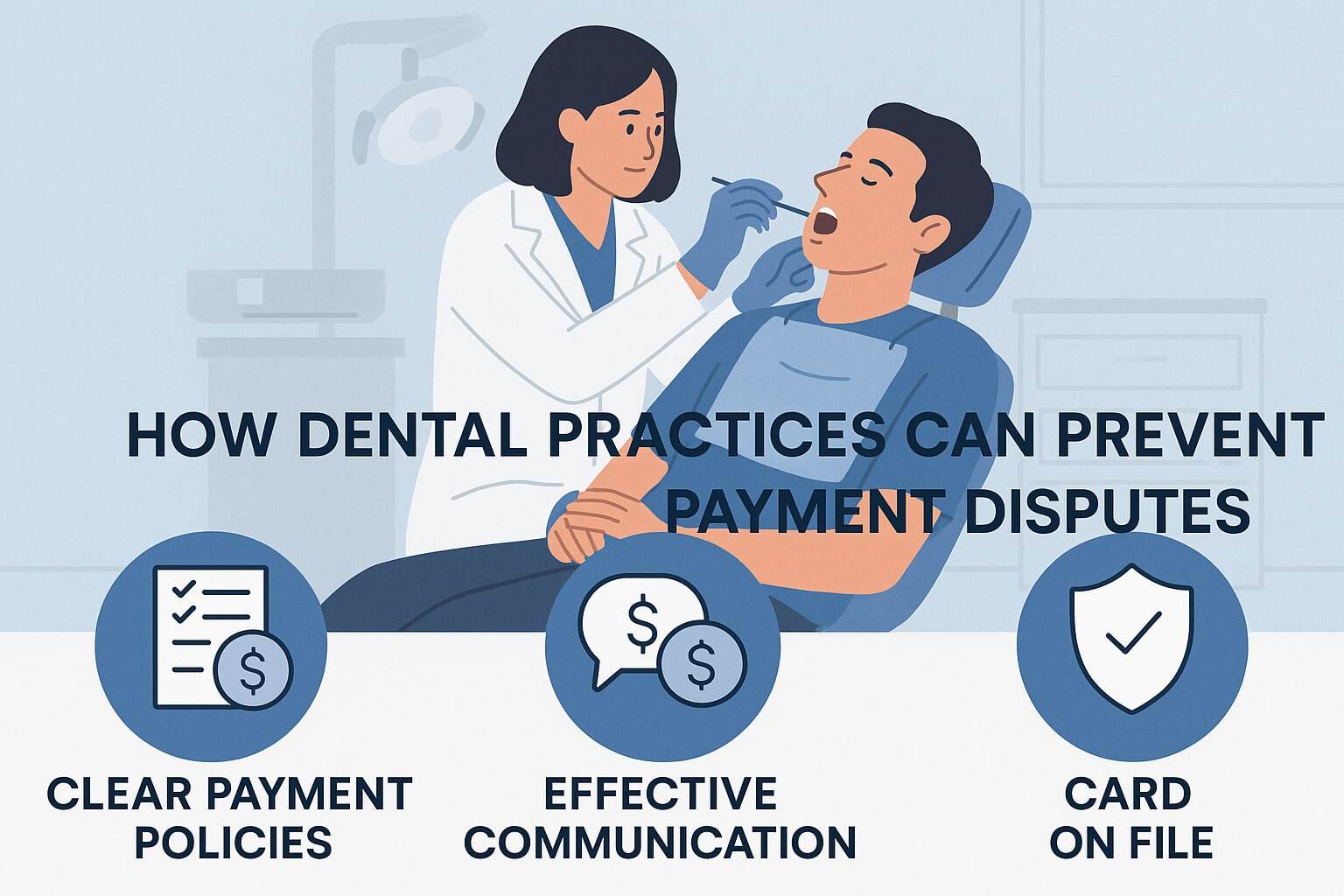
Payment disputes are a growing issue for dental practices in the United States. Patients are paying with credit cards, HSAs, FSAs, and payment plans more than ever, and they often juggle confusing insurance rules at the same time.
When they don’t understand a bill or feel they were overcharged, they may call their bank instead of your office. That’s when a payment dispute can turn into a chargeback, pulling money out of your merchant account and damaging your reputation with processors.
The good news is that most payment disputes in dental practices are preventable. With clear communication, strong documentation, smart payment technology, and well-trained staff, you can dramatically cut down on disputes and protect your revenue.
This guide walks through practical, up-to-date strategies that any U.S. dental office can implement, from small solo practices to multi-location groups.
We’ll look at how payment disputes and chargebacks actually work, how they show up in dentistry, and which policies, workflows, and tools help you avoid painful losses.
Throughout the article, we’ll use the terms payment disputes, chargebacks, and dental payment policies often to help you optimize for search and keep the focus on what matters: preventing disputes before they start.
Understanding Payment Disputes and Chargebacks in Dental Practices
Before you can prevent payment disputes, you need to understand what they are and how they move through the system. A payment dispute generally begins when a patient questions a charge, either directly with your office or with their bank or card issuer.
If the patient calls their bank instead of you, the bank may open a formal investigation. When the bank reverses the transaction through the card network, that reversal is called a chargeback. In dentistry, chargebacks are especially painful because the service has already been delivered and chair time can’t be recovered.
For U.S. card networks like Visa, Mastercard, American Express, and Discover, general chargeback time limits are often between 60 and 120 days from the transaction date or from the date services were supposed to be delivered.
Patients may still dispute charges later in some scenarios, but most disputes fall within this window. Merchants (including dental practices) typically have 20–45 days to respond with evidence, depending on the network and the specific reason code.
In a dental setting, payment disputes frequently involve misunderstandings, such as patients believing insurance will cover more than it did, or being surprised by post-EOB balances. Even if your practice did everything correctly, a bank could still side with the patient if you lack strong documentation.
That is why payment dispute prevention in dental practices must start long before a card is ever run. You need clear policies, transparent communication, and records that show the patient knew what they were agreeing to pay.
What Counts as a Payment Dispute or Chargeback in Dentistry?
A payment dispute in a dental office is any situation where the patient questions or refuses to pay all or part of the bill. This might begin as a phone call about a confusing statement, an email complaining about pricing, or a patient insisting they never authorize the charge.
Once the patient contacts their card issuer or bank, the issue escalates into a formal dispute case under card network rules, and it may eventually become a chargeback if the transaction is reversed.
Common payment dispute scenarios in dental practices include complaints that a procedure was “not performed,” “not as described,” or “too expensive compared with what was quoted.” Others claim they were charged twice, charged after canceling an appointment, or billed for services they thought insurance would fully cover.
In family dentistry, disputes sometimes arise because a spouse or parent didn’t realize another family member used the card for treatment. Whether or not you think the complaint is reasonable, the bank will expect you to prove that the patient authorized the payment and understood the financial responsibility.
Chargebacks are more than just refunds. When a chargeback is filed, your practice may be hit with extra chargeback fees from your payment processor, and repeated disputes can push your chargeback ratio into a risk zone.
Excessive disputes can lead to higher processing costs, rolling reserves, or even termination of your merchant account. That’s why preventing payment disputes in dental practices is not just about smoothing patient relationships—it’s a vital part of your financial risk management.
Why Dental Payment Disputes Are Different from Retail Disputes
Dental payment disputes are very different from disputes in retail or e-commerce. In a typical online purchase, a customer disputes a tangible product: something they didn’t receive, or something that arrived broken or counterfeit.
In dentistry, the “product” is a professional service that’s been delivered in your operatory, often in multiple stages. You can’t “take back” a crown prep or scaling session to recover your cost if a payment dispute leads to a chargeback.
Dental practices also operate inside a complex three-party ecosystem: the patient, the provider, and the insurance carrier. Patients often misunderstand how deductibles, annual maximums, waiting periods, and coverage percentages work.
When insurance pays less than expected, they see their bill go up and feel blindsided. This confusion is a major driver of payment disputes and is unique to healthcare, including dentistry.
On top of that, dental practices must comply with HIPAA and PCI DSS requirements, follow state regulations on consent and financial disclosures, and coordinate benefits for families and multiple policies. All of this makes documentation and communication more important than ever.
Unlike retail, where a simple receipt might be enough, dental offices need treatment plans, financial consent forms, EOBs, and detailed case notes to defend against chargebacks. Recognizing how different dental payments are is the first step to designing workflows that prevent payment disputes before they turn into lost revenue.
Common Causes of Payment Disputes in Dental Offices

Most payment disputes in dental practices don’t come out of nowhere. They usually trace back to a breakdown along the patient’s financial journey: unclear estimates, poor explanations, confusing insurance messaging, or sloppy payment handling.
When you study the reasons patients file disputes and chargebacks, you see patterns that can be fixed with better systems.
One major cause of payment disputes is misunderstanding insurance coverage. Patients often assume that “insurance covers everything,” especially for preventive care, and don’t realize how quickly annual maximums can be exhausted.
When a large restorative case hits or a claim is downgraded, they see a much higher balance than expected and feel misled. Another driver is inadequate pre-treatment financial communication—for example, staff members telling patients “it should be around this number” without explaining that it’s only an estimate based on current benefits information.
Operational issues also spark payment disputes. These include double billing, delayed posting of insurance payments, billing patients months after treatment, or running a card for an amount different from what the patient approved.
Scheduling and cancellation policies cause disputes when no-show or late cancellation fees were never clearly explained.
Finally, poor customer service—such as ignoring billing questions or being defensive when patients raise concerns—pushes patients to go straight to their bank. When you tighten these weak spots, you reduce payment disputes and reinforce trust in your dental practice.
Insurance Misunderstandings and Surprise Balances
Insurance misunderstandings are probably the number one source of payment disputes in dental practices. Patients routinely believe that if a procedure was “pre-authorized,” insurance is guaranteed to pay a certain amount.
In reality, pre-authorizations and pre-treatment estimates are not promises of payment. Carriers can downgrade procedures, apply frequency limits, or deny coverage entirely once the claim is processed. When that happens, the remaining balance gets shifted to the patient, who may feel that the practice changed the price without warning.
Surprise balances also show up when deductibles and annual maximums are not clearly explained at the front desk. Patients might receive multiple smaller bills for different stages of treatment and assume they are being billed twice.
Sometimes, insurance payments arrive weeks or months after treatment, and practices delay sending statements while they “wait for the carrier.” This creates a time gap in which the patient forgets the details and is shocked by a bill long after the appointment. That shock often leads to payment disputes and, ultimately, chargebacks.
To prevent these disputes, dental practices should build a process where insurance benefits are verified and explained in plain English before treatment. Staff need to tell patients that insurance figures are estimates, not guarantees, and that the patient is ultimately responsible for the full fee.
Written financial agreements should restate this clearly. When patients understand that insurance is a benefit, not a contract with your office, they are less likely to file payment disputes when their plan pays less than expected.
Communication Gaps at the Front Desk and in the Operatory
Even when your estimates are accurate, communication gaps can trigger payment disputes. Front-desk staff might focus on getting forms signed and insurance cards scanned, while clinicians discuss clinical details but mention costs only briefly.
If nobody fully “owns” financial conversations, patients walk away with an incomplete picture. Later, when the statement doesn’t match what they remember, they assume there was a billing error or overcharge.
In many dental practices, different team members give different answers about fees. A hygienist might casually tell a patient, “This will probably be covered,” but the treatment coordinator later gives a more realistic estimate. If the patient only remembers the optimistic comment, they feel misled.
Likewise, if your team avoids talking about money because it feels awkward, they might rush through explanations or use jargon that confuses patients even more. That confusion is fertile ground for payment disputes.
To prevent disputes, assign clear roles and build scripts. Front-desk and financial coordinators should lead the conversation about costs and payment options, while clinicians reinforce key points without promising coverage.
All staff should use standard phrases that clearly separate clinical recommendations from financial arrangements. You can also use printed or digital financial guides that summarize your policies in a friendly tone.
When communication is consistent and proactive, you dramatically reduce payment disputes and keep your dental practice running more smoothly.
Operational and Billing Errors That Lead to Disputes
Sometimes payment disputes arise not from misunderstandings, but from actual mistakes in your billing process. These errors are easy to fix once you spot them, but they can be costly if they lead to chargebacks.
Examples include double charging a card, entering the wrong amount, billing under the wrong patient account, or failing to apply a payment that was made in person or via online portal. If your billing team is overwhelmed or your practice management software isn’t configured correctly, these errors can slip through.
Delayed billing is another operational issue. When patients are billed long after treatment, they may not remember giving consent or even visiting the office. If a card is stored on file and charged weeks later without a reminder or invoice, the patient may feel the transaction is unauthorized and file a payment dispute.
Poor recordkeeping compounds the problem: if you can’t quickly show signed consent, itemized statements, and appointment logs, you will struggle to win a chargeback case.
To prevent these billing-related payment disputes in dental practices, establish standard operating procedures. Use checklists for posting payments, reconciling batches, and closing out days. Run regular audit reports to catch duplicate charges and unapplied credits.
Configure your software so that card-on-file charges automatically generate receipts and notifications. When your operational systems are tight, you reduce honest mistakes that turn into disputes and keep your accounts receivable under control.
Building Clear Financial Communication with Patients
The single most powerful tool for preventing payment disputes in dental practices is clear, consistent communication. Patients are much less likely to call their bank if they feel your office has been upfront about costs, insurance limitations, and payment expectations.
That means building a structured financial conversation into your intake, treatment planning, and checkout processes, rather than treating money as an afterthought.
Effective financial communication starts with listening. Ask patients what they’ve experienced in the past with dental bills and what concerns they have about out-of-pocket costs. Then explain your process step by step: how you estimate insurance, when they will be billed, which payment methods you accept, and what happens if insurance pays differently than expected.
Use simple language instead of insurance jargon, and avoid making promises you can’t guarantee. Patients should walk out knowing roughly what they will owe and when.
You should also have written financial policies that match what your team says verbally. When patients receive the same information in person, on paper, and via email or text, they’re more likely to trust your practice and less likely to open payment disputes.
Train your team to see financial communication as part of patient care, not as uncomfortable “collections talk.” When financial transparency becomes part of your culture, payment disputes decline, and patient satisfaction rises.
Setting Expectations at the First Contact and New-Patient Intake
Preventing payment disputes begins before a patient ever sits in the chair. The very first phone call or online booking is your chance to set expectations.
When a new patient calls, your team should briefly explain your financial philosophy: you’ll help them maximize insurance benefits, provide clear estimates, and discuss payment options before treatment.
For U.S. dental practices, you can also mention common concepts like deductibles, co-pays, and annual maximums so that patients are not surprised later.
During new-patient intake, include a financial responsibility form alongside clinical and HIPAA paperwork. This document should explain that insurance is a contract between the patient and the carrier, that estimates are not guarantees, and that the patient is ultimately responsible for the full fee.
Make space for patients to list their preferred payment methods and whether a third party (like a parent or spouse) will be helping with payments. Get signatures electronically or on paper, and store these forms in your practice management system for easy retrieval if a payment dispute arises.
On your website and appointment confirmations, include a short, friendly summary of your financial and cancellation policies. Many payment disputes arise simply because patients don’t remember what they were told verbally.
When your policies are repeated at multiple touchpoints—phone, email, forms, and signage—you build a consistent message. This early transparency reduces the chance that patients will feel blindsided, which is one of the main reasons they initiate payment disputes or chargebacks.
Using Visual and Written Estimates to Avoid Surprises
People process information better when they can see it. Instead of just telling patients what a procedure will cost, show them. Use your practice management or case presentation software to generate visual treatment plans that separate clinical steps and financial details.
The financial portion should show your full fee, the estimated insurance portion, and the estimated patient responsibility. Highlight that these numbers are estimates and may change based on the carrier’s final decision.
Give patients a printed or digital copy of this estimate and walk through it with them. Point out key items like deductibles, coverage percentages, and annual maximums. Encourage them to ask questions and take the estimate home if they need time to decide.
When patients sign the treatment plan or a separate financial consent that references the estimate, you have strong evidence if a payment dispute is later raised. You can show the bank that the patient understood and accepted the expected costs.
Follow up with written confirmations whenever major treatment plans are scheduled. A simple email that says, “Here is your planned treatment and estimated out-of-pocket cost,” reinforces expectations and can be attached later as evidence in a dispute.
By investing a few extra minutes in clear estimates and written confirmation, your dental practice dramatically reduces payment disputes and makes patients feel more in control of their finances.
Smart Payment Policies and Consent Forms that Prevent Disputes
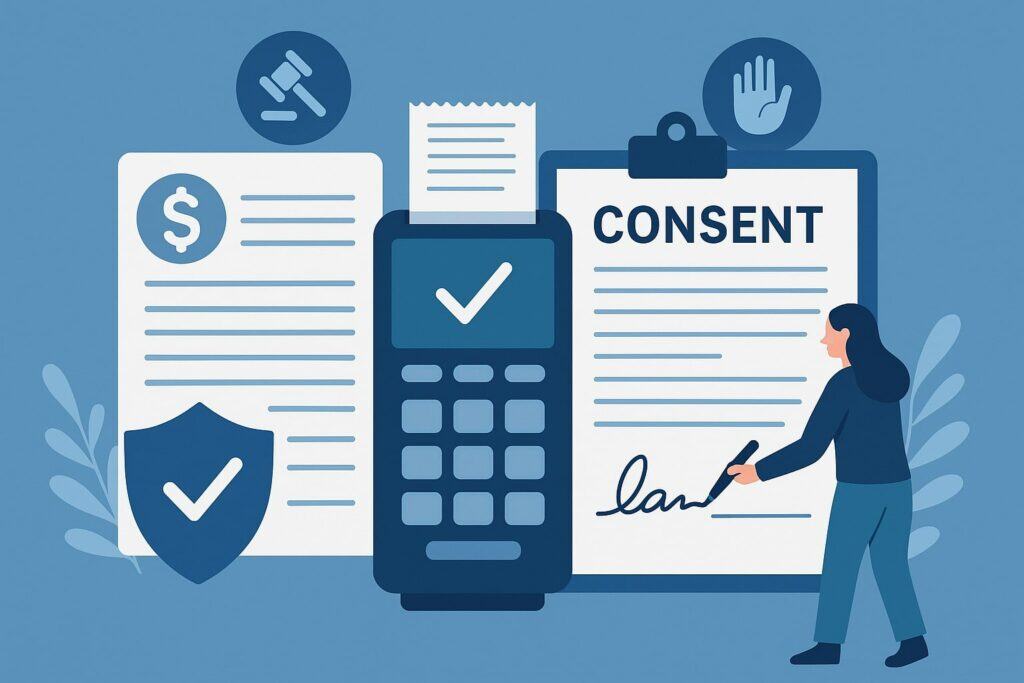
Policies and paperwork may not be glamorous, but they’re essential tools for preventing payment disputes in dental practices. Clear, well-written financial policies tell patients exactly what to expect.
Strong consent forms provide proof that the patient agreed to the treatment and the associated charges. When a dispute or chargeback happens, these documents become your best defense.
Your financial policy should explain in simple terms how your practice handles insurance claims, co-pays, pre-payments, payment plans, and no-show fees. It should also cover how you use cards on file, when you may charge them, and what communication patients will receive beforehand.
Include a short section about disputes themselves: encourage patients to contact your office directly if they have any questions about a charge rather than going straight to the bank. Patients who feel invited to talk things through are less likely to initiate payment disputes.
Consent forms should reference both the clinical and financial aspects of care. In addition to general consent, you may use procedure-specific consent for major treatments, as well as separate payment authorization forms for recurring charges or financing arrangements.
Signed documents should be stored securely, linked to the patient’s account, and easy to export if your processor needs supporting evidence. Together, these policies and forms form the foundation of a dispute-resistant dental practice.
Drafting a Patient-Friendly Financial Policy
A good financial policy protects your dental practice against payment disputes without sounding harsh or legalistic. Start by writing it in a warm, conversational tone, emphasizing that your goal is to help patients receive the care they need while keeping costs clear and manageable.
Use headings and short paragraphs so patients can quickly scan for important sections like “Insurance,” “Payment Options,” and “Cancellation Policy.”
In the Insurance section, explain that your team will gladly file claims and help estimate benefits, but that insurance is ultimately between the patient and the carrier. Make it clear that patients must pay any balance not covered by insurance.
In Payment Options, list accepted cards, HSA/FSA cards, checks, cash, and any third-party financing options. Describe how you handle cards on file and recurring payments—when cards may be charged, how patients will be notified, and what to do if they want a different card used. This level of clarity is critical for avoiding future payment disputes about “unauthorized” charges.
For the Cancellation and No-Show Policy, clearly state any fees and the time frame for canceling or rescheduling without penalty. Many payment disputes involve patients who were charged for missed appointments they didn’t realize would incur a fee. Remind patients of this policy in appointment reminders and at checkout.
Finally, include a short “Questions and Concerns” section that invites patients to contact your office if they ever see a charge they don’t understand. When your financial policy is friendly, transparent, and consistent, it significantly reduces payment disputes and supports long-term trust.
Payment Authorization, Cards on File, and Recurring Payments
Modern dental practices increasingly rely on cards on file, membership plans, and payment plans to help patients afford care. These tools also create risk if not handled correctly.
Patients may later claim they never approved a specific charge or didn’t understand how often their card would be billed. To prevent these payment disputes, you need clear payment authorization documents and a well-documented workflow for recurring charges.
A strong payment authorization form should specify the card used, the patient or guarantor’s name, the types of charges that may be run (for example, balances after insurance, payment plan installments, or membership fees), and the maximum frequency or amount.
It should also describe how the patient will be notified before each charge—by email, text, or statement—and how they can revoke authorization. Make sure patients sign this form electronically or in ink, and store it securely in your software.
When you run cards on file for balances after insurance, send a quick message first: “Your insurance claim has been processed and you have an outstanding balance of $X.00. We will charge your card on a file ending in ____ on October 26, 2026 unless you contact us with questions.”
This small step drastically reduces payment disputes, because patients are not surprised by the transaction. For payment plans, give patients an amortization schedule that shows each expected charge.
With these clear authorizations and communications in place, your dental practice can use modern payment tools without inviting unnecessary payment disputes and chargebacks.
Leveraging Technology and Payment Processing Tools to Reduce Disputes
Technology can be one of your strongest allies in preventing payment disputes in dental practices. Modern practice management systems, patient portals, and integrated payment solutions make it easier to share statements, collect informed consent, and track every transaction. The key is to choose tools that support transparency and documentation rather than just speed.
First, ensure your payment processing setup is aligned with EMV and PCI DSS best practices so that card transactions are secure and properly authorized. Non-compliant systems increase the risk of fraud-related disputes and potential fines.
Next, integrate payments directly with your practice management software so that charges, refunds, and adjustments are automatically tied to patient records. This integration makes it much easier to pull detailed receipts, signed forms, and treatment notes if you need to respond to a chargeback.
Finally, use patient-facing tools like online portals and mobile-friendly statements to keep patients informed. When patients can easily view their treatment history, insurance payments, and outstanding balances, they are far less likely to open payment disputes with their bank.
Technology can’t replace human communication, but it can greatly reduce errors and misunderstandings that lead to disputes and chargebacks.
Using Patient Portals, e-Statements, and Text Reminders
Patient portals and digital communication tools are powerful for keeping patients informed and reducing payment disputes. A secure patient portal lets patients log in to view their treatment history, insurance EOBs, itemized statements, and upcoming appointments.
When patients can see exactly what services were performed and what insurance paid, they feel more confident that charges are accurate. That confidence makes them more likely to call your office with questions instead of filing a dispute with their bank.
E-statements and text reminders also help. Instead of mailing paper statements that may be misplaced or ignored, send electronic statements with clear breakdowns of charges and payment options. Include a “Questions? Call or text us first” note on every digital statement.
Automated text reminders can alert patients when a payment is coming due, when a card on file will be charged, or when a balance is past due. These gentle nudges often prevent the shock that triggers payment disputes.
Make sure your digital tools are mobile-friendly, since many patients will view statements on their phones. Use plain language and short paragraphs to explain charges. If your portal allows, give patients a way to send secure messages or ask billing questions online.
By meeting patients where they already are—on their devices—you reduce confusion, encourage dialogue, and prevent avoidable payment disputes in your dental practice.
Keeping Payment Systems Secure, Compliant, and Well-Documented
Security and compliance may seem unrelated to payment disputes, but they play a huge role in how card issuers view your practice. If your systems are outdated or non-compliant with PCI DSS, disputes involving fraud or unauthorized charges may be harder to fight.
Dental practices that fail to secure cardholder data can face penalties and reputational damage in addition to increased disputes.
Work with your payment processor to ensure you’re using EMV-enabled terminals, point-to-point encryption, and tokenization for cards on file. Avoid storing card data inside your practice management system or on local computers.
Instead, use secure vaulting through your payment provider. This reduces the risk of data breaches that can trigger widespread cardholder disputes. Also, review your merchant account statements and chargeback reports regularly. Many processors offer dispute dashboards that track open cases, deadlines, and outcomes.
Finally, document every step of your payment workflows. Keep detailed logs of who processed payments, when refunds were issued, and how adjustments were made.
When a payment dispute arises, you’ll need to quickly assemble a dispute response package that includes receipts, signed consents, treatment notes, scheduling records, and communications. The faster and more complete your response, the better your odds of winning the case and deterring future disputes.
Handling Chargebacks and Payment Disputes When They Happen
Even the best-run dental practices will occasionally face payment disputes and chargebacks. What matters is how you respond. A calm, structured approach can turn a potentially damaging situation into a chance to educate the patient and protect your practice. It can also help you learn from each case so that similar disputes are less likely in the future.
When you receive notice of a dispute or chargeback, act quickly. Card networks and processors set strict deadlines—often 20–30 days or less—for merchants to respond with evidence, and some networks give up to 45 days for certain stages.
If you miss a deadline, you’ll almost certainly lose the case, even if you were in the right. Assign one person in your office or billing service to monitor dispute alerts and coordinate responses.
At the same time, reach out to the patient directly. Sometimes patients initiate payment disputes simply because they couldn’t get through to the office or didn’t understand a statement. A respectful phone call or written explanation may persuade them to withdraw the dispute.
Even if they don’t, showing that you tried to resolve the issue in good faith can strengthen your position with the bank. The goal is to protect your revenue while preserving the relationship whenever possible.
Step-by-Step Response Plan for Chargebacks
A clear chargeback response playbook helps your team move fast when a dispute hits. Start by collecting all relevant information about the patient and transaction: the date of service, the amount charged, the card type, and any related invoices.
Pull the signed treatment plan, financial consent, payment authorization, and any procedure-specific consents. Export appointment logs, chart notes, and any messages that show the patient scheduled, confirmed, and received the treatment in question.
Next, create a concise dispute narrative. This is a brief, professional explanation of what happened, written for the bank or card network. It should summarize the services provided, the patient’s understanding of costs, and why the charge was valid.
Attach supporting documents in an organized way, clearly labeling each file. Many processors provide templates or portals to upload evidence. Follow their instructions closely; missing or mislabeled documents can weaken your case.
Submit your dispute response as early as possible, well before the deadline. Keep a record of everything you send and any case numbers you receive. Afterward, review the outcome and note what went well and what didn’t.
Did the bank ask for specific documentation you didn’t have? Did the patient raise an issue that your financial policy doesn’t address clearly enough? Use each chargeback as a learning opportunity to refine your preventive systems and avoid similar payment disputes in the future.
When to Issue a Goodwill Refund and Move On
Not every payment dispute is worth fighting. In some cases, a goodwill refund is the smarter business decision, even if you believe the charge was valid.
For example, if the amount is small, documentation is weak, or the patient is extremely dissatisfied, you may decide that preserving your reputation and avoiding stress is more valuable than winning the dispute. This is especially true in competitive U.S. markets where online reviews and word-of-mouth can make or break a dental practice.
Before deciding, consider several factors: the dollar amount at stake, your documented evidence, the patient’s history with the office, and the potential impact on staff time. If you choose to issue a refund, do it clearly and professionally.
Explain that you’re resolving the matter as a customer-service gesture, not because you believe the charges were improper. Encourage the patient to contact the office in the future rather than their bank if any concerns arise. This helps re-train patient behavior and reduces future payment disputes.
However, don’t let goodwill refunds become a default option. Track how often they occur and why. If you see patterns—like frequent disputes around certain procedures, providers, or communication points—address those root causes.
The goal is to minimize disputes overall while handling the unavoidable ones in a way that protects both your financial health and your brand.
Training Your Team to Prevent Payment Disputes
Policies and technology only work if your team understands and uses them consistently. That’s why staff training is a critical part of preventing payment disputes in dental practices.
Everyone—from front-desk coordinators to hygienists and doctors—should know the basics of your financial policies, how to talk about money, and what to do if a patient has a billing concern.
Start by including financial communication in your regular team meetings. Review your financial policy together and role-play common scenarios, such as explaining insurance estimates, presenting payment options, or responding to a frustrated patient.
Teach staff to stay calm, listen actively, and avoid getting defensive. Emphasize that it is always better for patients to bring concerns to the office than to file payment disputes with their bank.
Also train your team on basic dispute concepts: what a chargeback is, why it’s harmful to the practice, and how strong documentation helps.
When staff understand that sloppy notes or missing signatures can cost the practice real money, they are more likely to follow systems carefully. A well-trained team is your front line of defense against payment disputes and chargebacks.
Front-Desk Scripts and Role-Playing for Tough Conversations
Front-desk and financial coordinators are at the heart of payment dispute prevention, because they handle most of the money conversations. Give them scripts and support so they feel confident discussing fees, insurance limitations, and payment policies. Scripts should be flexible, not robotic—guides to keep conversations clear and consistent.
For example, when presenting an estimate, a script might say: “Based on your current insurance information, your estimated out-of-pocket investment today is $____. Insurance may pay more or less once they process the claim, and any difference would be your responsibility.”
Use role-playing exercises during team meetings to practice these scripts. Have one staff member pretend to be a patient worried about costs, while another explains the estimate and payment options.
Then switch roles and practice handling a patient who is upset about a previous bill. Encourage staff to use empathy phrases like, “I can see why that would be frustrating,” followed by a clear explanation of policies and next steps.
Role-playing also prepares staff for conversations about cards on file, no-show fees, and membership renewals. When team members have rehearsed these scenarios, they are less likely to panic or say inconsistent things that lead to misunderstandings.
Over time, confident, empathetic communication at the front desk dramatically reduces payment disputes and reinforces your practice’s reputation as transparent and patient-centered.
Building a Culture of Documentation and Follow-Through
Preventing payment disputes in dental practices also depends on your internal culture. If documentation is seen as busywork, it will be inconsistent. If follow-through on financial conversations is left to chance, patients will slip through the cracks.
Instead, build a culture where accurate notes, scanned documents, and timely follow-ups are non-negotiable parts of patient care.
Encourage clinicians to document treatment recommendations, patient questions, and any discussions about fees or insurance. Even brief chart notes like “Reviewed estimate and patient agreed to proceed” can help demonstrate informed consent later.
Front-desk staff should note when financial policies are reviewed, when payment authorizations are signed, and when statements or reminders are sent. These records provide a timeline that is invaluable if a payment dispute or chargeback occurs.
To support this culture, use checklists and task lists in your practice management system. For example, you might require that “signed financial consent uploaded” and “estimate given” boxes be checked before complex treatment can be scheduled.
Run periodic audits to ensure documents are complete. Celebrate staff who consistently maintain excellent documentation, and provide coaching where gaps appear. When everyone understands that their documentation protects the practice and their colleagues, payment disputes become less frequent and easier to resolve.
Compliance, Security, and Recordkeeping for Dispute Defense
Compliance, security, and recordkeeping may feel like back-office topics, but they are central to preventing and defending against payment disputes in dental practices.
Card issuers and processors look more favorably on merchants who follow industry standards and can present clear records when disputes arise. Meanwhile, regulators and professional bodies expect dental practices to safeguard patient and payment information.
First, review your payment processing environment for PCI DSS compliance. Ensure that your credit card terminals are EMV-enabled, use encryption, and are properly configured. Avoid storing card data locally or writing card numbers on paper forms.
Instead, use secure tokenization through your payment provider. The American Dental Association (ADA) emphasizes that practices accepting cards must understand their obligations under PCI and follow network security requirements to reduce breach and dispute risks.
Recordkeeping is just as important. Keep invoices, receipts, signed consents, treatment notes, and communications well organized and backed up. Establish retention policies that comply with state regulations and professional guidelines.
When a payment dispute or chargeback is filed, strong records can be the difference between losing revenue and successfully defending the charge.
What to Keep On File for Every Patient and Payment
To defend against payment disputes, your dental practice should maintain a standard documentation package for every patient.
At a minimum, this should include: new-patient intake forms, signed HIPAA acknowledgments, general and procedure-specific consents, financial policies, and any payment authorizations for cards on file or recurring charges. These documents establish that the patient understood both the clinical and financial aspects of care.
For each major procedure or treatment plan, keep the signed estimate or treatment plan that shows expected fees and insurance estimates. Attach copies of any pre-authorizations, benefit breakdowns, and insurance EOBs.
Store all receipts for in-person payments and online transactions, including card type and last four digits, in your practice management or payment system. Note any refunds, adjustments, or payment plan changes, with dates and initials of the team members making the changes.
Communication is also crucial. Save important emails, text messages, and portal messages related to treatment and billing. If a patient calls with a concern about a bill, document the conversation in their chart, including what was explained and any agreements made.
When a payment dispute arises, this comprehensive record allows you to quickly assemble a clear story and present convincing evidence to the processor or bank. The more organized your files, the faster you can respond and the more likely you are to win.
Monitoring Metrics and Continuously Improving Your Processes
Payment dispute prevention is not a one-time project. It’s an ongoing process that benefits from regular measurement and improvement. By tracking key indicators, your dental practice can see where disputes start, which policies work, and where additional training or technology may be needed.
Start with simple metrics like number of disputes per month, total dollar value disputed, and chargeback win rate. Compare these to your monthly collections to get a rough dispute ratio.
Card networks become concerned when merchants have high dispute ratios, so keeping yours low is important for maintaining favorable processing terms. Track how many disputes involve insurance misunderstandings, authorization issues, or communication problems. This tells you where to focus prevention efforts.
Combine payment dispute metrics with A/R aging and collection performance. If you see a lot of old balances and frequent disputes, that may indicate weak communication or delayed billing.
Regularly reviewing these numbers with your team keeps everyone aware that payment disputes are not just “billing issues” but practice-wide concerns. Over time, small adjustments—better scripts, clearer policies, improved statements—will show up as fewer disputes and more predictable cash flow.
Using Dispute Data and Patient Feedback to Refine Your Systems
Every payment dispute contains useful information about your systems. After each case is resolved, do a brief internal review.
Ask questions like: Did the patient misunderstand insurance coverage? Was the estimate inaccurate or poorly explained? Was a card charged without clear prior notice? Were important forms missing or incomplete? The answers will highlight process gaps that can be fixed.
Patient feedback is equally valuable. When patients call about a bill, treat it as a chance to learn, not just a problem to solve. Ask what confused them and what would have made things clearer.
If multiple patients say your statements are hard to read or your estimates are unclear, that’s a strong signal to redesign them. Similarly, if patients praise your transparency and responsive communication, share that feedback with your team to reinforce good habits.
Consider implementing simple surveys after major treatments that ask about financial communication. A few targeted questions can tell you whether your policies are understood or causing anxiety.
Use this data, along with dispute trends, to prioritize improvements each quarter. Over time, your dental practice will design a payment experience that patients trust—one where payment disputes are rare, and when they do occur, you are fully prepared to handle them efficiently and fairly.
Frequently Asked Questions
Q1. What are the most common reasons patients dispute dental charges?
Answer: In U.S. dental practices, the most common reasons for payment disputes fall into a few predictable categories. First, many patients dispute charges when their insurance pays less than they expected.
They may have misunderstood their coverage, deductibles, or annual maximums and assume the practice “overcharged” them. When they see a balance they didn’t anticipate, some call their bank instead of the office, triggering a dispute or chargeback.
Second, billing errors and timing issues can lead to disputes. Examples include duplicate charges, incorrect amounts entered at the terminal, or balances billed months after treatment with no prior notice. If a card on file is charged without a reminder, patients may think the transaction was unauthorized.
Finally, poor communication around cancellation fees, cosmetic procedures not covered by insurance, or membership plan renewals can create confusion. Patients who don’t recall agreeing to these terms may contest the charges with their card issuer.
The best way to reduce these payment disputes is to focus on clear, consistent communication and strong documentation. Provide written estimates that explain insurance limitations, review financial policies at intake, and send reminders before running cards on file.
When patients know what to expect and feel comfortable asking questions directly, they are far less likely to escalate issues to their bank.
Q2. How long do patients have to dispute a dental credit card charge?
Answer: The timeline for payment disputes and chargebacks is governed by card network rules, not by dental industry rules. In general, major card brands such as Visa, Mastercard, American Express, and Discover allow cardholders about 60 to 120 days from the transaction date (or from the date services were to be provided) to file most types of disputes.
The exact time limit varies by network and the specific reason code, and some scenarios may allow longer or shorter windows.
For example, many networks provide up to 120 days for disputes related to services not received, services not as described, or unauthorized transactions. In healthcare and dental contexts, certain disputes may be tied to the date of service completion rather than the initial pre-payment.
From the merchant side, dental practices typically have 20–45 days to respond with evidence, depending on the network and processor. Missing these deadlines almost always results in losing the case.
Because of these timeframes, it is essential for dental offices to monitor chargeback notifications and respond promptly. At the same time, you should encourage patients to contact your office first with any billing concerns.
Many issues can be resolved through a phone call, refund, or payment plan adjustment before they become formal disputes. Clear financial communication and quick follow-up are key to preventing payment disputes from escalating.
Q3. What documentation does a dental practice need to win a chargeback?
Answer: To successfully defend a payment dispute and win a chargeback case, a dental practice must supply clear, well-organized documentation. At a minimum, you should include a copy of the signed treatment plan or estimate, showing the services recommended, expected fees, and insurance estimates.
Attach signed financial policies and any payment authorization forms, especially for cards on file or recurring payments. These signed documents demonstrate that the patient understood and agreed to your financial terms.
You should also provide evidence that the services were actually rendered. This includes appointment logs, chart notes, and clinical documentation that match the dates and procedures billed. Itemized receipts, credit card transaction records, and any statements sent to the patient help connect the payment to the treatment.
If the dispute involves insurance, include benefit breakdowns, pre-authorizations, and EOBs to show how the final patient balance was calculated. Communications—emails, text messages, portal messages, or call notes—are particularly useful when they show that the patient received explanations or questioned a bill and got a response.
Present everything in a concise narrative that explains what happened and why the charge is valid. Avoid dumping unorganized files into the dispute portal; instead, label each document and reference it in your explanation.
The goal is to make it easy for the bank’s reviewer to see that the patient was informed, consented to the treatment and fees, and received the services in question.
Strong documentation not only helps you win individual disputes but also discourages future payment disputes by showing that your practice takes compliance and transparency seriously.
Q4. How can small dental practices with limited staff prevent payment disputes?
Answer: Small dental practices sometimes feel at a disadvantage when it comes to preventing payment disputes, because they have fewer staff and less time to manage complex billing processes. The key is to prioritize a few high-impact steps that don’t require a large team.
First, create simple, patient-friendly written financial policies and estimates. Use templates for treatment plans and payment authorizations so you don’t have to reinvent the wheel each time. Even a basic set of clear forms can dramatically reduce misunderstandings that lead to disputes.
Second, lean on technology. Choose a practice management system that integrates payments, lets you send e-statements, and offers basic patient portal features.
Automated appointment reminders, balance alerts, and receipts can handle much of the routine communication, freeing your staff to focus on complex questions. Many modern payment processors also provide online dashboards to track disputes and deadlines, so you don’t need a full-time employee dedicated to chargeback management.
Finally, invest in training your small team on financial communication and documentation. Even a brief monthly meeting to review scripts, role-play common questions, and discuss recent issues can have a big impact.
When every team member knows how to explain insurance estimates, present fees, and invite questions, patients are more likely to work directly with your office instead of filing disputes with their bank. With a few well-chosen systems and habits, even the smallest dental practice can keep payment disputes low and cash flow stable.
Q5. Should dental practices ever refuse to accept certain payment methods to reduce disputes?
Answer: Some dental practices consider refusing certain payment methods, such as certain credit cards or online wallets, to avoid payment disputes and chargebacks. While this might reduce some risks, it also creates barriers for patients and can hurt collections.
In most cases, it’s better to accept standard payment methods—major credit and debit cards, HSA/FSA cards, and reputable digital wallets—while tightening your policies and documentation instead of restricting payments.
That said, you can adopt targeted rules to reduce dispute risk. For example, you might require in-person card present payments for larger treatment plans instead of taking card numbers over the phone.
You might require a signed payment authorization for cards on file and for any transaction where the card is not physically present. Certain high-risk scenarios, like very large cosmetic cases or out-of-state patients paying in advance, may warrant extra verification steps or partial pre-payments.
Rather than banning specific cards, focus on strengthening your front-end processes: clear consent, accurate estimates, transparent policies, and secure payment processing. These steps will reduce payment disputes across all methods, without sacrificing patient convenience.
If you notice that disputes cluster around a particular payment channel (for example, online payments without prior contact), consider adjusting that channel’s workflow instead of shutting it down entirely.
Conclusion
Preventing payment disputes in dental practices is not about one big policy or a single technology tool. It’s about building a consistent, patient-centered approach to financial communication, documentation, and follow-through.
When patients understand their treatment, their insurance, and their financial responsibility, they are much less likely to call their bank and more likely to call you.
By clarifying insurance estimates, using written financial policies, collecting strong consents, and leveraging modern payment tools, your dental practice can significantly reduce disputes and chargebacks.
Training your team to speak confidently about money, documenting every key step, and responding quickly when concerns arise will further protect your revenue. At the same time, you’ll build trust and reduce stress for both patients and staff.
In today’s U.S. payment environment, disputes and chargebacks are a fact of life—but they don’t have to be a constant headache. With the strategies in this guide, you can turn your financial systems into a strength of your practice rather than a vulnerability.
Start by reviewing your current policies and communication, pick a few high-impact improvements, and implement them consistently. Over time, you’ll see fewer payment disputes, stronger cash flow, and more satisfied patients who feel confident in both your clinical care and your financial transparency.