Credit card fees in dental practices are no longer just a small “cost of doing business.” For many US offices, they are now one of the largest practice overhead items after payroll and rent.
As more patients swipe, tap, and pay online, it’s essential for every dentist, office manager, and practice owner to understand how these credit card fees work, what’s negotiable, what’s regulated, and how to keep them under control without hurting patient relationships.
In this in-depth guide, we’ll break down the types of credit card processing fees you see in a dental practice, explain the latest rules around surcharging and cash discounts, highlight issues unique to healthcare and dental, and walk through practical steps to analyze and reduce your costs while staying compliant and patient-friendly in the US market.
Why Credit Card Fees Matter for Dental Practices in the US

Credit card fees in dental practices add up quickly because dentistry blends high-ticket procedures with frequent follow-up visits. A single crown, implant, or Invisalign case can be several thousand dollars.
Even a “standard” hygiene appointment often includes out-of-pocket copays. When 2–3% of every credit card payment goes to processors and banks, that’s thousands of dollars per year in lost margin.
Patient expectations have also shifted. Many patients assume a dental office will accept all major cards, contactless wallets, and sometimes even online pre-payments or payment plans.
If you refuse cards or push too hard toward cash, you risk no-shows, delayed treatment acceptance, and higher accounts receivable. That means credit card fees in dental practices are directly tied to both convenience and production.
At the same time, processing costs themselves are rising. Industry data shows average total credit card processing fees for US merchants typically fall between about 1.5% and 3.5% per transaction, depending on card brand, card type, and pricing model.
Healthcare and dental often skew toward the higher end because of virtual card payments from insurers, card-not-present transactions, and compliance requirements.
For a small solo practice, reducing the effective rate from, say, 3.1% to 2.3% can be the equivalent of adding thousands of dollars in profit per year without seeing a single new patient. That’s why understanding credit card fees in dental practices is no longer optional; it’s a core part of sound practice management.
How Patient Payment Habits Are Changing
In the past, many patients paid at the front desk via check or mailed a check when they received a statement. Today, a large share prefers credit and debit cards, mobile wallets, or online links. Younger patients, in particular, expect card-on-file and text-to-pay options.
Health savings account (HSA) and flexible spending account (FSA) cards also behave like credit or debit cards at the terminal, adding to overall card volume.
These habits matter because every time a patient pays with plastic, your practice incurs credit card processing fees.
In addition, more practices are using third-party patient financing platforms or insurance portals that may pay claims via virtual credit cards. These new channels can come with higher processing costs than traditional in-office terminals.
As telehealth, online scheduling, and digital forms become more common in dentistry, practices are also taking more card-not-present payments: deposits for cosmetic consults, pre-payments for large cases, or online bill pay for overdue balances.
Card-not-present transactions almost always carry higher interchange and risk-based fees than card-present transactions, which further increases credit card fees in dental practices.
Impact of Fees on Profitability and Pricing
Every percentage point of fees erodes your collections. For example, if your practice collects $1,000,000 annually and 70% of that is paid by credit card, a 3% effective fee on those card transactions means $21,000 per year in costs. Lowering the effective rate even by a few tenths of a percent can create meaningful savings.
Those fees influence how you price procedures, structure discounts, and extend courtesies. The American Dental Association (ADA) notes that when you give a discount for upfront payment but still allow patients to pay that discounted amount by debit or credit card, you may effectively lose more income because you’re also paying a processing fee on the lower price.
Understanding your true effective rate helps you decide whether to:
- Adjust fees to reflect rising practice costs.
- Encourage lower-cost payment methods like ACH.
- Implement a compliant surcharge or cash discount program.
- Negotiate better terms with your payment processor.
Without this insight, credit card fees in dental practices quietly eat away at profitability, making it harder to invest in technology, staff, or training.
The Anatomy of Credit Card Processing Fees
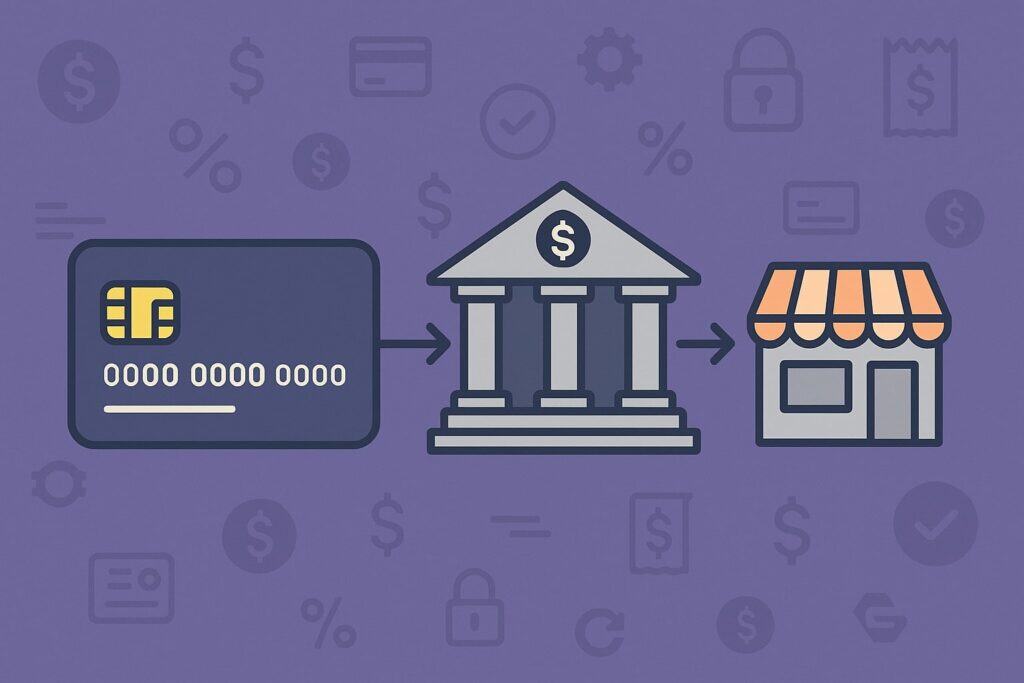
When a patient pays with a card, several entities take a piece of the transaction. To manage credit card fees in dental practices, you need to know who gets paid and which charges are negotiable.
At a high level, each card transaction includes:
- Interchange fees – Paid to the card-issuing bank (e.g., the bank that issued the patient’s Visa or Mastercard).
- Assessment or network fees – Paid to the card network (Visa, Mastercard, Amex, Discover).
- Processor markup – Paid to your merchant services provider or payment processor.
Visa, Mastercard, American Express, and Discover publish interchange schedules that vary by card type (debit vs credit, rewards vs basic), transaction type (card-present, online, keyed), and merchant category.
Healthcare and dental fall into specific merchant category codes (MCCs) that carry certain interchange rates.
The key point: Interchange and assessments are non-negotiable, while processor markup is where you have leverage. Many dental offices focus on “the rate” quoted by a salesperson but never see the breakdown between these parts. That makes it hard to tell if you’re getting a fair deal.
Interchange, Assessment, and Processor Markup Explained
Interchange fees are set by the card networks and shared with issuing banks. They are meant to cover fraud risk, handling costs, and the value of extending credit.
Interchange is typically expressed as a percentage of the transaction plus a per-item fee, such as 1.70% + $0.10. These amounts differ widely depending on card type and transaction details.
Federal Reserve and network data show average credit card interchange rates in the US around 2% of the transaction amount, often higher than in regions like the EU, where caps apply.
Assessment or network fees are smaller charges paid directly to the card network (e.g., Visa assessment). They are also calculated as a percentage of volume or a small per-item fee and are not negotiable by individual merchants, including dental practices.
Processor markup is what your payment processor charges above interchange and assessments. This can take the form of:
- A percentage of each transaction (e.g., 0.3%).
- A per-transaction fee (e.g., $0.05–$0.15).
- Monthly membership or subscription fees.
- Additional “junk” fees like PCI fees, statement fees, batch fees, etc.
When you look at credit card fees in dental practices, most of the variation from one provider to another comes from their markup and fee structure, not from interchange or assessments. That’s why understanding your statement and pricing model is so important.
Typical Fee Ranges for In-Person, Online, and Virtual Card Payments
Average total credit card processing fees (interchange + assessments + markup) depend on how you accept payments:
- In-person, card-present transactions at the terminal are usually cheapest, often in the range of roughly 1.5%–3% for many small businesses, depending on card type and pricing model.
- Online or card-not-present payments (patient portal, text-to-pay, manually keyed amounts) tend to be higher, commonly 2%–3.5% or more, because of higher fraud and risk.
- Virtual credit cards used for insurance claim payments can be even more expensive if the processor treats them as high-risk or card-not-present transactions. Dental industry analyses note that virtual cards can significantly increase the cost of getting paid by insurers if practices are not careful.
In practice, many dental offices end up with an effective blended rate between about 2.3% and 3.2% when you average all card types and channels over a month. If your effective rate is substantially higher, that’s a red flag and a reason to dig deeper into your credit card fees.
Pricing Models Dental Practices Commonly See

The way your processor structures pricing dramatically affects how transparent and controllable your credit card fees are. Dental practices often encounter three main models: flat-rate, tiered (or bundled), and interchange-plus. There is also a growing “membership” or subscription-style pricing that can work well for some offices.
Understanding these models helps you compare quotes apples-to-apples and avoid misleading offers.
Flat-Rate Pricing
Flat-rate pricing charges the same rate on every transaction, regardless of card type or interchange variation. You’ll see something like:
- 2.9% + $0.30 per transaction for all credit cards.
- 2.6% + $0.10 for in-person and 2.9% + $0.30 for online.
This model is common with simple, out-of-the-box solutions and some practice management or online scheduling platforms that bundle payments into their software.
Pros:
- Extremely easy to understand and forecast.
- No need to analyze interchange categories; you know your rate.
- Often no separate statement or batch fees.
Cons:
- You may overpay on many transactions, especially debit or basic credit cards that carry low interchange.
- Rates for card-not-present or virtual card transactions may be especially high.
- Negotiating down flat rates can be harder, and some vendors “bake” payment revenue into their software pricing.
For dental practices with modest volume or high value on simplicity, flat-rate can be acceptable. But as volume grows, many offices discover that an effective rate near 3% is not competitive and start shopping for alternatives that better reflect actual risk and card mix.
Tiered (Bundled) Pricing
Tiered, or bundled, pricing categorizes transactions into buckets such as:
- Qualified (lowest rate).
- Mid-qualified.
- Non-qualified (highest rate).
Sales reps may quote only the “qualified” rate, which looks very attractive, while many real-world dental transactions fall into mid or non-qualified tiers due to card type, rewards levels, or how the transaction is processed.
Challenges of tiered pricing include:
- Lack of transparency. You rarely see the underlying interchange.
- Unpredictable costs. You can’t easily predict which tiers your transactions will hit.
- Opportunity for silent margin expansion if the processor reclassifies more volume into higher tiers.
Because dental practices accept a lot of rewards cards and card-not-present payments, many transactions fall into higher-cost tiers. That’s why tiered pricing is often one of the most expensive models over time, even though the initial quote looks attractive.
If your statement shows terms like “qualified,” “mid-qual,” or “non-qual,” or lists a handful of blended rates, you’re likely on tiered pricing. That’s a signal to dig into your credit card fees and consider switching models.
Interchange-Plus and Membership/Subscription Models
Interchange-plus pricing passes through interchange and assessments at cost, then adds a clearly defined markup such as:
- Interchange + 0.30% + $0.10 per transaction, or
- Interchange + $0.05 per transaction with a monthly fee.
This model is generally considered the most transparent. You see exactly what the bank and network take, and you see exactly what your processor charges. For dental practices with any meaningful card volume, interchange-plus is often the most cost-effective way to manage credit card fees.
Membership or subscription models are a variation of interchange-plus. Instead of adding a percentage markup, some processors charge:
- A flat monthly membership fee (e.g., $79–$199).
- Interchange-plus a very small per-transaction fee (e.g., $0.05–$0.10).
This can be beneficial for high-volume dental practices, especially multi-location groups, because you pay almost no percentage markup on your credit card volume. However, you must analyze whether the monthly membership fee makes sense given your monthly processing volume.
For US dental practices, a well-structured interchange-plus or membership model can bring the effective rate closer to the underlying interchange, saving thousands annually compared to flat-rate or tiered pricing.
Special Challenges for Dental and Healthcare Merchants
Credit card fees in dental practices are shaped by several industry-specific factors you won’t necessarily find in a typical retail environment. Understanding these challenges helps explain why your statement looks the way it does.
Virtual Credit Cards and Insurance Payments
One growing issue is virtual credit cards used by some insurance companies and third-party administrators to pay claims. Instead of using ACH or paper checks, they issue a one-time card number that your office runs like any other card.
While virtual cards may speed up payment, they often come with higher processing fees than ACH or even standard card-present transactions. The ADA and state dental associations point out that many state laws now require plans to disclose fees associated with virtual card payments and to offer an alternative non-fee option like ACH.
If you routinely accept virtual credit cards:
- Ask payers to switch you to EFT/ACH wherever possible.
- Document any fees and volume so you can calculate how much virtual cards are costing your practice.
- Train your billing team to recognize virtual cards and not treat them as “free” money.
Over time, shifting more claim payments to ACH instead of virtual cards can significantly reduce credit card fees in your dental practice.
Recurring Payments, Payment Plans, and High-Ticket Procedures
Dental practices also rely on payment plans for orthodontics, implants, and full-mouth reconstructions. Many offices store cards on file and run them monthly or use third-party patient financing platforms integrated with their practice management software.
Recurring, card-not-present payments increase your exposure to:
- Higher interchange categories.
- Chargebacks if patients dispute charges.
- Additional processor fees for recurring billing or payment plan modules.
Careful setup can reduce these costs. Whenever possible:
- Use secure, tokenized card-on-file solutions that properly flag recurring transactions.
- Consider ACH or bank-draft arrangements for long-term plans, especially for large balances.
- Ensure your consent forms and treatment agreements clearly explain how and when cards will be charged.
Because high-ticket treatment plans generate larger dollar amounts, even small differences in effective rate can have a big impact. A 0.5% savings on $300,000 of card-based payment plans is $1,500 a year, often for the same amount of work.
PCI Compliance, HIPAA Considerations, and Data Security
Dental practices process sensitive financial and health information simultaneously. That means you must think about:
- PCI DSS (Payment Card Industry Data Security Standard) – governs how card data is handled, stored, and transmitted.
- HIPAA – protects patient health information and interacts with how your systems store payment details alongside clinical data.
The ADA warns that practices that do not comply with payment card security and network requirements can face financial penalties and are at increased risk for data breaches.
Practically, this means:
- Avoid storing card numbers directly in your own systems wherever possible; use tokenization offered by compliant processors.
- Use encrypted terminals and gateways that are validated for PCI compliance.
- Keep software, firewalls, and anti-malware up to date.
- Make sure third-party vendors (patient financing, online scheduling, virtual terminal providers) sign appropriate business associate agreements (BAAs) where PHI is involved.
Good security practices don’t just avoid fines; they can also reduce chargebacks and fraud-related fees, indirectly lowering your overall credit card costs.
Surcharging, Cash Discounts, and Convenience Fees
With rising credit card fees in dental practices, many offices are exploring ways to pass some or all of these costs to patients, or to incentivize them to use lower-cost payment methods. The three main strategies are surcharging, cash discounts, and convenience fees.
Each of these has legal, card-brand, and patient-relationship implications. You must proceed carefully, especially in healthcare settings where trust and patient experience are critical.
Legal and Card-Brand Rules for Surcharging in the US
A surcharge is an additional fee added when a patient chooses to pay with a credit card, intended to cover the cost of card acceptance. In most US states, surcharging credit cards is legal, but there are specific state restrictions and card-brand rules regarding:
- Which card types can be surcharged (usually credit only; not debit or prepaid).
- How much you can surcharge (often capped at the lower of your actual cost or a fixed percentage, such as 3%).
- How you must disclose surcharges on receipts and signage.
Visa, Mastercard, and other networks periodically update their rules. They typically require:
- Registration with the network or acquirer before surcharging.
- Proper wording on signage and receipts.
- Equal treatment of card brands if you surcharge (no surcharging one brand but not another, with limited exceptions).
Recent industry news also shows ongoing settlements and negotiations about interchange and surcharging rules, which may gradually lower average swipe fees and adjust how merchants can steer payments.
Because regulations and card-brand rules change, you should consult with legal counsel and your processor before implementing a surcharge program in your dental practice.
Designing a Patient-Friendly Surcharge or Cash Discount Policy
Even if surcharging is legally allowed in your state, you need to decide whether it makes sense for your patient base. Some dental practices:
- Add a clearly disclosed surcharge (e.g., 3%) on credit card payments only.
- Offer a cash or check discount for patients who choose non-card methods.
- Use “non-cash adjustment” programs that set a standard price but lower it for cash or debit.
Whichever approach you choose, you should:
- Be transparent. Patients should see signage at check-in and on financial policies, not just at checkout.
- Avoid surprises. Tell patients about fees when discussing treatment plans, not only when they come to pay.
- Keep policies simple. Complicated rules (e.g., different percentages for different card brands) confuse staff and patients.
- Consider patient demographics. A higher-income, cosmetic-heavy practice may see less pushback than a Medicaid-heavy office, where patients are more sensitive to fees.
You must also ensure your discount or surcharge policy aligns with payer contracts and state insurance rules, especially when dealing with in-network fees and covered services. When in doubt, consult the ADA’s practice management resources and your state dental association for guidance.
Communicating Fees Transparently at Check-In and Check-Out
How you communicate about credit card fees in dental practices can make the difference between patient acceptance and frustration. Best practices include:
- Adding a brief explanation to your financial policy patients sign.
- Including a simple line on treatment estimates, such as “Quoted fees reflect our standard cash/check price. Credit card payments may incur a processing adjustment up to X% where permitted by law.”
- Training staff with empathetic scripts, focusing on rising costs and the goal of keeping overall treatment fees as low as possible.
- Ensuring signage at the front desk clearly states any surcharges, cash discounts, or non-cash adjustments.
Patients are more accepting of reasonable fees when they feel informed and respected. Clear communication also helps protect your practice from complaints, chargebacks, or regulatory scrutiny.
How to Analyze Your Existing Credit Card Fees
Before you change processes or implement new policies, you need to know exactly what you’re paying now. That means analyzing your merchant statements and calculating your true effective rate.
Reading Your Merchant Statement Line by Line
Most merchant statements are not user-friendly, but they typically contain:
- Total card volume – The total dollar amount processed for the month.
- Total fees – The total cost of processing for that month.
- Interchange categories – Individual line items for different card types and transaction formats.
- Processor fees – Markup, monthly fees, PCI fees, statement fees, gateway fees, etc.
Start by calculating your effective rate:
Effective rate = (Total processing fees ÷ Total card volume) × 100
This gives you a big-picture percentage for that month. Then, go line by line to:
- Identify which fees are non-negotiable (interchange and network fees).
- Highlight which fees are clearly processor markup.
- Note any unfamiliar charges (e.g., “regulatory fee,” “network access fee,” “PCI non-compliance fee”).
If your statement is from a practice management software vendor or integrated payment provider, ask them for a detailed fee breakdown if the statement is too summarized. You have the right to see how your credit card fees in the practice are being calculated.
Benchmarking Your Effective Rate Against Industry Norms
Once you know your effective rate, compare it to typical ranges for similar small healthcare practices:
- Many US small businesses see blended rates between roughly 2% and 3%+, but your goal is to be as close to the underlying interchange as practical.
- If your practice is routinely above 3%, especially with significant in-person volume, that’s a sign you may be overpaying.
- Compare months with similar volume and card mix to see if your rate is creeping up over time.
Also consider:
- Chargeback fees and write-offs related to payment disputes.
- Gateway or platform fees for online patient portals.
- Costs associated with virtual card payments from insurers.
Benchmarking helps you decide whether to renegotiate, switch pricing models, or seek a different provider altogether.
Spotting Junk Fees and Unfavorable Terms
Some merchant accounts layer on “junk fees” that don’t provide real value, such as:
- Non-qualified or mid-qualified surcharges on tiered pricing.
- Statement or reporting fees that should be included.
- PCI “program” fees that are high relative to your risk.
- Early termination or liquidated damages clauses in your contract.
- Monthly minimums that penalize you during slower months.
Make a list of these items and estimate their annual cost. Do the same for any equipment leases for terminals or PIN pads; many leases cost far more than simply buying devices outright.
Armed with this information, you can have a more productive conversation with your processor or shop for a new one that offers clearer, more practice-friendly terms.
Strategies to Reduce Credit Card Fees in Your Dental Office
Once you understand your current fees, you can begin reducing credit card costs in your dental practice through a mix of negotiation, process optimization, and payment mix management.
Choosing the Right Processor and Negotiating Better Terms
If your current provider cannot offer transparent, competitive pricing, it may be time to explore alternatives that understand dental practices specifically. When evaluating processors, look for:
- Interchange-plus or membership pricing with clearly stated markups.
- Reasonable monthly fees that reflect your volume.
- No long-term contracts with hefty termination penalties.
- Experience with healthcare and dental merchant category codes.
- Integrated solutions with your practice management software, but without excessive “platform” markups.
Request a side-by-side analysis: give prospective processors 1–3 months of recent statements and ask them to show, line by line, what your costs would have been under their model. Use that to negotiate with your current provider or to justify switching.
Remember that even small changes in markup, per-item fees, or junk fees can save more than you might expect when multiplied across all your monthly transactions.
Optimizing How You Run Cards (MCC, Card-Present vs Keyed, Etc.)
How you process transactions can also affect your credit card fees:
- Use EMV/contactless terminals and avoid manually keying card numbers when possible. Keyed or “card-not-present” transactions usually cost more due to higher risk.
- Make sure your merchant category code (MCC) correctly reflects dental or healthcare; miscoding can lead to higher interchange or mismatched risk profiles.
- Capture all required AVS and CVV data for online or over-the-phone payments to meet interchange and fraud prevention requirements.
- Batch your transactions daily to avoid additional batch or settlement fees.
Simple workflow adjustments, like always dipping or tapping cards rather than keying them in, can nudge more of your volume into lower-cost interchange categories, reducing your overall credit card fees in the practice.
Leveraging ACH, Debit, and Financing Options to Lower Costs
Not every payment needs to go on a high-fee credit card. Consider:
- ACH/eCheck payments for large treatment plans, especially when patients are comfortable providing bank details.
- Encouraging debit card use, which can carry lower fees than rewards credit cards in some cases.
- Offering third-party financing for very large cases, which transfers some fees to the financing company in exchange for faster, guaranteed payment.
- Providing small cash or check discounts where permitted and appropriate, as long as they don’t conflict with payer contracts or state rules.
By gently steering patients toward lower-cost payment methods, you can reduce your average effective rate without compromising convenience. Just ensure your policies are transparent and compliant with card-brand and legal requirements.
Implementing a Patient-Centric Payment Policy
Reducing credit card fees in dental practices should never come at the expense of trust and patient experience. A strong payment policy balances financial health, compliance, and patient satisfaction.
Balancing Convenience, Compliance, and Practice Profitability
When shaping your policy, consider:
- Convenience: Patients want easy ways to pay—card, mobile wallet, portal, or text-to-pay. Removing too many options can backfire.
- Compliance: Surcharges, discounts, and billing practices must comply with card rules, state laws, insurance contracts, PCI, and HIPAA.
- Profitability: The practice must maintain healthy margins to invest in staff, technology, and quality care.
Your written financial policy should clearly explain:
- Accepted payment methods (credit cards, debit, HSA/FSA cards, cash, checks, ACH).
- Any surcharges, discounts, or non-cash adjustments, including when they apply.
- Expectations for copays, deductibles, and balances due.
- How recurring payments and stored cards are handled.
This document becomes the backbone of your discussions with patients, your training with staff, and your response if questions arise.
Staff Training, Scripts, and Workflows
Even the best payment policy fails if your team is uncomfortable explaining it. Invest time in:
- Role-playing financial conversations, such as how to explain a credit card surcharge or offer an ACH option.
- Providing simple scripts, for example: “We’re committed to keeping our overall treatment fees as low as possible. Because card companies have increased their fees, we add a small processing adjustment when you choose to use a credit card. If you prefer, you can avoid that fee by paying with debit, cash, check, or ACH.”
- Ensuring front-desk and billing staff know how to select the right payment type in your software to avoid errors that increase fees.
- Training on fraud and chargeback prevention, such as verifying identities and collecting signatures where appropriate.
A confident, empathetic team can reduce friction around payment, minimize disputes, and help patients understand why your practice manages credit card fees the way it does.
Monitoring Results and Adjusting Over Time
Payment policies and processing relationships are not “set and forget.” Plan to:
- Review your effective rate each quarter.
- Track how many patients are paying via credit card vs ACH, debit, or other methods.
- Monitor any patient feedback or complaints related to payment methods or surcharges.
- Stay informed about changes in state surcharging laws, ADA guidance, and card-brand rules.
If you observe increased patient frustration or a sudden rise in fees, revisit your approach. Sometimes small tweaks—like lowering a surcharge percentage or adding a new low-cost payment option—can improve both patient satisfaction and your bottom line.
Common Mistakes Dental Practices Make With Credit Card Fees
To bring everything together, here are some frequent pitfalls that drive up credit card fees in dental practices:
- Ignoring the statement. Many offices treat processing as a fixed cost and never review their statements, missing creeping rate increases or new junk fees.
- Staying on tiered pricing too long. Practices often start on tiered pricing and never switch, even when interchange-plus would be more transparent and cheaper.
- Leasing equipment at inflated costs. Long-term terminal leases can cost thousands more than purchasing hardware outright.
- Accepting virtual cards without analysis. Some practices don’t realize how much insurer virtual credit card payments cost relative to ACH.
- Implementing surcharges without proper compliance. Poorly designed or communicated surcharge programs can violate card rules or state laws and upset patients.
- Under-training staff. If staff don’t know how to run cards correctly, you’ll see more keyed transactions, errors, and chargebacks, all of which increase costs.
- Not shopping periodically. Processors compete fiercely for volume. Failing to get quotes every few years can mean paying above-market rates.
Avoiding these mistakes helps you control credit card fees in your dental practice and frees up cash for investments that directly benefit patients and your team.
FAQs
Q.1: Is it legal to charge patients a credit card fee in a dental office?
Answer: In much of the US, it is legal to add a surcharge to credit card transactions, but there are important caveats:
- Some states have specific restrictions or disclosure requirements.
- Card networks typically limit surcharges to the lower of your actual cost or a capped percentage and may require you to register before surcharging.
- You generally cannot surcharge debit or prepaid cards, even if they are run as “credit.”
Because laws and network rules change, and because healthcare has special considerations, always:
- Check current state surcharge laws.
- Review Visa/Mastercard and other network rules.
- Consult legal counsel and your processor before adding surcharges.
Many dental practices instead choose cash discounts or “non-cash adjustments,” which can sometimes be easier to structure compliantly, but these too must be carefully designed.
Q.2: What is a good effective credit card processing rate for a dental practice?
Answer: A “good” effective rate depends on your card mix, volume, and pricing model, but for many US dental practices:
- A blended rate somewhere around 2%–3% is common, with lower costs possible on well-negotiated interchange-plus or membership models.
- If your effective rate is consistently above 3% with mostly in-person card volume, you may be overpaying.
Rather than chasing a single ideal number, focus on:
- Ensuring you’re on a transparent pricing model.
- Reducing junk fees.
- Steering more volume into lower-cost transaction types, like EMV card-present or ACH for larger plans.
Q.3: How do virtual credit card payments from insurers affect my fees?
Answer: Virtual credit cards are essentially one-time card numbers used by insurers or third-party payers to pay claims. While they can speed up payments, they often:
- Are processed as card-not-present transactions at higher interchange tiers.
- Generate higher percentage fees than ACH or checks.
- May be subject to additional rules or fees from your processor.
The ADA notes that many states require dental plans to notify providers about virtual card fees and offer alternative non-fee payment options such as ACH.
If you receive virtual card payments:
- Ask payers to switch you to EFT/ACH whenever possible.
- Track how much these payments are costing relative to your other transactions.
- Consider policy changes that prioritize lower-cost payment modalities for claims.
Q.4: Can I offer different discounts depending on how patients pay?
Answer: Yes, many dental practices offer cash or check discounts, but you should be careful. The ADA cautions practices to think through the income loss from discounts given on card payments, because you are already paying a processing fee to a third party.
If you want to offer discounts:
- Clearly spell them out in your financial policy.
- Ensure they comply with payer contracts and state insurance rules, especially for in-network or government-program patients.
- Confirm that they do not conflict with anti-discrimination or anti-steering rules from card networks.
When properly structured, modest discounts can encourage lower-cost payment methods without creating confusion or compliance risks.
Q.5: How often should I review my credit card processing setup?
Answer: It’s wise to:
- Review statements monthly to spot obvious anomalies.
- Perform a deeper quarterly or annual review of your effective rate, pricing model, and fee structure.
- Request new quotes from competing processors every 2–3 years, or sooner if your volume changes significantly or if you see substantial fee increases.
Staying proactive ensures that credit card fees in your dental practice remain a manageable line item instead of a silent profit leak.
Conclusion
Credit card fees in dental practices are not going away. If anything, they will remain a major cost as patients continue to favor cards, mobile wallets, and online payments. But you are not powerless.
By understanding how interchange, assessments, and processor markups work—and by recognizing the special challenges of healthcare and dental—you can make smarter decisions about your payment setup.
Start by calculating your effective rate and reading your statements carefully. Benchmark your costs, identify junk fees, and consider moving to more transparent pricing like interchange-plus or a well-structured membership model.
Explore ways to gently steer patients toward lower-cost payment options such as ACH, while staying fully compliant with card-brand rules, state laws, and ADA guidance.
Most importantly, keep the patient experience at the center. Clear communication, thoughtful policies, and well-trained staff will help patients understand why certain fees or policies exist, reducing friction and maintaining trust.
When you treat credit card fees as a strategic, manageable expense rather than an unavoidable mystery, your dental practice can protect its margins, invest more in patient care, and remain financially healthy in a changing payment landscape.