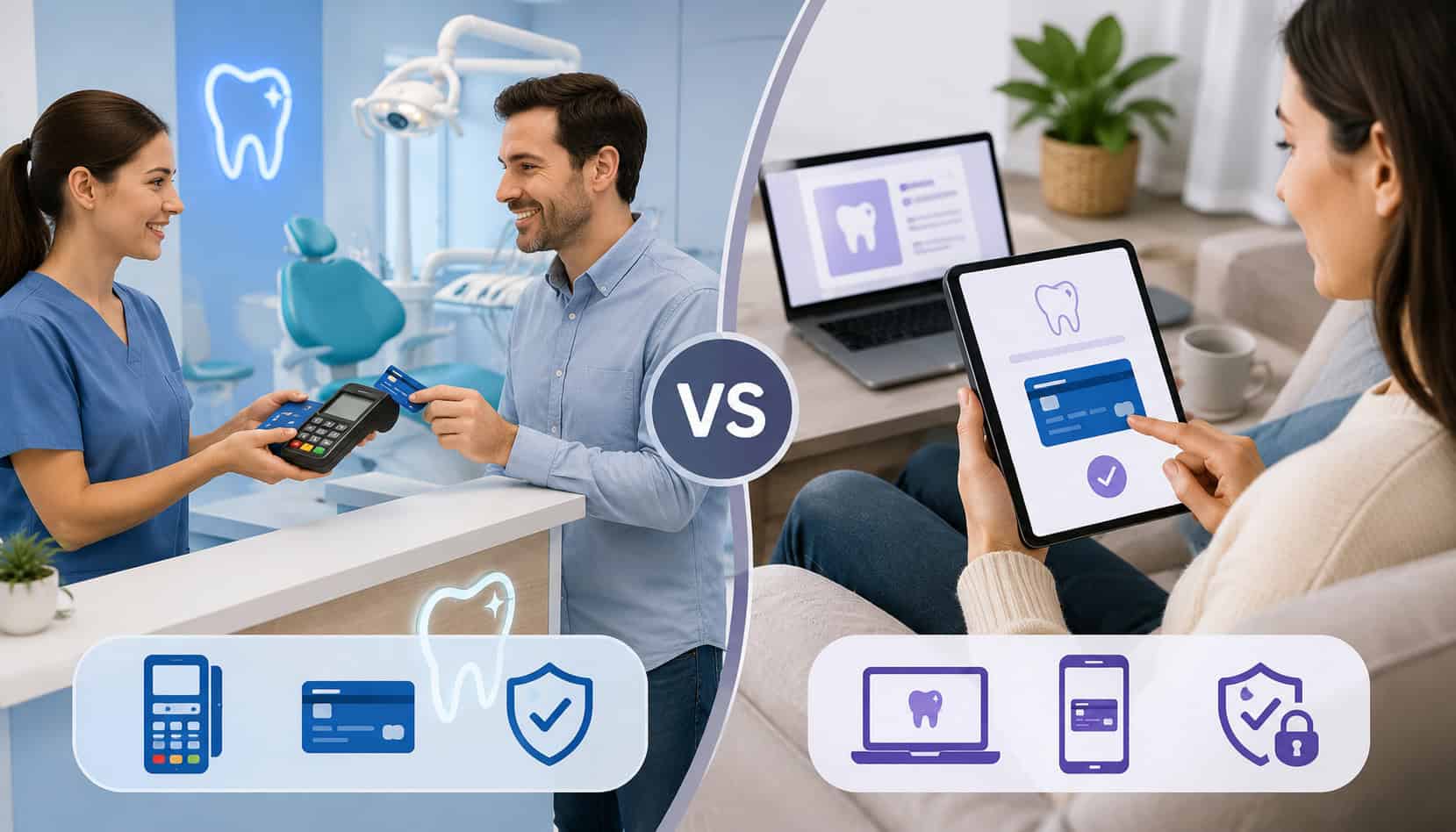
Dental offices handle payments in more ways than ever. A patient may tap a card at the front desk after a hygiene visit, pay an online invoice from home, leave a treatment deposit over the phone, approve a recurring orthodontic plan, or use a patient payment link after insurance has processed. Each of those payment moments affects convenience, risk, documentation, security, and cost.
That is why understanding Card-Present vs Card-Not-Present Payments in Dentistry matters for dentists, office managers, billing teams, practice owners, front-desk staff, and healthcare administrators.
The distinction is not just a technical processing label. It influences how dental credit card processing works, how disputes are handled, how payment data should be protected, and how dental payment processing fees may appear on statements.
Card-present payments usually happen in the office when the physical card or mobile wallet is processed through a secure terminal. Card-not-present payments happen when the card and cardholder are not processed face to face, such as online payments for dentists, emailed invoices, phone payments, saved card-on-file transactions, and recurring dental billing payments.
Both payment types can be useful. The goal is not to choose one and ignore the other. The best dental office payment solutions usually combine secure in-office terminals with safe remote payment tools, clear documentation, consistent refund policies, and staff training.
What Are Card-Present Payments for Dentists?
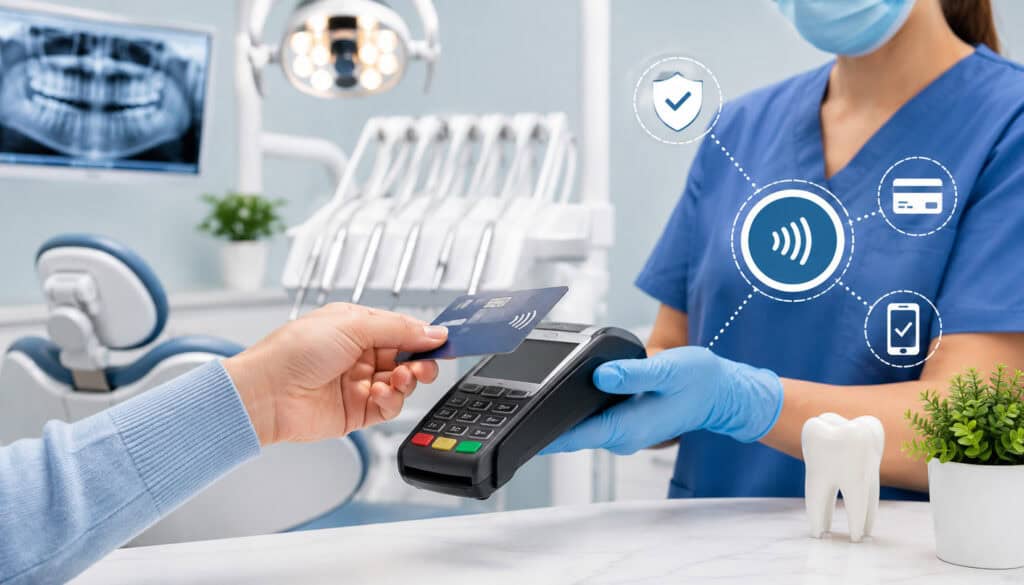
Card-present payments for dentists happen when the patient’s payment card or mobile wallet is physically used at the dental office. This usually means the patient is standing at checkout, and the front-desk team processes the payment through a chip reader, tap-to-pay terminal, contactless payment device, swipe device, or integrated point-of-sale system.
Common card-present examples include a patient paying a copay after a cleaning, settling a same-day treatment balance, paying for an emergency visit, or leaving a deposit before starting a crown, implant, aligner, or cosmetic procedure. The key point is that the payment credential is presented in person and processed through a secure device.
Modern card-present payments may involve:
- EMV chip cards
- Contactless tap-to-pay cards
- Mobile wallets
- Debit cards
- Credit cards
- In-office payment terminals
- Integrated checkout devices
Card-present payments are often preferred for front-desk checkout because they are fast, familiar, and easy for staff to confirm. The patient is physically present, the office can provide a printed or emailed receipt, and the payment can be matched to the appointment, provider, procedure, or account balance.
For dental teams, card-present payments also reduce the need to manually key card numbers. Keyed transactions can introduce errors, increase processing risk, and create weaker documentation if the office does not have a consistent workflow. A secure terminal helps keep card data out of the practice’s hands, which supports better dental payment security.
Card-present payments are especially helpful in busy practices because they fit naturally into the checkout process. After the clinical visit is complete, the patient reviews the balance, pays at the desk, receives a receipt, and leaves with a clear understanding of what was paid.
What Are Card-Not-Present Payments in Dental Offices?
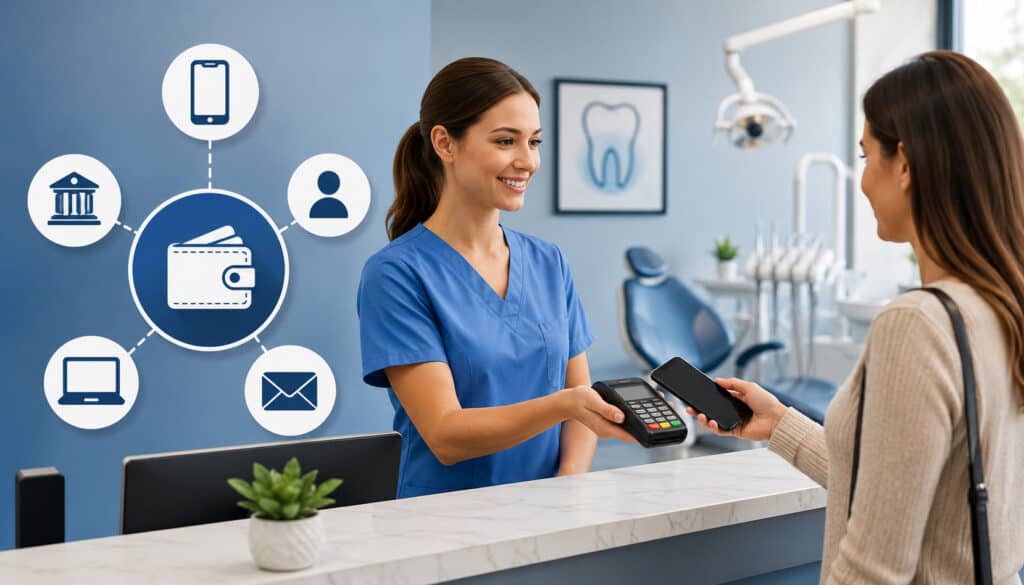
Card-not-present payments dental offices accept are transactions where the physical card is not processed face to face through an in-office terminal. The patient may still authorize the payment, but the payment is completed remotely or through a stored credential rather than by inserting, tapping, or swiping a card at the front desk.
Examples include online payment links, patient portal payments, emailed invoices, phone payments, recurring billing, card-on-file payments, and remote treatment deposits. These dental payment processing methods are especially useful when patients are not in the office but still need a convenient way to pay.
Common card-not-present situations include:
- A patient paying an outstanding balance from home
- A parent paying for a family member’s visit remotely
- A patient making an orthodontic payment plan installment
- A billing team sending a secure payment link after insurance posts
- A cosmetic treatment deposit collected before scheduling
- A missed copay collected after the appointment
- A card-on-file payment run with prior authorization
Card-not-present payments are important because dental billing does not always end at checkout. Insurance estimates change, claims may be partially paid, balances can remain after benefits are applied, and patients may need flexible options for treatment costs.
Remote payment tools help billing teams collect balances without relying only on mailed statements or repeated phone calls.
However, card-not-present payments require stronger documentation. Since the patient and card are not physically verified at a terminal, the office should keep clear records of authorization, invoices, receipts, treatment estimates, refund terms, and communication history. This is especially important for dental chargeback prevention.
Secure card-not-present workflows should avoid collecting card details by email, text message, sticky note, paper form, or unprotected spreadsheet. Instead, dental offices should use hosted payment pages, secure patient payment links, tokenized card storage, and role-based staff access.
For practices evaluating remote collection tools, resources on payment processing products and services for dental practices can help clarify common options such as terminals, recurring billing, ACH, payment dashboards, and integrated systems.
Card-Present vs Card-Not-Present Payments in Dentistry: Key Differences
The main difference between card-present and card-not-present payments is where and how the card is processed. In dentistry, that difference affects the front desk, billing team, patient communication, chargeback risk, security controls, and dental payment processing fees.
Card-present payments work best when the patient is physically in the office. They are ideal for checkout, hygiene visits, copays, treatment balances, and same-day deposits. Card-not-present payments work best when the patient is remote, the balance is billed later, or the office needs to collect after insurance adjudication.
Neither method is automatically “better” in every situation. The right choice depends on the payment moment. A patient standing at the desk should usually use a secure terminal.
A patient receiving an emailed balance after insurance should usually receive a secure online payment option. A patient on a longer treatment plan may need recurring billing or card-on-file authorization.
| Category | Card-Present Payments | Card-Not-Present Payments | What Dental Offices Should Consider |
| Typical setting | In-office checkout | Remote billing or online payment | Match the method to where the patient is paying |
| Common tools | Chip reader, tap terminal, mobile wallet terminal | Payment links, portals, virtual terminal, card-on-file | Use secure, PCI-aware tools for both |
| Convenience | Fast for patients at the desk | Flexible for patients paying later | Offer both to reduce collection friction |
| Fraud risk | Generally lower when chip/tap is used | Can be higher without verification | Keep strong authorization records |
| Documentation | Receipt, appointment record, signed estimate | Invoice, authorization, receipt, email/payment confirmation | Store records consistently |
| Staff workload | Efficient at checkout | Reduces follow-up calls when automated | Use reporting and reconciliation tools |
| Processing cost | Often lower-risk pricing | May carry higher risk-based costs | Review statements by transaction type |
| Dispute prevention | Stronger when patient is present | Depends heavily on documentation | Use clear policies and confirmations |
Dental offices should think of both methods as part of one payment ecosystem. A strong setup supports secure dental payments in person and remotely, while also giving the billing team enough documentation to answer patient questions, reconcile deposits, and respond to disputes.
Processing Fees and Risk Differences
Card-present payments may carry lower risk because the card or mobile wallet is processed through a secure device while the patient is physically present.
Chip and contactless payments create stronger transaction evidence than a manually keyed card number. That does not mean card-present payments are risk-free, but the payment environment gives the office more verification points.
Card-not-present payments can involve higher risk because the card is not being physically presented to the terminal. The payment may be entered online, keyed into a virtual terminal, processed through a saved token, or charged as part of a recurring plan. Depending on how the payment is authorized and documented, the chance of a dispute may be higher.
Dental payment processing fees can also vary by transaction type. A chip or tap payment, keyed transaction, online payment, recurring payment, ACH payment, and mobile wallet payment may not all be priced the same way. The total cost depends on card type, authorization method, processor pricing, assessment fees, gateway fees, and other statement details.
Patient Convenience and Payment Flexibility
Card-present payments are convenient when the patient is already in the office. The patient can pay immediately after treatment, receive a receipt, and leave with a settled balance. For front-desk teams, this creates a clean workflow because the appointment, ledger, payment, and receipt can be handled in one moment.
Card-not-present payments add flexibility when patients need to pay outside the office. This is especially helpful after insurance adjustments, for treatment deposits, family balances, payment plans, orthodontic installments, and cosmetic dentistry. Instead of calling the office during business hours, patients can use online payments for dentists through secure links or portals.
Offering both methods can improve collections because it reduces friction. Some patients want to tap a card at checkout. Others prefer paying from a phone after reviewing an invoice. A strong dental office payment solution should support both without forcing staff into risky manual workarounds.
Documentation and Dispute Prevention
Documentation is one of the most important parts of dental chargeback prevention. A payment dispute can happen even when the office provided care correctly, especially if the patient does not recognize the charge, misunderstands insurance coverage, questions a treatment deposit, or believes a refund was promised.
For card-present payments, offices should keep receipts, treatment estimates, signed financial agreements, appointment records, and itemized statements. For card-not-present payments, the documentation should be even more complete.
Keep payment confirmations, patient authorization, invoice copies, communication records, refund terms, and card-on-file agreements when applicable.
Clear documentation protects both the patient and the practice. It helps staff answer questions quickly, reduces confusion about balances, and creates a reliable record if a transaction is challenged. Documentation should be organized, accessible to authorized staff, and consistent across locations or providers.
When Dental Offices Should Use Card-Present Payments
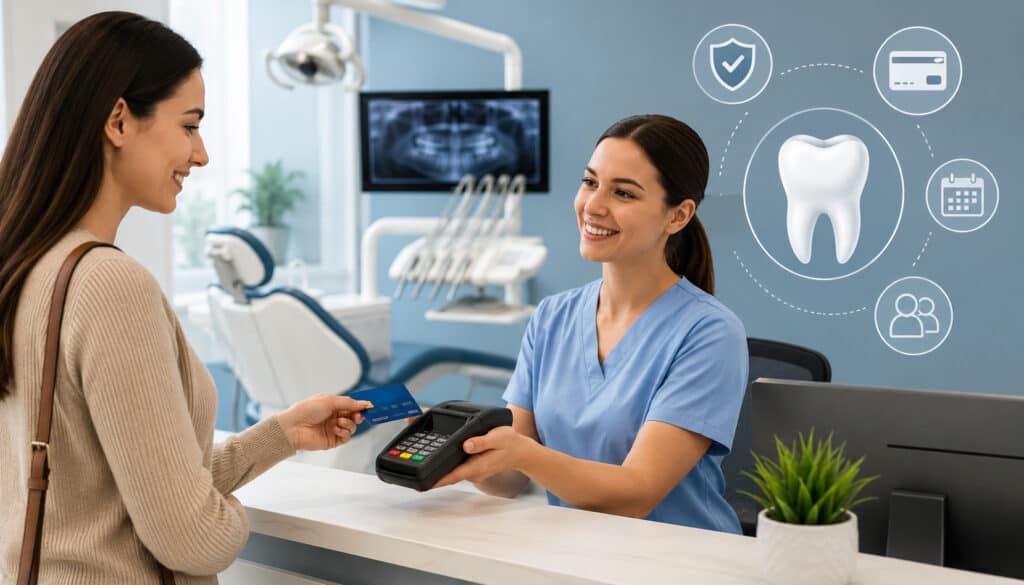
Dental offices should use card-present payments when the patient is physically in the practice and ready to pay at checkout. This is the simplest and most natural time to collect because the patient has just received care, the front desk can review the balance, and the payment can be processed securely through an in-office terminal.
Common situations include hygiene visits, exam balances, emergency appointments, copays, same-day procedures, treatment deposits, and outstanding balances discussed in person. If the patient has a card or mobile wallet available, card-present processing is usually more efficient than taking a phone payment later.
Card-present payments are also useful for reducing accounts receivable. When the front desk collects at the time of service, the office avoids extra statements, follow-up calls, delayed payments, and billing confusion. This can improve cash flow and reduce administrative work for the billing team.
Good card-present workflows include:
- Reviewing the balance before asking for payment
- Explaining what insurance may still affect
- Using chip or tap instead of keyed entry
- Offering printed or emailed receipts
- Posting the payment promptly to the patient ledger
- Matching the payment to the correct provider, location, or procedure
- Documenting any treatment deposit terms
Card-present payments also support a better patient experience when handled professionally. Patients should not feel rushed or surprised. The front desk should be able to explain the balance, accepted payment methods, financing or payment plan options if available, and refund or cancellation terms for deposits.
Dental offices can learn more about broader merchant services for dentists when comparing how terminals, point-of-sale tools, and payment reporting fit into daily operations.
When Dental Offices Should Use Card-Not-Present Payments
Card-not-present payments are best when the patient is not physically in the office or when the balance becomes due after the appointment.
Dental billing often continues after treatment because insurance claims, benefit estimates, adjustments, and secondary coverage can change the final amount owed. Remote payment options make it easier to collect without adding unnecessary phone calls.
Use card-not-present payments for online balance payments, remote invoices, recurring payment plans, orthodontic billing, cosmetic treatment deposits, missed copay follow-ups, family account payments, and post-insurance balances. These methods are also helpful for patients who manage bills for children, spouses, dependents, or older family members.
Card-not-present workflows should be secure and structured. The office should not ask patients to send card numbers by email or text. Staff should not write card details on paper or store them in notes. Instead, use secure patient payment links, hosted checkout pages, tokenized card-on-file tools, and payment portals.
Remote payment options can improve collections because they meet patients where they are. A patient who cannot answer a billing call during work may still pay an invoice after hours. A parent who was not present at the appointment can pay from a phone. A patient starting a larger treatment plan can approve scheduled payments without calling the office every month.
Online Payment Links and Patient Portals
Online payment links and patient portals give patients a simple way to pay balances without calling the office. The billing team can send a secure link by approved communication channels, and the patient can review the amount due, enter payment information on a hosted page, and receive confirmation.
These tools are useful for dental billing payments because many balances are not finalized at the exact time of service. Once insurance posts, the office can send an updated invoice with a payment link. This reduces manual collection work and gives patients a convenient way to settle balances.
Patient portals can also support transparency. When patients can see balances, statements, and payment history, they are less likely to be confused by a charge. Secure portals and links also reduce the need for staff to handle sensitive card data directly.
Recurring Billing and Card-on-File Payments
Recurring billing and card-on-file payments can help dental offices manage treatment plans, orthodontic billing, membership programs, and larger patient balances. Instead of asking patients to call each month, the office can charge an approved amount on an agreed schedule using a secure saved payment token.
The key is authorization. Patients should understand the amount, frequency, start date, end date, cancellation terms, refund policy, and what happens if a payment fails. Staff should document consent and keep the agreement available in the patient’s financial record.
Secure card-on-file does not mean storing the full card number in the practice management system, on paper, or in a spreadsheet. A better workflow uses tokenization, where sensitive card data is replaced with a secure token that can be used for future authorized payments.
For offices building these workflows, this article on card-on-file for treatment plans and missed-appointment fees is a useful informational resource.
Security Considerations for Both Payment Types
Dental payment security matters for both card-present and card-not-present payments. Dental offices handle sensitive patient information, financial records, and treatment details, so payment workflows should be designed to reduce unnecessary exposure.
Secure dental payments are not only about technology; they also depend on staff habits, permissions, documentation, and consistent procedures.
For card-present payments, secure terminals should support chip and contactless transactions. Devices should be obtained from trusted payment providers, kept updated, and protected from tampering. Staff should know how to spot unusual terminal behavior and should avoid using personal devices or unapproved apps to collect payments.
For card-not-present payments, the focus should be on secure online tools. Hosted payment pages, encrypted payment links, tokenized card storage, and controlled virtual terminal access are safer than manual card handling. Dental offices should never store card numbers in email, text messages, paper files, sticky notes, screenshots, or general patient notes.
Access controls are also important. Not every staff member needs permission to issue refunds, view payment reports, create recurring plans, or process card-on-file payments. Role-based access helps prevent mistakes and reduces internal risk.
A secure payment setup should include:
- PCI-aware workflows
- Encryption
- Tokenization
- EMV-capable terminals
- Hosted payment pages
- Secure payment links
- Unique staff logins
- Limited refund permissions
- Regular reconciliation
- Clear incident procedures
Dental offices reviewing compliance basics may find this resource on PCI DSS requirements for dental practices helpful for understanding payment data responsibilities.
Protecting Patient Payment Data
Protecting patient payment data starts with reducing how often staff directly handle card details. In-office terminals should encrypt payment information at the point of interaction. Online payments should route patients to secure hosted pages rather than asking them to provide card numbers through unsecured messages.
Tokenization is especially useful for card-on-file and recurring billing. Instead of saving the full card number, the system stores a token that can be used for approved future payments. This supports convenience while reducing the risk associated with storing sensitive payment credentials.
Dental offices should also control who can access payment tools. Use individual logins instead of shared passwords. Limit refund and void permissions. Review user access when employees change roles or leave the practice. Train staff to recognize suspicious payment requests, unusual refund requests, and unsafe communication habits.
Reducing Chargebacks and Payment Disputes
Chargebacks can occur for many reasons: the patient does not recognize the charge, expects insurance to pay more, disputes a deposit, claims a refund was promised, or says the payment was not authorized. Strong documentation can reduce the chance of disputes and improve the office’s ability to respond.
For both card-present and card-not-present payments, provide receipts and itemized statements. For larger treatment plans, use signed estimates and financial agreements.
For deposits, explain whether the deposit is refundable, partially refundable, or applied to future treatment. For recurring billing, document the patient’s authorization and payment schedule.
Communication matters just as much as paperwork. Patients should understand what they are paying, why they owe it, and what may change after insurance. A clear billing conversation can prevent frustration later.
How Payment Type Affects Dental Processing Costs
Payment type can affect dental payment processing fees because different transactions carry different levels of risk, verification, and network handling. A card-present chip transaction at the front desk may price differently from a keyed phone payment, online invoice payment, recurring card-on-file charge, ACH transaction, or mobile wallet payment.
Dental offices should avoid assuming that every card transaction costs the same. Statements often include multiple fee categories, including interchange, assessments, processor markup, gateway fees, monthly fees, PCI-related fees, batch fees, chargeback fees, and possibly fees for value-added tools. Some costs are tied to card brand and card type, while others are tied to the processor or software setup.
Card-not-present payments may cost more in some cases because they can carry higher risk. However, the total business value may still be positive if remote payments reduce collection delays, staff calls, mailed statements, and unpaid balances.
For example, an online invoice payment may carry a different cost than an in-office tap, but it may also help collect money that would otherwise remain outstanding.
Practices should review:
- How many payments are card-present versus card-not-present
- How many transactions are keyed manually
- Whether online payments use a gateway fee
- How recurring billing is priced
- Whether ACH is available for larger balances
- Chargeback frequency and fees
- Monthly software or reporting costs
- Funding timing and deposit reconciliation
A good review should look beyond rates. It should connect payment costs to workflow efficiency, collection speed, patient convenience, and staff time. For deeper context, this guide on dental payment processing fees can help offices understand common statement categories.
Best Practices for Dental Payment Processing Methods
The best dental payment processing methods support both patient convenience and operational control. Dental offices should not rely on one payment channel for every situation.
Instead, they should build a balanced workflow that includes in-office terminals, secure online payments, payment links, recurring billing, card-on-file authorization, ACH where appropriate, and clear reporting.
For card-present payments, use modern terminals that support chip, tap, and mobile wallets. Place the terminal where patients can easily review the amount before paying. Offer printed or emailed receipts, and make sure payments are posted correctly to the patient account.
For card-not-present payments, use secure patient payment links and portals. Avoid collecting card information through unsafe channels. Use tokenized card storage for approved future payments and recurring plans. Make sure every remote payment is tied to an invoice, estimate, statement, or documented balance.
Best practices include:
- Use chip and tap terminals for in-office payments.
- Send secure payment links for remote balances.
- Provide itemized invoices and receipts.
- Use written financial agreements for larger treatment plans.
- Keep refund and cancellation policies consistent.
- Train staff on safe payment handling.
- Reconcile deposits daily.
- Review processing statements monthly.
- Limit access to refunds and card-on-file tools.
- Document recurring billing authorization clearly.
Dental offices should also align payment workflows with patient communication. A payment link without context can feel suspicious. A treatment deposit without clear terms can lead to disputes. A recurring plan without written authorization can create confusion. The more transparent the process, the fewer billing problems the office is likely to face.
Common Mistakes Dental Offices Should Avoid
Many payment problems in dental offices come from small workflow shortcuts. These shortcuts may feel harmless at the moment, especially during a busy day, but they can increase security risk, processing costs, chargebacks, and patient complaints.
One common mistake is keying card numbers unnecessarily. If the patient is standing in the office, staff should use a secure terminal whenever possible. Keyed entry should be reserved for situations where it is truly needed and supported by proper authorization.
Another major mistake is accepting card details by email or text. Patients may send card information because they think it is convenient, but the office should not encourage or store sensitive payment data in unsecured channels. Staff should reply with a secure payment link or direct the patient to an approved portal.
Dental offices should also avoid storing card numbers on paper forms, sticky notes, scanned documents, spreadsheets, or patient notes. Even if the intention is convenience, manual storage creates unnecessary risk. Tokenized card-on-file tools are safer and easier to manage.
Other mistakes include:
- Failing to verify patient identity for phone payments
- Not documenting card-on-file authorization
- Using unclear refund policies
- Not explaining treatment deposits
- Sending invoices without enough detail
- Ignoring chargeback notices
- Letting too many staff members issue refunds
- Not reviewing processing statements
- Mixing personal payment tools with practice payments
- Failing to reconcile daily deposits
These mistakes can affect cash flow and patient trust. They can also make it harder to respond when a patient questions a charge. A strong payment process should be repeatable, documented, and easy for staff to follow.
FAQs
What is a card-present payment in dentistry?
A card-present payment in dentistry is a transaction where the patient’s physical card or mobile wallet is processed in person at the dental office using a chip reader, tap-to-pay terminal, contactless device, or card terminal.
What is a card-not-present payment for dental offices?
A card-not-present payment is a transaction where the card is not physically processed in the office. Examples include online payment links, patient portals, phone payments, emailed invoices, recurring billing, and card-on-file payments.
Which payment type is safer?
Both can be safe when handled correctly. Card-present payments using chip or tap terminals are generally strong for in-office checkout, while card-not-present payments can be secure when dental offices use encrypted payment links, hosted payment pages, tokenization, and proper access controls.
Are card-not-present payments more expensive?
Card-not-present payments may carry higher processing costs because they can involve more risk than chip or tap card-present transactions. However, actual dental payment processing fees depend on the card type, processor pricing, gateway setup, transaction method, and statement structure.
Can dental offices take payments over the phone?
Yes, dental offices can take payments over the phone, but they should verify the patient, confirm the payment amount, provide a receipt, and avoid storing card details manually. Sending a secure payment link is often a safer option.
Are online payment links secure for dental practices?
Online payment links can be secure when they use encryption, hosted payment pages, and trusted payment technology. They are generally safer than collecting card numbers by email, text message, paper form, or voicemail.
How can dentists reduce chargebacks?
Dentists can reduce chargebacks by using signed treatment estimates, itemized invoices, clear refund policies, payment receipts, documented authorization, card-on-file agreements, and clear communication about insurance estimates and patient balances.
Which payment methods should dental offices offer?
Dental offices should offer a practical mix of payment methods, including chip and tap card payments, mobile wallets, secure online payments, patient payment links, recurring billing, card-on-file options, and ACH where appropriate.
Conclusion
Card-Present vs Card-Not-Present Payments in Dentistry comes down to patient location, payment method, risk, convenience, documentation, and cost.
Card-present payments are best for in-office checkout, copays, same-day balances, and treatment deposits when the patient is physically present. Card-not-present payments are best for online invoices, patient payment links, recurring plans, card-on-file payments, post-insurance balances, and remote family payments.
Dental offices do not need to choose only one. A strong payment strategy uses secure in-office terminals for checkout and secure online tools for remote payments. It also includes clear receipts, signed treatment estimates, documented authorization, consistent refund policies, and trained staff.
When dental teams understand the difference between card-present and card-not-present payments, they can improve patient convenience, reduce avoidable risk, manage dental payment processing fees more effectively, and protect practice cash flow.
The result is a smoother payment experience for patients and a more reliable billing process for the entire dental office.